
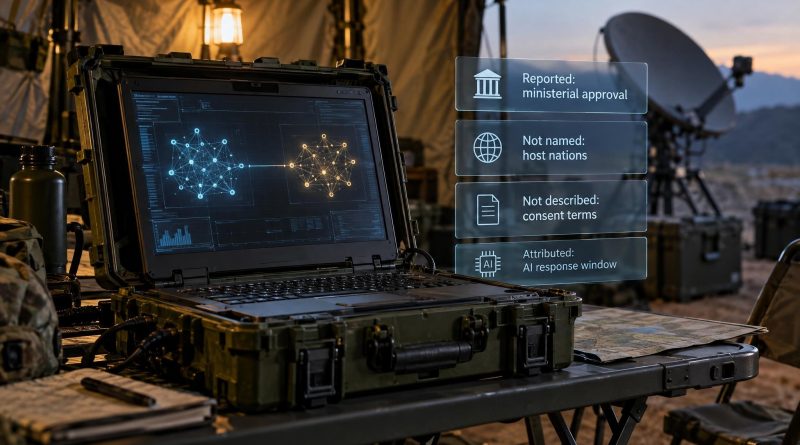
UK Military Deploys Cyber Hunt Teams Overseas as AI Accelerates Security Threats
The British military is deploying specialist cyber warfare teams to locations across Europe and Asia in an effort to identify and disrupt hostile hackers before they can launch attacks against the United Kingdom’s defence systems. The operations reflect a growing emphasis on proactive cyber defence as artificial intelligence increases the speed and complexity of digital threats.
According to reporting published by The Independent on 8 November 2026, British military personnel are conducting overseas operations designed to detect malicious activity beyond the United Kingdom’s own defence networks.
The deployments involve specialist teams physically travelling to overseas locations, where they investigate digital threats and attempt to identify hostile actors before attacks can reach British military infrastructure.
Major General Mike Fayers, commander of the Defence Cyber and Electromagnetic Force, outlined the approach in an interview with The Times, describing a shift towards identifying threats closer to their origins rather than relying exclusively on domestic defensive systems.
The operations reportedly involve personnel from across the armed forces and may require approval from Defence Secretary Wes Streeting.
While the latest reporting provides additional insight into Britain’s evolving cyber defence strategy, the practice itself is not new. Senior military officials publicly confirmed the UK’s involvement in similar operations in 2023.
The renewed attention comes amid warnings that artificial intelligence is significantly reducing the time available for organisations and governments to identify and address cyber vulnerabilities.
Taking Cyber Defence Beyond National Borders
The strategy, commonly known as hunt forward, involves sending military cyber specialists into partner countries to identify malicious activity on their networks.
Rather than waiting for an attack to reach domestic infrastructure, participating teams work alongside international partners to detect intrusions, analyse hostile activity and potentially disrupt threats before they escalate.
The approach was pioneered by United States Cyber Command and has increasingly become part of international military cybersecurity cooperation.
British involvement was publicly acknowledged in September 2023, when Lieutenant General Tom Copinger-Symes, then deputy commander of UK Strategic Command, discussed the country’s hunt forward capabilities with Recorded Future News.
Copinger-Symes described the operations as occupying a space between conventional cyber defence and offensive cyber activity.
He explained that working with international partners to identify threats within their networks could strengthen collective security while providing greater visibility of potentially hostile operations.
The UK’s 2023 Defence Command Paper had already referenced the importance of learning from cyber incidents and identifying threats beyond domestic networks.
The latest reporting therefore represents a further account of an established military capability rather than the announcement of an entirely new programme.
However, the extent to which the operations have expanded since their initial confirmation remains unclear.
The reported deployment locations have not been publicly identified beyond references to Europe and Asia, while details concerning mission duration, participating units and operational outcomes remain limited.
Artificial Intelligence Reduces Response Times
One of the most significant concerns raised by Fayers involves the accelerating pace of cyber threats.
According to The Independent, the commander warned that artificial intelligence was enabling hostile actors to identify and exploit vulnerabilities considerably faster than traditional security processes could respond.
He suggested that defensive response windows previously measured in days could now be reduced to double-digit minutes.
Such a shift would place considerable pressure on military and civilian cybersecurity teams, particularly those responsible for complex networks containing large numbers of systems and devices.
However, the specific timeframe remains an assessment attributed to Fayers rather than an independently established measurement.
The reporting does not provide supporting incident data, technical methodology or a detailed explanation of how the reduced response window was calculated.
Nevertheless, his concerns are consistent with broader assessments of artificial intelligence’s emerging influence on cybersecurity.
The UK’s National Cyber Security Centre, in its Annual Review 2026, identified artificial intelligence as an increasingly important factor in the changing digital threat environment.
The agency assessed that AI could substantially increase the speed, scale and efficiency of existing malicious activities, including vulnerability discovery, reconnaissance and the development of exploitation techniques.
It also warned that organisations may face growing pressure to identify and patch security weaknesses before attackers can exploit them.
Importantly, the NCSC’s assessment does not establish that every cyberattack now operates within a matter of minutes.
Instead, it identifies a broader trend towards faster and more scalable malicious activity, with the eventual impact of AI-enabled cyber operations still developing.
For defence organisations, that uncertainty provides an additional incentive to strengthen early detection capabilities and improve coordination with international partners.
Integrating Cyber and Electromagnetic Warfare
The overseas operations form part of the activities associated with Britain’s Defence Cyber and Electromagnetic Force, an organisation combining specialist capabilities across digital networks and the electromagnetic spectrum.
According to Fayers, the force is intended to protect military systems against hostile cyber activity while addressing threats involving electronic detection, communications interference and jamming.
Cyber operations and electromagnetic warfare increasingly intersect in modern military environments.
Military communications, navigation systems, surveillance platforms and other essential capabilities depend on interconnected digital infrastructure and access to the electromagnetic spectrum.
Disruption in either domain can affect operational effectiveness, making coordination between specialist teams an important consideration for defence planners.
Fayers reportedly wants the force to expand as the military develops its ability to respond to increasingly sophisticated threats.
However, the available reporting does not establish the full operational capacity of the overseas hunt teams or indicate whether individual deployments combine cyber and electromagnetic activities.
The distinction matters because the two capabilities, although organisationally connected, perform different technical functions.
Cyber threat hunting focuses on identifying malicious behaviour within digital systems, while electromagnetic warfare concerns activities involving the radio-frequency environment and electronic communications.
Their integration may improve military coordination, but the public reporting does not establish how extensively they are combined in overseas operations.
International Cooperation and NATO Preparedness
The UK’s approach reflects a wider movement towards proactive cybersecurity cooperation among allied nations.
The United States has developed hunt forward operations as a means of detecting malicious activity within partner networks, while European and NATO countries have expanded cooperation through joint training, information sharing and specialist exercises.
In November 2025, Canadian and Latvian cyber experts conducted a four-day NATO Threat Hunting Workshop in Riga.
The programme brought together analysts from ten NATO and European countries, alongside representatives from CERT.EU, to develop practical skills in detecting and investigating suspicious network activity.
Participants worked with live data and open-source cybersecurity tools, including Velociraptor, to identify potential intrusions and improve intelligence sharing.
The exercise demonstrated the importance placed on proactive threat detection across allied defence organisations.
However, training programmes and operational hunt forward deployments serve different purposes.
While workshops develop analytical capabilities and strengthen professional relationships, operational deployments involve military specialists working within the infrastructure of another country.
Those activities introduce additional legal, political and diplomatic considerations.
The NCSC’s Annual Review 2026 also emphasised international partnerships as a fundamental component of Britain’s cybersecurity strategy.
The agency identified the Five Eyes intelligence partnership as a central mechanism for exchanging threat information, coordinating security assessments and strengthening collective resilience.
Such cooperation can help governments identify malicious activity that may otherwise remain undetected within national networks.
However, the NCSC’s broader account of international collaboration does not independently confirm the specific British military deployments described in the latest reporting.
Sovereignty and Oversight Raise Important Questions
Despite the defensive objectives associated with hunt forward operations, deploying foreign military personnel into another country’s digital infrastructure raises questions about sovereignty, consent and operational oversight.
The distinction between defensive monitoring and offensive cyber activity can become particularly sensitive when military specialists encounter infrastructure associated with hostile actors.
While identifying malicious software or compromised systems may fall within an agreed defensive mission, more intrusive actions could involve additional legal or operational authorisation.
The original reporting in The Times indicated that the teams operate with host-nation consent. However, the identities of participating countries and the specific arrangements governing those deployments have not been publicly detailed.
The reporting also suggested that specialist activities may require approval from the British defence secretary.
That provides some indication of ministerial involvement, although the applicable approval procedures, legal framework and arrangements for parliamentary oversight have not been publicly established in the accounts reviewed.
Similar concerns have arisen previously in international discussions about hunt forward operations.
In 2023, reporting highlighted reservations among some defence officials in France and Japan regarding the implications of allowing foreign military cyber specialists to operate within national networks.
Those concerns did not constitute findings of misconduct by the United Kingdom. They illustrated the sensitivities surrounding military access to another country’s digital infrastructure.
The effectiveness of international cybersecurity cooperation depends not only on technical capability but also on trust, clearly defined permissions and confidence that participating nations retain control over their systems.
Specialist Skills Remain a Strategic Challenge
Expanding overseas cyber operations also presents significant workforce and training challenges.
The effectiveness of hunt forward teams depends on specialists capable of identifying advanced threats, analysing network activity and operating within unfamiliar technical environments.
Military cyber personnel must often work alongside local engineers and security analysts while navigating differences in infrastructure, procedures and national security requirements.
During his 2023 interview with Recorded Future News, Copinger-Symes identified personnel and specialist skills as important constraints on the development of Britain’s cyber capabilities.
Although that assessment predates the latest reporting, it highlights the importance of maintaining a sufficiently experienced workforce as demand for advanced cybersecurity expertise increases.
The combination of cyber defence and electromagnetic warfare adds further complexity, requiring personnel with different technical specialisations and operational experience.
Fayers’ reported ambition to expand the force will therefore depend not only on investment but also on recruitment, training and the retention of skilled personnel.
The latest reports do not provide sufficient information to assess current staffing levels, deployment readiness or whether the available workforce can support a substantial expansion.
Growing Concerns About Critical Infrastructure
The overseas military operations have also been reported against a backdrop of wider concern about cyberattacks affecting civilian infrastructure.
According to The Independent, the British government has encouraged households to maintain emergency supplies, including food, water, medication and battery-free communication equipment such as wind-up radios.
The advice followed warnings from Streeting that hostile cyber activity could disrupt essential services, supply chains and electronic payment systems.
Recent attacks affecting refrigeration systems in parts of Europe have also demonstrated how digital vulnerabilities can produce consequences beyond conventional information technology environments.
The newspaper reported that cybercriminals had remotely manipulated refrigeration temperatures, affecting a limited number of systems in Britain.
Such incidents highlight the potential for attacks against connected equipment to disrupt physical operations.
However, the available reporting does not establish a direct connection between those incidents and the overseas military deployments.
Nor does the emergency preparedness advice indicate that a specific attack against British infrastructure is imminent.
The concerns instead reflect the growing dependence of essential services on interconnected technologies and the potential consequences when those systems are compromised.
What Remains Unconfirmed
Although the latest disclosures provide a clearer picture of Britain’s proactive cyber defence approach, important operational details remain undisclosed.
The countries hosting the reported missions have not been publicly identified, and the scale, duration and outcomes of the deployments have not been independently established.
The reporting also does not clarify whether the activities represent a substantial expansion of the capabilities confirmed in 2023 or a continuation of existing operations.
Similarly, the precise legal and ministerial oversight arrangements remain unclear, despite indications that host-nation consent and senior government approval form part of the process.
The Ministry of Defence had not provided a response in The Independent’s published account.
The reported acceleration of cyber threats through artificial intelligence also warrants further scrutiny. While official assessments support concerns about increasing speed and sophistication, the specific reduction in response times described by Fayers has not been independently quantified.
These uncertainties do not diminish the strategic importance of proactive threat detection.
Instead, they underline the need to distinguish between confirmed military capabilities, attributed operational claims and assessments of emerging technological risks.
A Changing Approach to National Cyber Defence
Britain’s overseas hunt forward operations reflect an increasingly important principle in modern cybersecurity: effective defence may require identifying hostile activity before it reaches the systems an organisation is responsible for protecting.
For military organisations, that can mean extending detection capabilities into partner networks, sharing intelligence and developing a more comprehensive understanding of adversarial activity.
The emergence of increasingly capable artificial intelligence tools may strengthen the argument for earlier detection and faster defensive responses.
However, the operational advantages of working beyond national borders must be balanced against the requirements of sovereignty, accountability and international cooperation.
The latest reporting provides evidence of the continued development of Britain’s forward cyber defence strategy, but it leaves substantial questions about the scale and oversight of the programme.
As the military seeks to expand its capabilities, the central challenge will be demonstrating that overseas cyber operations can deliver meaningful security benefits while maintaining the trust of partner nations.
The broader lesson extends beyond Britain’s armed forces.
In an increasingly interconnected digital environment, protecting national infrastructure is no longer solely a matter of defending systems within geographical borders.
It also requires international cooperation, skilled personnel and the ability to identify threats before they develop into major incidents.
Whether Britain’s expanding focus on proactive cyber defence can keep pace with the changing threat environment will depend on the effectiveness of those partnerships, the resilience of its technical infrastructure and the transparency of the arrangements governing its operations.
Whatever a hunt forward team is permitted to do inside a partner’s network, the detection work itself begins with knowing what normal looks like and what traces an intruder leaves behind. Networking study earns its keep there: traffic, naming, routing and logs stop being background and become the material you read to separate ordinary activity from something out of place. The reporting leaves host nations, consent terms and outcomes unstated, but the craft of looking inside a network can be learned without resolving any of those gaps. Readers who want that grounding can explore The Hack Academy’s online cybersecurity training programme, where networking is one of the listed subject areas alongside cybersecurity fundamentals, with self-paced learning and practical exercises set beside the theory, all in authorised, controlled environments.