
US Flight Shutdown Raises Alarm Over Aviation’s Cyber Resilience
The nationwide ground stop has been lifted, but the disruption has exposed urgent questions about the systems keeping aircraft moving. Officials report no indication of a cyberattack, while federal audits reveal vulnerabilities that predate the latest crisis.
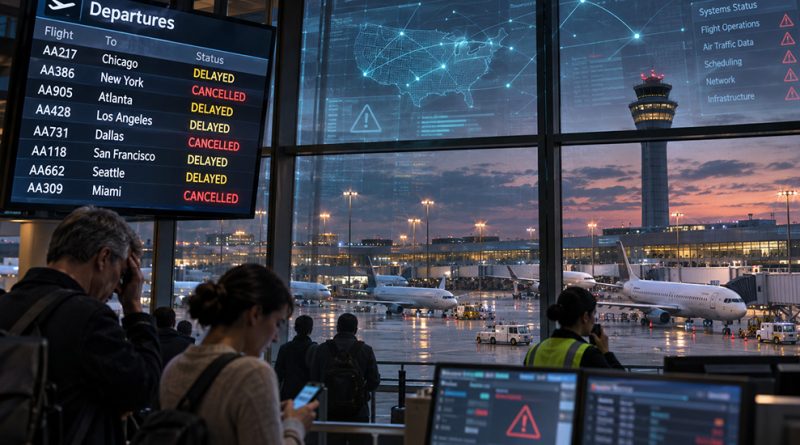
Thousands of flights were cancelled after a communications failure forced the United States into a nationwide ground stop on Friday, 13 November. The restriction lasted more than four hours before being lifted. Reuters, citing Flightradar24, reported more than 4,700 cancellations and 10,000 delays on Friday, with another 700 flights already cancelled for Saturday.
The immediate disruption is an aviation emergency. The deeper issue is the resilience of the infrastructure supporting an industry that cannot operate normally without dependable communications and trustworthy information. The Federal Aviation Administration’s initial statement confirmed problems affecting multiple air traffic control centres, while warning that its account remained preliminary.
Officials have reported no indication of a cyberattack, although the investigation remains open. That distinction must govern any examination of the incident: an infrastructure failure is not evidence of sabotage.
Nevertheless, the cybersecurity questions are substantial. Federal investigations conducted before this shutdown documented ageing air traffic systems and weaknesses in aviation communications security. Those findings do not explain Friday’s failure, but they provide an alarming backdrop to it.
An Overloaded Network And An Unfinished Explanation
At an evening briefing, the US transportation secretary said instability in radar and communications systems began at approximately 3.36pm Eastern time. He described switches and routers becoming overloaded with data and producing inconsistent information, prompting the shutdown. This was an official preliminary explanation, not a published forensic reconstruction of the failure.
The homeland security secretary initially described the incident as involving “no cyberattack”. When pressed on whether that conclusion was certain, however, he acknowledged that the investigation was continuing and that officials were not ruling the possibility out. The position was therefore more qualified than an unconditional clearance: no evidence of an attack had emerged, but the cause remained under examination.
The FAA’s own published statement offered less technical detail. It confirmed communications problems across multiple Air Route Traffic Control Centers and said technicians were investigating. It did not identify a failed component, explain why the problem affected multiple facilities or provide a complete account of the recovery.
A nationwide ground stop is not, by itself, evidence that aircraft have been compromised. FAA guidance describes ground stops as restrictive traffic-management measures used when capacity is severely reduced, including during equipment failures. Keeping additional aircraft on the ground helps prevent overloaded airspace, extended airborne holding and airport congestion.
That safety response and the underlying infrastructure failure should be judged separately. Stopping departures may be the appropriate operational decision. The harder question is why the supporting systems reached a condition in which such a sweeping restriction became necessary.
The Disruption Does Not End When Departures Resume
Airlines’ responses illustrated the scale of the interruption. In a travel alert updated at 7.40pm Eastern time on Friday, JetBlue said that night’s flights were being cancelled, except departures bound for Europe. It also introduced a waiver allowing affected customers to change their travel arrangements.
The effects extended beyond US carriers and airports. The Associated Press reported that Air Canada cancelled its remaining flights between Canada and the United States on Friday evening. The airline also warned of possible disruption to other services that travelled through US airspace.
Resuming departures does not immediately restore an airline’s schedule. Aircraft and crews displaced by a prolonged grounding can leave subsequent services without the resources they need. Reporting by the Financial Times highlighted the potential for this mismatch to prolong disruption after the original restriction is removed.
The headline cancellation figures also require care. They are changing operational totals, not a completed investigation attributing every disrupted flight to the communications failure. Earlier on Friday, the FAA had already forecast weather-related problems at several major airports, including wind, low cloud and rain or snow showers. Those conditions complicate any attempt to assign the entire day’s disruption to one cause.
For passengers, the distinction may offer little immediate comfort. For investigators, insurers and policymakers, it matters. Establishing the actual consequences of the failure requires separating its direct effects from other problems occurring at the same time.
Why Cybersecurity Matters Even Without A Cyberattack
Cybersecurity is often discussed as though its only purpose is to prevent stolen information. In critical infrastructure, the ability to keep systems available is equally important. The US National Institute of Standards and Technology defines information security around confidentiality, integrity and availability: protecting information, preserving its reliability and ensuring that authorised users can access it when needed.
An aviation communications failure therefore raises questions that overlap with cybersecurity even when no malicious activity has been established. Can operators trust the information reaching them? Can essential services continue when a component becomes unavailable? Can recovery take place without introducing further uncertainty?
These are questions about resilience, not an accusation that someone attacked the system. Reliability engineering and cybersecurity intersect around continuity and recovery, but they are not interchangeable. A failed router is not automatically a compromised router, just as an overloaded network is not automatically the target of a denial-of-service attack.
The timing of other technology incidents also cannot establish a connection. Microsoft told the Associated Press that it had no indication the FAA grounding was related to the separate disruption affecting Outlook and other services.
The legitimate investigative task is to identify dependencies and failure mechanisms. It is not to assemble simultaneous outages into a coordinated attack without evidence.
Federal Auditors Had Already Identified Serious Weaknesses
The condition of US air traffic infrastructure was a documented concern long before Friday.
A September 2024 Government Accountability Office report examined an FAA assessment of 138 air traffic control systems. The agency had classified 51 as unsustainable and another 54 as potentially unsustainable. Of those 105 systems, 58 had critical operational effects on airspace safety and efficiency. The report identified problems including obsolete functionality and difficulties obtaining spare parts.
Those figures describe an earlier assessment, not the number of systems that failed this week. They also do not mean that every ageing system is vulnerable to the same attack. Their significance is that concerns about maintainability and operational consequences were formally documented years before the latest shutdown.
A separate GAO report, published on 21 September 2026, addressed cybersecurity more directly. It found incomplete assessments and security documentation concerning threats such as interference, spoofing and jamming. It also identified gaps in defined, real-time monitoring capabilities for spectrum-related threats.
The auditors additionally identified weaknesses in authentication, encryption and protocol design affecting applications used to exchange text-based aviation information. They warned that fraudulent messages could disrupt operations or create safety risks. The Department of Transportation agreed with the report’s nine recommendations.
These findings establish a vulnerability backdrop, not a cause for Friday’s outage. A weakness involving radio-frequency communications does not establish that the reported router problems resulted from interference or spoofing. The important unanswered question is whether the relevant risks have been adequately assessed, monitored and reduced.
Previous Failures Show That No Attacker Is Required
The most useful historical comparisons are those that distinguish malicious activity from mistakes while examining how both can interrupt essential operations.
After the January 2023 outage of the Notice to Air Missions system, the FAA said its preliminary review found that contract personnel had unintentionally deleted files while addressing synchronisation between a primary database and a backup database. The agency reported no evidence of a cyberattack or malicious intent.
That episode provides a specific reason to scrutinise backup arrangements. The relevant question is not simply whether a secondary system exists, but whether the same maintenance action or dependency can affect both the primary service and its alternative.
The July 2024 CrowdStrike outage offers another distinct example. The cybersecurity company said a configuration update for Windows systems triggered a logic error that caused affected computers to crash. It explicitly stated that the incident was not a cyberattack.
The consequences for aviation were substantial. In its annual filing, Delta reported approximately 7,000 flight cancellations over five days, affecting 1.4 million customers. The airline also acknowledged that its preventive measures and disaster-recovery arrangements might not be sufficient to avoid future business interruptions.
Neither event establishes what happened in November 2026. Together, however, they demonstrate why investigating an outage cannot stop at the question of malicious intent. Authorised activity can also trigger widespread disruption when testing, dependencies or recovery arrangements prove inadequate.
The lesson is not that software updates should be avoided. It is that the mechanisms for introducing changes, detecting unexpected consequences and restoring dependable service deserve the same scrutiny as the component that first failed.
The Criminal Threat To Aviation Is Already Established
Although no attack has been established in the current incident, the aviation sector faces documented criminal targeting.
In a 2025 warning, the FBI said the group known as Scattered Spider had expanded its targeting to airlines. The bureau described criminals impersonating employees or contractors to deceive IT help desks into granting access. It warned that third-party technology providers were also targets and that intrusions could lead to data theft, extortion and ransomware.
That warning concerns a different pathway from a communications equipment failure. It shows how an organisation’s exposure can extend through identity checks, support procedures and supplier access, rather than beginning with a direct attack on an aircraft or an air traffic control system.
There is also a confirmed example of ransomware disrupting airport services. The Port of Seattle disclosed that its August 2024 incident was a ransomware attack. Encryption and the measures taken to contain the intrusion affected baggage services, check-in kiosks, ticketing, passenger information displays and other systems.
The boundaries of that incident are important. The Port said the proprietary systems of major airline partners and the systems of federal partners, including the FAA, were not affected. It also said safe travel remained possible.
That distinction should shape coverage of any aviation cyber incident. Airport passenger services, airline corporate systems, federal air traffic infrastructure and aircraft systems are not one undifferentiated network. Disruption in one area cannot be treated as proof of compromise in another.
The FBI warning and Seattle attack establish that criminal threats are real. Neither identifies a perpetrator or an attack mechanism for Friday’s failure.
Modernisation Has Its Own Accountability Problem
Replacing ageing infrastructure is necessary, but announcing a modernisation programme does not demonstrate that its delivery risks are under control.
A GAO report published on 14 September 2026 acknowledged progress in the FAA’s accelerated programme. By May, the agency reported replacing 2,560 of 5,170 old copper communications connections with fibre-optic links.
However, auditors found that the programme lacked a comprehensive lifecycle cost estimate and an integrated schedule for its first phase. Instead, it had 11,389 individual project schedules that were not integrated. The Department of Transportation partially agreed with the recommendations and pointed to existing planning work, but GAO maintained that the arrangements did not meet the required standard.
This report does not establish that modernisation caused the November outage. It does raise a separate accountability issue: whether urgent replacement work is being coordinated well enough to manage dependencies and minimise disruption.
The choice should not be framed as either accepting obsolete systems or rushing replacements into service. The public needs evidence that upgrades are reducing risk, not merely evidence that installation work is happening.
Stranded Passengers Face A Separate Digital Risk
Even an outage with no malicious cause can create opportunities for criminals.
The Federal Trade Commission has warned that scammers monitor social media for distressed travellers and impersonate airline customer-service representatives. They may request booking references, personal information or financial details, or direct passengers to fraudulent websites. The warning was issued in the aftermath of earlier travel disruptions, not as confirmation of a new campaign associated with Friday’s grounding.
For affected passengers, the practical safeguard is to contact an airline through its established app, website or published telephone number, or speak with staff at the airport. An unsolicited account offering immediate rebooking assistance should not be trusted simply because the flight disruption is genuine.
This is a potential secondary consequence, not evidence about the original cause. The infrastructure investigation and any fraud investigation would address different conduct, different victims and potentially entirely different actors.
What A Credible Investigation Must Establish
The most important questions now concern the sequence of failure, the safeguards that were expected to contain it and the evidence supporting the official explanation.
Investigators should establish what changed before the first instability appeared. Was the initiating event a component failure, a configuration change, an abnormal increase in traffic or another interaction? What records support that conclusion, and how does it account for the involvement of multiple facilities?
They should also explain the role of alternative communications arrangements. Were backup services available? What capacity could they support? Were the primary and alternative paths dependent on common equipment, suppliers or management systems? A description of the initial fault will be incomplete without an account of why its consequences required a nationwide response.
The reported inconsistent data deserves particular attention. The public explanation should distinguish between missing information, delayed information and information that could not be relied upon. Those conditions may require different operational responses. Officials need not disclose sensitive network configurations to explain which problem occurred and how reliable service was restored.
The cybersecurity assessment requires similar discipline. A credible account should explain the scope of the examination supporting the finding of no malicious activity. It should distinguish an early absence of indicators from a completed investigation, without treating the mere continuation of investigative work as evidence that an attack is likely.
Existing government cybersecurity guidance provides useful benchmarks for the wider industry. A joint advisory updated in July 2025 recommends stronger authentication, network separation, protected backups and regular restoration testing to reduce the effects of ransomware and account compromise. Those measures address documented criminal risks, but they are not a substitute for diagnosing a telecommunications failure.
The final test is whether corrective action can be verified. Which changes will be made, who will be responsible and how will their effectiveness be demonstrated? What temporary protections will remain in place while longer-term work proceeds? A statement that service has returned cannot answer those questions.
A Warning That Extends Beyond One Outage
The central finding is not that America’s aviation system has been shown to be under cyberattack. It has not. The available official account points towards a technical failure, while investigators continue their work.
The more defensible concern is that essential infrastructure must withstand both accidental failures and deliberate interference. Previous incidents show how mistakes can disrupt aviation, while federal warnings and confirmed attacks establish that malicious threats cannot be dismissed. The two risks demand different investigations, but both require dependable recovery arrangements.
Restoring departures resolves the immediate restriction. It does not, on its own, establish why the failure spread, whether the alternatives were adequate or whether the next disruption will be contained more effectively.
That is the warning left by this shutdown. The question is not merely whether an attacker was involved. It is whether the systems supporting essential air travel can keep functioning when something goes wrong, and whether the institutions responsible can demonstrate that they have addressed the weaknesses already placed on the public record.
The disruption is a stark reminder that digital resilience begins before systems fail. Although a cyberattack has not been established in this incident, the questions it raises about security, preparedness and recovery extend far beyond aviation. Readers looking to strengthen their understanding of these risks can take the next step through The Hack Academy’s online cybersecurity training programme. Developing your cybersecurity knowledge can help you recognise suspicious activity, assess the services you rely on and make more informed decisions about protecting personal and business information. The time to build that awareness is before a crisis, not in the middle of one.