
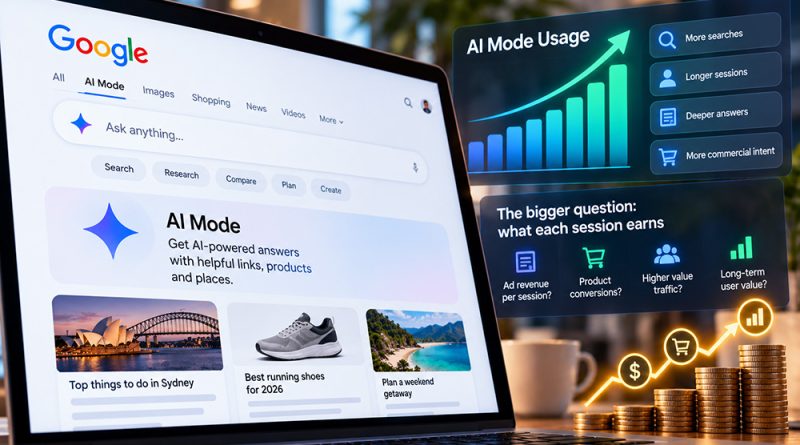
Google’s AI Mode is growing. The harder test is what each session earns
The most revealing admission on Alphabet’s third-quarter earnings call was not that Search advertising had slowed. It was that strong growth in AI Mode queries had affected Search because AI Mode monetises at a lower rate. Executives also said that Search query growth was the highest in five years and that AI Mode queries run about three times longer than traditional searches, as TechCrunch reported. More use, longer questions, less money per query: that is the shape of Google’s problem.
The temptation is to read that as a verdict on AI Mode. It is not. It is a measurement problem with a business model attached. Google has given investors the direction of travel but not the distance. Campaign US reported that the company has not disclosed a product-level revenue comparison between AI Mode and traditional Search. Without it, the argument has to run on proxies: query growth, click-through rates and the pace of an advertising rollout.
More queries, less per query
The quarter was not weak in aggregate. Revenue rose 25 per cent to US$127.6bn, Google Cloud revenue rose 103 per cent to US$30.7bn and operating profit rose 30 per cent to US$40.6bn. Net profit fell to US$26.2bn, with an unrealised loss on Alphabet’s SpaceX investment weighing on earnings. Campaign US reported that total revenue came in below a US$128.2bn forecast and that advertising revenue of US$82.0bn missed a US$83.4bn LSEG consensus cited by Reuters. Search and other advertising still grew 12 per cent, down from 17 per cent in the second quarter and 19 per cent in the first.
AI Mode was not the only drag. Chief Business Officer Philipp Schindler identified foreign exchange as the single largest contributor to the deceleration from the second quarter. He also pointed to disruption for some Asia-Pacific retailers after the EU removed its de minimis exemption, and to the normalisation of media and entertainment spending after the FIFA World Cup. Any account that makes AI Mode the sole cause of slower Search growth is overreading the call. The narrower point is that AI Mode’s lower monetisation had an impact while its usage was rising.
Ars Technica reported that, according to Schindler, each AI Mode query earns less revenue than a similar traditional web search, with fewer ads that cost less to run. That is enough to explain why growth in AI Mode can dilute revenue per query even as total queries rise. It is not enough to show that AI Mode is unprofitable. Google has not published a product-level cost or profit figure for the format, and lower monetisation is not the same as a failed product. A format can earn less per interaction and still be worth building if those interactions become more valuable over time or create demand that would not otherwise exist.
The bridge Google is building
Google’s first response is to sell more inventory. It announced that ads in AI Overviews and AI Mode would reach more users and queries, move into international markets and add multi-turn ads in the United States. Campaign US reported that the expansion covers ten markets, including Australia, India, Malaysia, New Zealand, Pakistan, the Philippines and Singapore, with Canada, Kenya and Nigeria completing the announced rollout. Australia’s presence makes it a test market for the rollout. On the supplied evidence it says nothing about Australian revenue, advertiser response or user reaction.
The logic is easy to follow. If an AI-assisted session carries fewer ads, adding ads and markets can lift total revenue while the format matures. But that is a bridge, not proof that the destination is sound. Ad load can raise revenue while testing users’ patience or advertisers’ returns. TechCrunch reported that Google says the early signs are good: click-through rates for sponsored product listings in AI Mode are comparable to organic listings, and its user research found the ads relevant. Those are company claims. They are useful signals, not independent confirmation that the economics work.
The advertiser side is less tidy. Campaign US, citing Google help pages, reported that advertisers cannot target AI Overviews or AI Mode exclusively, or opt out of either separately from Search. Some placements may also carry AI-generated explanations that advertisers cannot write, edit, approve or opt out of. That does not prove advertisers are being harmed. It does mean the new inventory is hard to price as a separate product. Ars Technica reported that Schindler was careful to control expectations, saying advertisers might need time to understand the value of AI search ads. If a campaign cannot isolate the placement, comparable click-through rates are a thin basis for judging incremental return.
What click-through does not measure
Click-through is an attention metric. On its own it says little about conversion, cost per acquisition or revenue per session. Google’s claim that sponsored listings in AI Mode perform like organic listings is relevant, but it is not a revenue comparison. A user may click at a similar rate and still spend less, buy less or return to the assistant rather than to the advertiser. The decisive measures are revenue per AI-assisted session and the value advertisers can see from the placement. Neither has been disclosed.
The strongest counterargument is that this is early. New formats often monetise below established ones while they learn, and Google says most AI Mode queries are incremental rather than substitutions, as Investing.com reported. Search advertising is still growing at a double-digit rate. Alphabet has a cloud business growing 103 per cent and enough operating profit to fund experimentation. The company can afford a transition. The question is how long it lasts and what it costs. Capital expenditure was US$51.4bn in the quarter, mostly for AI infrastructure. Free cash flow was negative US$9.1bn, and 2026 capital expenditure guidance was US$195bn to US$205bn. That is not a solvency problem. It does raise the price of a prolonged monetisation gap.
Google can also point to the shape of AI Mode demand. Executives said one in five AI Mode searches globally involves voice, images or documents. Longer, multimodal questions may carry more context and commercial intent. But length is not a price signal, and Google did not disclose the rate of query growth. The behaviour is real. The revenue consequence is inferred.
The market reaction deserves the same discipline. Reports of the share fall ranged from 8 per cent to more than 12 per cent, depending on the outlet and the timing of the measurement. BBC News reported that market value fell to US$3.46tn from US$3.97tn, a loss of just over US$500bn. A single trading move is not a verdict on a product, and a profitable company can absorb a bad reception. But strong aggregate profit does not prove AI Mode works either. The sell-off expressed uncertainty about the transition, not a measured conclusion about its endpoint.
The tests that matter
None of this proves AI Mode will fail. The argument is more modest: Google has demonstrated demand, not durable economics. The rollout is a bet that more inventory and more markets will close the gap. That bet may pay. It has not yet been shown to pay, and three tests would settle more than another quarter of query headlines. First, is revenue per AI-assisted session converging with traditional Search? Second, are advertisers seeing conversions and returns they can measure, rather than clicks? Third, can ad load rise without making the assistant feel like a billboard with an answer attached? Google does not publish all three. It should.
If the ad formats mature and advertisers accept the placements, the third-quarter numbers will look like a transition cost. If the gap persists, more ads may lift gross revenue while eroding the quality of the experience or the willingness of advertisers to pay for bundled inventory. Alphabet’s capital spending would make that a costly place to linger. This is a possibility, not a forecast. The evidence supports the uncertainty, not either ending.
Google’s position is enviable in one respect: it can run this experiment inside an existing search business, which gives it time, data and distribution. It does not give it a proven model. The right question next quarter is not how fast AI Mode use grew, or whether the shares bounced. It is whether each AI-assisted session is becoming more valuable to Google and to the advertisers paying for it. Until that number is visible, the ad expansion is a well-funded bet, not a settled answer.
What does a healthy total hide when the unit underneath it is getting weaker? Alphabet can report rising revenue while each AI-assisted search earns less, which is why this column keeps returning to the figure Google has not published. Security work asks a similar question of a system: not just whether the overall picture looks sound, but what happened on one account, one host or one session. Cybersecurity fundamentals treats access, records and evidence as things to specify and check, so an aggregate result does not quietly stand in for the measurement nobody made. Readers who want to build that habit of naming the measure before trusting the result can explore The Hack Academy’s online cybersecurity training programme, which lists cybersecurity fundamentals among its subject areas and sets self-paced learning and practical exercises alongside the theory.