
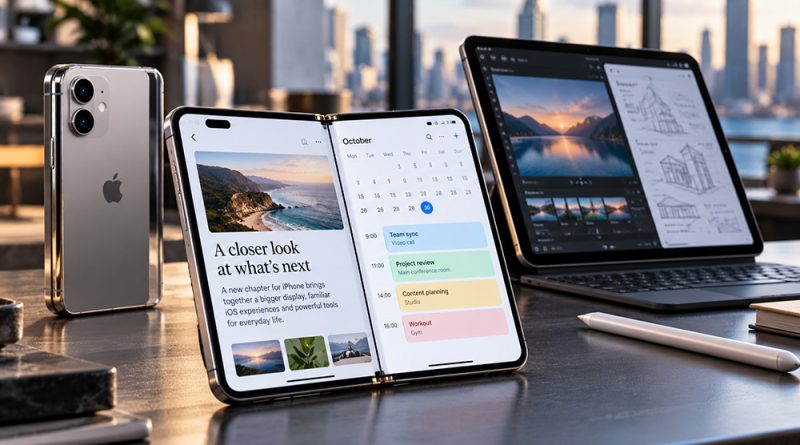
The iPhone Duo Is a Premium Bet on Convergence, Not an iPad Replacement
The first question about the iPhone Duo is too easy. Open it and you get a 7.6-inch display. Put it beside the new OLED iPad mini, which BGR describes as 8.5 inches, and the gap looks small enough to make the tablet seem redundant. That is where the replacement argument begins, and where it goes wrong.
Screen size is the least interesting part of the comparison. The Duo is better understood as a premium attempt to fold a phone and a small tablet into one pocketable device. It is not an iPad successor. Its case rests on convergence and portability. The case against it rests on software, input and accessories. Those are workflow questions, not diagonal measurements.
The mini case is real, but narrow
There is a replacement argument, but a narrow one. Connor Jewiss, writing for BGR, describes the Duo as excellent for reading, widescreen video and messaging, and notes that it folds into a pocket. He reports a 3,000-nit inner display and ProMotion. ProMotion is reported only on the Duo and the iPad Pro in Apple’s line-up. For consumption on the move, that is a coherent pitch.
It is not a general iPad pitch. Jewiss’s account is one owner’s view, not a usability study, and he concludes that the iPad mini is probably the only Apple tablet the Duo could replace without much inconvenience. Craig Federighi, Apple’s senior vice president of software engineering, is reported by Computer Hoy to have made a similar point: the Duo could fill the gap for someone who had an iPad mini or similar. He also reportedly said it may look like an iPad but is not one.
That is positioning, not a discontinuation notice. Nothing in the reporting suggests that Apple has ended an iPad model. A company can protect the mini’s use case without collapsing the iPad line.
Software draws the border
The operating system is where the replacement question gets its answer. BGR reports that the Duo runs iOS 27 while iPads run iPadOS 27. The iPad has freely resizable windows, window tiling, Exposé and, in iPadOS 27.2, an extended display mode for external monitors. The Duo stops at two windows and runs rebuilt iPhone apps. That is not a small difference in polish. It is a difference in what the device is designed to do.
The hands-on detail is more revealing. Jewiss found Split View easy to trigger and used it more than he expected. But he reports that the keyboard fills the entire screen in Split View and covers the bottom of the other app, and that Safari feels constrained. A two-window layout can be useful for a short task. It is not a workspace.
Reports differ on how iPad-like the interface looks. ShiftDelete.Net, in leak-based reporting, describes sidebars and navigation elements moved to the right edge. Macworld argues that the Duo remains limited to basic two-app Split View, with a four-app dock and without the menu bar, desktop-class apps or Apple Pencil Pro support. The accounts are not fully reconciled. The distinction is useful: an app can adopt an iPad-style sidebar without giving the device iPadOS window management.
The accessory tax
Input is where the premium looks least complete. BGR reports that USB-C Apple Pencil support will arrive later in the year, with timing undetermined. The Duo lacks an attachment system like the iPad mini, iPad Air or iPad Pro, so the basic Pencil must be paired through the USB-C port rather than charged and stored magnetically. Macworld says Apple Pencil Pro support is unavailable. There is no official way to carry a Pencil on the Duo.
Keyboards are another boundary. BGR reports that neither the Duo nor the iPad mini has a first-party keyboard option, while the iPad Air and iPad Pro support a Magic Keyboard with trackpad. The Duo can prop itself up in Tent Mode and pair with a Bluetooth keyboard, but a full-size keyboard may be larger than the device itself. It can be used for work without being designed around it.
The external display picture is less settled. BGR treats external display support as one reason the Duo will not replace the iPad for productivity; heise online reports that the Duo apparently lacks an extended display mode, unlike iPads with M-series processors, so content can be mirrored or output as video. The accounts describe different capabilities, but neither supports a full iPad substitute for desk work.
The price of one device
At $1,999, the Duo starts above every iPad, BGR reports. The obvious alternative is not another foldable but an iPhone plus a small iPad. Macworld calculated that an iPhone 18 Pro at $1,199 and an A17 Pro iPad mini at $599 cost $1,798, $201 less than the Duo, and that the pair offers two batteries, two processors and more combined storage. A Yahoo Tech summary put the new OLED mini at $699, a $1,898 bundle and a $101 saving.
The inconsistency warns against false precision, not against the direction. The mini figures refer to different models in the reports. But the broad arithmetic is consistent: in the cited US prices, two devices can cost less than one Duo. What the pair cannot buy is a tablet already in your pocket.
What the sceptics get right, and what they miss
The strongest counterargument is that the Duo does not have to replace an iPad to succeed. It can be an additional device for someone who wants a larger inner screen without carrying a bag. That makes the replacement framing narrow, but it is not evidence of a new category taking over. No sales, installed-base or migration data are in the reports.
A second is that the software gap may be temporary. Apple Pencil support is promised only as later in the year, and leak-based reporting describes an interface that borrows from the iPad. If later updates widen window management and input support, the Duo’s case would strengthen for some users. That is conditional, not a confirmed road map. A buyer cannot treat a future update as a current feature.
A third is that two windows may be enough. Jewiss used Split View more than he expected, and many tablet tasks involve one app plus a reference. Treating two windows as a universal deal-breaker would overstate one reviewer’s experience in the other direction. The sensible claim is narrower: two windows cover some work, iPadOS covers more, and the difference matters most for several apps, annotations or an external screen.
The convenience premium is real even if it is hard to measure. One device to charge, one object to carry and no moment of switching can be worth a premium to some buyers. The mistake is to turn a preference into a universal verdict.
A buyer’s test, not a tablet obituary
For a reader whose tablet use is mainly reading, browsing and video, and who values pocketability, the Duo could replace an iPad mini without much inconvenience. That conditional case assumes the reported display and app behaviour are broadly accurate, the reader does not depend on a Pencil, a first-party keyboard or extensive multitasking, and the premium price is acceptable. It is not a prediction that the mini will disappear.
For a reader who writes, annotates, uses an external monitor or needs several apps at once, an iPad Air or iPad Pro remains the more suitable purchase on the reported evidence. That case assumes iPadOS multitasking and accessory support matter, the Duo remains limited to two windows and delayed Pencil support in current reports, and the external display limitation applies. Future software could change that.
For a buyer who wants two independent devices and will carry both, an iPhone 18 Pro plus an iPad mini could offer more battery, storage and flexibility for a lower combined price in the cited US figures. That assumes the prices are accurate for the models considered, the buyer can tolerate two devices, and separate batteries and processors matter more than one-device portability. It is an option, not a universal recommendation.
The iPhone Duo is not an iPad obituary. It is a premium bet that some people will trade flexibility for convergence. The mini’s consumption role is real, the Duo’s display is reported to be bright, and pocketability is its clearest advantage. But the iPad’s defence is not screen size. It is iPadOS, window management, Pencil support and keyboard accessories, the unglamorous layer that turns a display into a tool.
The useful question is not whether a 7.6-inch foldable can become a full tablet. It is which tablet jobs you actually do, and what you will give up to avoid carrying a second device. On the evidence available, the Duo can absorb the iPad mini’s reading and video role for some buyers. It does not replace the iPad as a platform. Apple is selling convergence and portability at a premium, not an iPad successor.
Screen size makes the comparison easy, but the column’s real test is what the device can do once the app, stylus or keyboard is added. Security work asks a related question: where does a familiar surface end and a system’s actual permissions and dependencies begin? Cybersecurity fundamentals is one of the listed subject areas in The Hack Academy’s online training programme, which sets self-paced learning and practical exercises alongside the theory. Readers who want to examine capability and limits as defined boundaries, rather than infer them from appearances, can explore The Hack Academy’s online cybersecurity training programme to see the subject areas and learning approach.