
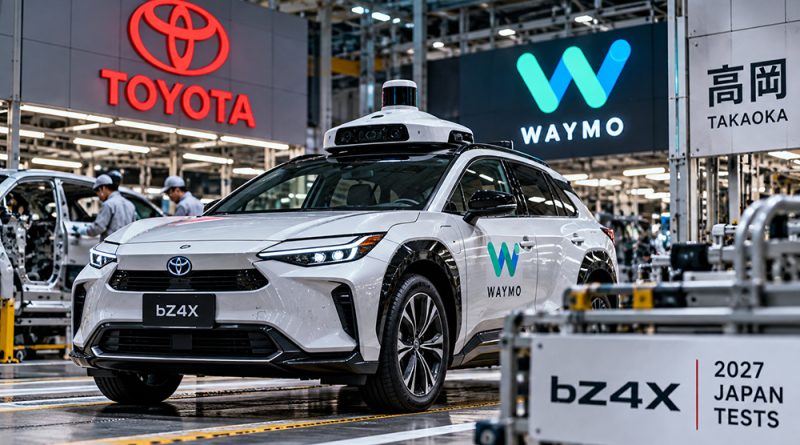
Toyota to build Waymo-equipped bZ4X vehicles at Takaoka for 2027 Japan tests
Toyota and Waymo announced on 30 October 2026 that Toyota will build a fleet of autonomous bZ4X vehicles at its Takaoka plant in Toyota City, Aichi Prefecture, and fit Waymo’s self-driving hardware at the same site. The companies plan to begin initial operations in Japan in 2027 to test and validate the vehicles, with deployment to the United Kingdom and other Waymo-serviced markets in later years.
The arrangement is the next phase of a collaboration announced in April 2025. Its significance lies less in the vehicle badge than in where the work happens: Toyota will combine base vehicle assembly and Waymo hardware installation under one roof, rather than converting completed cars at a separate facility.
A factory plan, not a live service
The companies’ wording is precise. They describe operations to test and validate the bZ4X fleet, not the start of a commercial driverless service. The 2027 date is therefore a testing milestone, and the announcement does not establish that a robotaxi service is running in Japan or that the bZ4X has been approved for one.
The UK comes later. The joint statement says deployment there and in other Waymo-serviced markets is planned for the following years, without a date. TechCrunch reports that Waymo has tested autonomous Jaguar I-Pace vehicles in London for months and intends to launch a robotaxi service once it receives the necessary permits. That London work is separate from the bZ4X plan, and the report does not show that permits have been granted.
Why Takaoka matters
The production plan changes the sequence Waymo has used to acquire vehicles. The Verge reports that the company previously bought finished cars, shipped them to a separate facility and retrofitted them with sensors, computers and extra wiring. At Takaoka, the factory will install Waymo’s self-driving sensors and computers on the assembly line as each car is built.
That could remove duplicated work, bespoke brackets and secondary shipping, and The Verge suggests it might lower costs. No saving, production speed or reliability benefit has been quantified, and the production plan has not been independently confirmed. TechCrunch characterises the partnership as looking like a conventional vehicle supplier deal for now, while noting that both companies describe future exploration.
TechCrunch reports that the planned vehicles are 2027 bZ4X models and that the model is known as the bZ in North America. The joint statement says the custom-outfitted version will have generous rear legroom, automatic doors, a power liftgate and ambient lighting to ease entry and exit. Those are the companies’ design intentions, not the results of an independent accessibility assessment.
A fleet of several platforms
The bZ4X adds another platform to Waymo’s fleet. Electrek reports that Waymo’s US fleet is still mostly Jaguar I-Pace SUVs, a model Jaguar no longer produces, and that Waymo has been adding the Zeekr-built Ojai van and the Hyundai Ioniq 5. That helps explain why the company is broadening its supplier relationships. No figure has been disclosed for how many bZ4X vehicles Toyota will build or what share of the fleet they will represent.
Safety claims and their limits
The joint announcement frames the collaboration as a way to scale safety-validated Level 4 autonomous vehicles and to reduce accidents caused by human error, while widening access to mobility for people who have difficulty getting around. These are the companies’ descriptions. The announcement includes no independent technical or safety assessment of the bZ4X platform.
Dmitri Dolgov, Waymo’s co-CEO, said in the announcement that, in areas where Waymo operates, it has demonstrated being up to 20 times safer than human drivers for serious crash injuries. The figure is an attributed executive claim. The supplied passage provides no methodology, and no independent assessment accompanies it. It should not be read as a measured result for the bZ4X fleet or for Japan and the UK.
A separate Tokyo target
Electrek reports that in September Waymo said it was targeting fully driverless commercial rides in Tokyo in 2027 with taxi operator Nihon Kotsu and ride-hailing app GO, scaling to about 100 vehicles and pending regulatory approval. The 30 October statement does not identify this as the same milestone, and the reported partner details and vehicle figure have not been officially confirmed. The two plans should not be merged.
What remains open
Several practical questions are unanswered. Electrek reports that Waymo did not share sensor specifications, unit volumes or per-vehicle costs. The companies also say they will continue exploring autonomous driving technology for personally owned Toyota vehicles, and initiatives with Woven by Toyota that use insights from Waymo’s real-world operations to improve safety for other road users. Those are stated intentions without dates or products.
The announcement gives the project a vehicle, a factory and a sequence: Japanese test operations first, later deployment to the UK and other markets. It does not show robotaxis carrying paying passengers in either country. Until the companies publish operating details and any regulatory approvals, 2027 should be read as a test and validation plan, and the UK as a later intention rather than a scheduled service.
A date in a technical plan can signal a launch or a first round of testing, and the difference is worth pausing over. Toyota and Waymo describe operations to test and validate a fleet, while the safety figures quoted arrive as attributed claims without a published method. That habit of reading a milestone for what it actually settles sits at the heart of cybersecurity fundamentals, where a capability is examined for scope, evidence and the conditions under which it was measured rather than accepted because it was announced. Understanding how a control is tested, and what a result does and does not cover, turns an impressive number into a question you can act on. The Hack Academy’s online cybersecurity training programme lists cybersecurity fundamentals among its subject areas, with self-paced learning and practical exercises alongside the theory, for readers who want to judge a technical claim by the evidence behind it.