Starbucks plans drive-through AI tests that keep baristas in the conversation
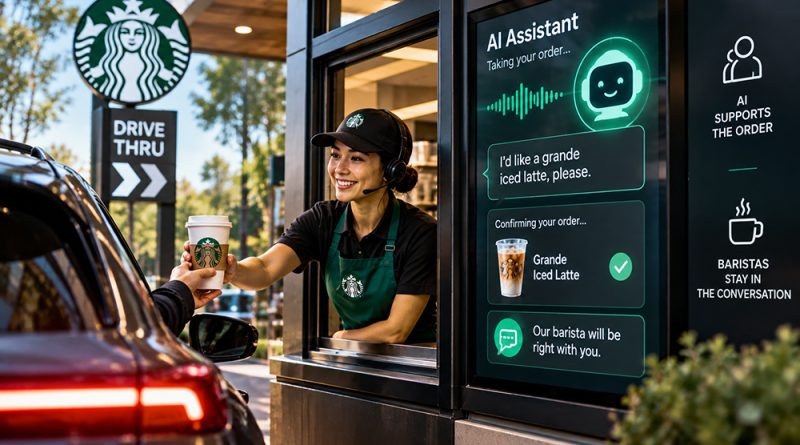
Starbucks is preparing to test artificial intelligence models that would work in the background at its drive-throughs, helping baristas enter orders while they talk to customers. Bloomberg reported the plan from remarks by chief executive Brian Niccol on an earnings call in late October 2026. The reports describe a testing plan, not an operating service, and they leave the most practical questions unanswered.
According to Bloomberg, Niccol told analysts that the company is preparing to test models that operate in the background to help baristas input orders more accurately and efficiently as they interact with customers. The stated aim is to let workers focus on the conversation while improving speed. That is the chief executive’s account, reported second hand; it does not establish that the system delivers either benefit.
A helper behind the counter, not an automated voice
On the description given, the proposed models are order-entry support rather than a fully automated order taker. The barista would remain in the customer conversation while software helped with the transaction behind the scenes. The reports do not explain how the models would generate or present that help, or how a worker would correct them.
The company’s stated purpose is narrow. It concerns the accuracy and efficiency of input, not menu recommendations, customer identification or payment. Those ideas appear elsewhere in the reporting, but as separate initiatives or possibilities. Keeping them apart matters because the drive-through test is the most concrete proposal and the one described with the clearest operational role.
What is already in use, what is planned and what is only an idea
Starbucks already uses AI in other parts of its ordering and staff tools. The Verge reported that Starbucks has started allowing customers to place orders through ChatGPT and that employees have access to Green Dot Assist, an AI-powered tool for questions about recipes and service standards. Neither tool is the proposed drive-through order-entry system, and neither provides evidence that the new test would work. The Verge report did not give deployment dates or scope for them.
The Verge also reported that Starbucks plans to integrate AI into the Starbucks app’s search and discovery features and is considering conversational and agentic ordering in future. Those are stated intentions. They would change how customers find and place orders, but they are not features the company has said are available to all app users.
The customer-facing drive-through concepts are further away. The Verge reported that Niccol said Starbucks would explore experiences that recognise participating customers as they arrive, present personalised digital menus and make payment more effortless. Yahoo Finance reported a related idea from an interview after quarterly results: a fast-pass style experience in which a customer arrives with the Starbucks app open, sees recent orders and can be asked whether they want the usual, with payment completed before collection at the window.
That is a potential experience as described by Niccol, not a rollout. It depends on the app, a customer account and a history of previous orders, but the reports do not say whether the concept would require loyalty membership, how a customer would join or what would happen to customers who did not want to take part.
2027 is a reported target, not a launch date
The Verge reported that testing of background AI models at the drive-through would begin in 2027. eMarketer’s summary of the call said fiscal 2027. The two labels may refer to different periods, and neither version amounts to a firm deployment schedule. No wider rollout date was reported.
Other basic details are also missing. The reports do not identify test markets, model providers, integration partners, costs or performance measures. Nor do they say how many drive-throughs might take part. The absence of those details makes the plan difficult to evaluate beyond its stated intent.
Why the drive-through matters
Yahoo Finance reported, attributing the figure to the company, that roughly half of Starbucks consumers use the drive-through. The figure indicates why the channel matters commercially, but it says nothing about whether AI will improve accuracy, speed or customer satisfaction. The reported benefits remain intended outcomes rather than measured results.
Yahoo Finance also reported that Starbucks’ loyalty programme reached a record 36 million 90-day active members and that fourth-quarter sales growth was 7.2 per cent. Those figures describe the business around Starbucks’ app and loyalty base, not the effect of the proposed AI features.
The employee case is equally unsettled. The stated aim is to free baristas to talk to customers while orders are entered more accurately and quickly. Whether the software reduces a barista’s workload or adds another step to check is not established by the reports. The reports did not include worker response, training requirements or an independent assessment.
The unanswered questions for customers
Customer recognition and personalised menus raise questions that the reports leave open. They do not describe what data would be used to identify a customer, how participation would be recorded, how long information would be kept, whether it would be shared with outside partners or how someone could opt out. Payment is central to the fast-pass idea, but the reports also do not explain how payment data would be handled.
Those gaps are not proof of a privacy problem. They are limits of the available reporting, and they matter because the features would depend on linking a customer, an arrival, an order history and a payment method. The reports do not establish that all those links would be used, or that Starbucks has settled how they would work.
For now, the most concrete proposal is behind the counter. Starbucks has described a plan to test order-entry support, with customer-facing personalisation still at the exploratory stage. Useful evidence would include a named test market, a technology partner, accuracy or speed measures and a plain account of customer data and consent. Until those appear, the drive-through AI story is a plan under development, not a service customers can use.
Recognition that greets a customer by name is still an exploratory idea in this story, yet underneath it sits a chain of decisions about identity: who or what is recognised, which record ties an arrival to an order history, what someone consents to and how they withdraw it, and how much of that machinery can be inspected rather than trusted. Those questions belong to cybersecurity fundamentals, where identity, permissions and data handling are studied as structures with limits rather than as features announced on an earnings call. They are also the questions this reporting leaves open. The Hack Academy’s online cybersecurity training programme lists cybersecurity fundamentals among its subject areas and sets self-paced learning and practical exercises alongside the theory, for readers who want to follow how a customer-facing promise becomes an access decision.