
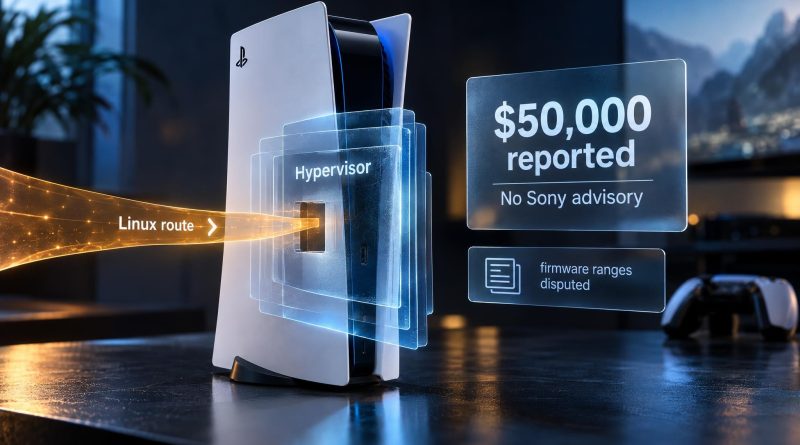
What the reported $50,000 PS5 bounty does and does not establish
A security researcher who uses the handle Jordy was reportedly paid $50,000 by Sony for privately reporting a PlayStation 5 hypervisor flaw, one that gave researchers a route to running Linux on the console. IGN, Tom’s Hardware, Yahoo Tech, 3DNews, 163.com and Les Numériques carried the account. Several relay the same underlying reporting, so the number of articles is not independent confirmation. The episode has turned a narrow technical dispute into a public argument about disclosure, payment and artificial intelligence.
The limits of the record matter as much as the claim. The accounts do not include a Sony advisory or changelog, a HackerOne case record or a CVE identifier. Yahoo Tech, carrying a Cult of Mac syndication, reported that the sum was the maximum listed for the programme and that Jordy’s HackerOne profile records a resolved PlayStation report at that amount. That is a description of a profile, not vendor confirmation. Those gaps frame everything that follows.
What a hypervisor flaw does
The hypervisor is the layer that polices access to the console’s most sensitive parts. A fault there can allow kernel-level code to run, which is the kind of low-level access needed to boot software the machine was not designed to run. IGN described the flaw in those terms and placed it in the core software or firmware layer; Yahoo Tech described it as a route towards the low-level access required for unsigned software such as Linux. The reporting includes no technical write-up or root-cause analysis. That is enough to explain why the bug mattered, and not enough to say how it worked.
Two firmware ranges, no reconciliation
The most concrete disagreement concerns versions. Tom’s Hardware and 3DNews reported that the ps5-linux-loader project requires a PS5 Phat, Slim or Pro on firmware 3.00 to 13.60. IGN and the 163.com repost of a 3DM Game article described the hypervisor bug as affecting or involving firmware 13.60 to 14.00. The two ranges may refer to different things, the loader’s supported versions and the bug’s reach, but the sources do not reconcile them. Neither is a Sony statement of affected versions.
The patch position is similar. Tom’s Hardware and 3DNews put the 14.20 release on 21 October 2026 and described it as patching or closing the flaw. Yahoo Tech reported the same version number but noted that Sony’s public release notes did not identify the bug as a specific fix. The release can be reported. The fix attribution is not confirmed by the changelog or advisory that none of the outlets quoted.
Why 19 November mattered
Grand Theft Auto VI is scheduled for PS5 on 19 November 2026. Reporting relayed by Yahoo Tech, and the community commentator madwax0r in comments to IGN, said the game requires current system software and a PlayStation Network sign-in. That requirement was attributed to current reporting and to madwax0r, not to Sony or Rockstar. Timing was therefore central: a patch before launch would close the route that owners of older firmware had preserved, and updating to play the game would mean giving it up.
IGN reported that Andy Nguyen, known in the scene as theflow0, had found the same flaw while working on PS5 Linux, and relayed Jordy’s claim that Nguyen found it in 2025 and kept it secret. Jordy’s account, relayed by IGN, is that the two initially agreed not to report the bug until after the game’s release. The reported aim, described by madwax0r and by Les Numériques, was that the launch-day firmware would still contain the flaw, so players could update and still boot Linux. Les Numériques relayed Nguyen’s account that he asked for a delay so people could buy the game legally and still use Linux. IGN said Nguyen could not be reached for comment.
Priority, AI and a disputed sequence
Jordy told IGN he reported the bug sooner because other researchers were also finding it with AI and he risked losing the $50,000. He denied being coached by Nguyen and said he found the flaw independently with AI, while describing Nguyen as a respected figure. Those are competing accounts, not a settled sequence, and the reporting offers no way to adjudicate.
The AI element carries its own limits. The method is Jordy’s stated account, relayed by IGN and repeated by Tom’s Hardware, 3DNews, 163.com/3DM and Les Numériques. The reporting includes no model output, vulnerability report or independent validation. The 163.com repost argued that the tools lowered the barrier for other researchers to reach the same flaw, and cautioned that a single case does not show that console jailbreaking has become unprecedentedly easy. The priority dispute reinforces the caution. Another researcher is reported to have reached the same flaw earlier, so the AI account is about rediscovery and speed rather than a new kind of defect.
The effect on the project is reported more consistently. Tom’s Hardware and Les Numériques reported that Nguyen said he was stepping away from the PS5 scene and stopping his PS5 Linux work, abandoning planned PS5 Pro support in 2027.
A bounty and a community
Bounty programmes pay for private disclosure so a flaw can be fixed before it is described in public. For some in the homebrew scene, the same flaw is a route to greater control over hardware they own. Those views can coexist, and here they collided. After Jordy posted about the payout, outlets reported criticism from people who saw the report as putting a personal reward ahead of a shared project, alongside defences from those who argued that a bounty should go to whoever reports first. The reporting summarises a social media argument rather than measuring it, so the scale of the backlash is not established.
What owners can reasonably conclude
For people who have been running Linux on an older PS5 firmware, the practical position is reported rather than confirmed. Firmware 14.20 is reported to close the path used by ps5-linux-loader, but Sony’s release notes do not name the bug, according to Yahoo Tech. The claim that new games require the latest firmware and a PSN sign-in comes from reporting and a community commentator, not from Sony or Rockstar. Anyone weighing an update is balancing a reported loss of the Linux route against requirements that have not been vendor-confirmed.
What would settle the factual questions is specific: a Sony advisory or changelog, a HackerOne record, a technical write-up and a reconciled firmware range. What the episode does not establish is equally worth stating. Nothing in the reporting describes a breach, malicious exploitation or data access, and the case does not show that AI has made console jailbreaking easy. It shows a private report, a reported $50,000 payout, a firmware release that reporting links to the flaw but Sony’s notes do not name, and a homebrew community still arguing about the order in which those things should have happened.
A paid report is not the same as a confirmed vulnerability, and the PS5 case turns on that gap: a reported bounty, a disputed firmware range and release notes that do not name the flaw. Reading those claims carefully starts with cybersecurity fundamentals, where evidence, scope and disclosure are assessed rather than assumed. The Linux route adds a useful technical layer, since it depends on understanding how low-level access and privilege boundaries work in practice. The Hack Academy’s online cybersecurity training programme lists cybersecurity fundamentals and Linux among its subject areas, with self-paced learning and practical exercises alongside the theory, for readers who want to examine how a vulnerability claim earns trust.