
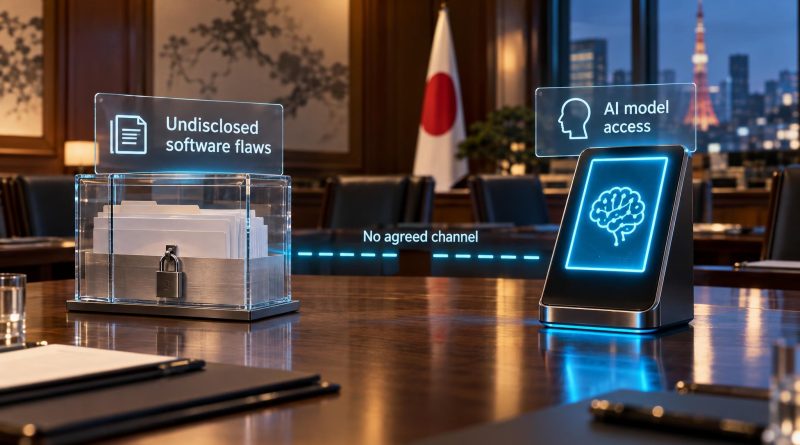
Japan reportedly plans to seek early access to undisclosed software flaws from US AI developers
Japan is reported to be planning to explore ways of obtaining early information about undisclosed software vulnerabilities from US artificial intelligence developers and other overseas technology companies. Nikkei Asia, which reported the plan, framed it as part of Tokyo’s response to a rise in cyberattacks. Yonhap News Agency, citing Nikkei and other Japanese media, said the government planned a ministerial meeting on 6 November and an emergency cybersecurity package.
Nikkei reported that Japan would seek ways to obtain the information at an early stage, not that a system for doing so had been agreed. Its opening excerpt said Tokyo was readying an emergency package and that Prime Minister Sanae Takaichi directed officials to draw it up in late October. Yonhap, in a report published on 5 November 2026, gave the meeting date and said the package would be announced then. The available reporting included no Japanese government document, package text or official statement.
Nikkei described a spike in cyberattacks, while Yonhap linked the plan to recent attacks it said were suspected of abusing AI and said Japan had asked major US AI developers to expand use. The available reporting included no independent government or technical confirmation of the scale or cause of those attacks.
Why early warning is the stated aim
If Japan learned of a serious flaw before public disclosure, it could investigate early which government agencies or critical infrastructure, including power and telecommunications, might be affected. Yonhap added that serious vulnerabilities carry a risk of exploitation as soon as they are disclosed. That is a rationale for earlier warning, not evidence that Japan has a working early-warning channel or that any particular flaw was identified. The reporting describes the objective and some institutional arrangements, but not the mechanism by which companies would share vulnerability details.
AI access is not disclosure
Yonhap reported that the Japanese government, some companies and financial institutions already hold access rights to high-performance AI models. It then made an important distinction: holding access to a model does not mean vulnerability information is provided to the Japanese government or companies. Those are different kinds of access. A model access right concerns use of an AI system. A vulnerability disclosure arrangement would concern the transfer of sensitive information about a software weakness before it becomes public. No company agreement to share such information is supported by the available reporting.
A wider package and open questions
Yonhap reported that the National Cybersecurity Office would handle information gathering. The package was also to include bringing security vendors and cloud companies into a public-private council on active cyber defence, which Yonhap described as intruding into attacker-side servers to neutralise attack attempts.
The reported element extends the package beyond information sharing into operational collaboration. The available reports do not show that the council has been formed, that any operation has been authorised or that any intrusion has taken place. Nor do they describe the council’s membership, legal authority, safeguards or oversight.
The same gaps surround the vulnerability proposal. The reporting does not describe the legal instrument, the data flow, confidentiality rules, handling requirements or what companies would be asked to provide.
What remains unresolved
The reporting shows that Japan already receives undisclosed vulnerability information, that any company has agreed to share it, or that access to an AI model entails such disclosure. They do not identify a specific breach, exploit, affected product or vulnerability. They also do not confirm that the 6 November meeting was held or that the emergency package was adopted.
The useful distinction is between a policy ambition and a working system for disclosure. The first is the reported ambition. The second requires legal authority, trusted channels, handling rules and cooperation from the companies that hold the information. The available reporting describes Japan as setting out to explore the first.
A government can hold access to a powerful AI model and still be told nothing about a serious flaw in the software around it. Disclosure is its own machinery: who finds a weakness, who hears about it first, how long the silence lasts and what the rest of us eventually learn. Internet vulnerabilities is the study that makes that machinery legible, from the classes of software weakness to the trade-off between giving defenders a head start and publishing details that anyone can use. If you would rather weigh a reported arrangement like this one than take it at face value, The Hack Academy’s online cybersecurity training programme lists internet vulnerabilities among its subject areas, with self-paced learning and practical exercises alongside the theory.