
The Real Test for Google Health and Apple Health: What Users Can Move
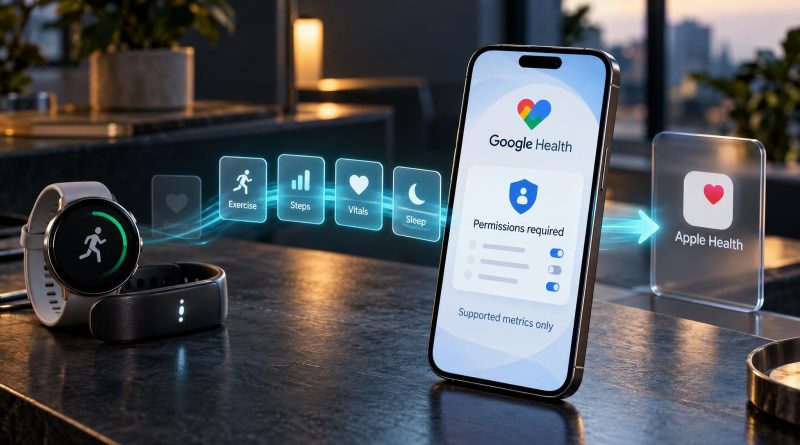
On 2 August 2026, Google announced that version 5.05 of its Google Health app was rolling out from that day in phases over the following week for Android and iOS. In its release note, the company documented a change with more practical weight than much of the rhetoric around digital health. On iOS, Google Health could write supported data back to Apple Health. The examples were exercise records, steps, vitals and sleep recorded by a Fitbit Air. The route ran through the profile icon, Partner apps and Apple Health, and data would flow only after the user granted permissions.
That small sequence is a better guide to the competition between Google and Apple than the idea that one company will own a person’s health for life. Health data is sensitive, personal and increasingly useful to software that wants to interpret it. The meaningful question is not who holds the master copy. It is what can move, under whose terms, with which gaps and at what cost to the user.
A one-way street becomes a gate
Before version 5.05, the traffic between the two systems had a clear direction. Trusted Reviews reported on 3 August 2026 that iPhone users could import Apple Health, HealthKit and Apple Watch data into Google Health but could not send Fitbit-recorded information back to Apple’s platform without third-party tools. The publication reported that the update ended a restriction that had kept information flowing in only one direction. That is a real change in mechanics, but it is not proof that the two systems are now symmetrical.
Google’s documentation names supported kinds of data and an explicit permission step. It does not establish that every record travels, or that a copied record remains identical in meaning and detail across the two platforms. Trusted Reviews reported that not every health metric was supported by the new sharing feature, and said reports suggested that heart rate variability was among the types that did not yet transfer. The important distinction is between an export route and full portability. A user may be able to move a useful slice of a health history without being able to move the whole thing.
The permission step matters too. In Google’s documented flow, the user opens the profile, selects Partner apps, chooses Apple Health and then follows set-up prompts or reviews permissions. Data begins to flow only after Google Health has been allowed to write to Apple Health. That is a visible form of user control, but it also places responsibility on the user to understand which categories have been switched on.
A platform built to reach past its own hardware
The broader contest is about where health data is collected, stored and interpreted. Egypt Independent reported in May 2026 that Google would turn the Fitbit app into the Google Health app from 19 May, with a Gemini-powered AI Health Coach that could summarise health records users chose to share, offer weekly fitness plans and answer questions about fitness and medical data. Google was trying to reach beyond Fitbit and Pixel Watch owners to people using Apple Watch, Oura ring and Garmin devices.
The reach of the app and the reach of its AI were not the same thing. Egypt Independent reported that, as of May, the AI assistant in Google Health was available only for Pixel Watch and Fitbit products, and that Google said it was working to add coaching support for Apple Watch and other devices later in the year. Data syncing and AI coaching are separate functions, and the distinction matters. A platform can accept a stream of records while reserving its most advanced interpretation for a narrower set of hardware.
The two services also entered the period with different shapes. Trusted Reviews noted in May 2026 that Apple Health had been exclusive to Apple devices, mainly the iPhone with later iPad support, while Google Health was available across iOS and Android. It reported that Google Health Premium replaced Fitbit Premium at £7.99 or $9.99 per month for features including personalised fitness plans, sleep summaries and holistic insights, and that Apple Health had no subscription and was free to use.
Trusted Reviews also noted that Apple Health had stronger medication tracking, a feature it said Google Health lacked at launch. Those descriptions carry a date. They show a trade-off rather than a simple scorecard: Google offered a wider platform and a paid interpretation layer; Apple offered a free app tied to its own devices.
From counting steps to giving advice
The next layer of competition is not the step count. It is the advice built on top of the count. Google’s 5.05 note also documented a US-only feature called Smart Health Links. Users could create a summary of medical records from the Health tab, choose what to include and share it by URL or QR code with a healthcare provider or family member. Google stated that the feature was available in the US only and was not intended for medical purposes or as a substitute for official clinical health records.
Benzinga reported on 12 October 2026 that Google’s partnership with Function Health had been announced that day and would let US users share Function lab results with the Google Health app later in the autumn. It said the partnership would bring more than 160 lab tests and the Medical Intelligence platform into Google Health, with measurements including cholesterol-related markers, fasting insulin, inflammation indicators, hormones and nutrients. The same report said Apple had announced a Health app overhaul in September 2026, adding AI-powered insights, a longevity dashboard and lab tests covering more than 50 biomarkers through Quest Diagnostics, along with the ability to import existing results.
Both descriptions came from secondary reporting and were not primary-confirmed. They nonetheless point to the direction of travel. Wearables can show a change in sleep or heart rate. Lab results and medical records can add context that a wrist sensor cannot capture. The company that can turn those fragments into guidance has a reason for users to return, which is why the competition is moving from measurement towards interpretation.
Trust beyond the toggle
Interpretation brings a separate test. Egypt Independent reported that Google, OpenAI and Microsoft have said their products are not intended for medical use or to replace doctors. It also reported that institutions including the Mayo Clinic and Duke University School of Medicine have warned that AI can be inaccurate, may lack necessary context and may not reason or run tests like a medical professional. Those cautions sit alongside product claims. They concern the quality and limits of advice, not a documented security incident.
This is not a story about a breach or unauthorised access, and the evidence available does not establish that either company sells personal health data to advertisers. The privacy question is more ordinary and harder to answer: whether a user can understand what has been shared, with which service, for what purpose and for how long. A permission screen is a starting point, not a complete account of a data lifecycle.
The trade-offs users actually face
The evidence does not describe one open ecosystem competing with one closed one. It describes different kinds of conditionality. Google Health was reported as running on both major mobile platforms, while some of its most distinctive features were tied to particular hardware or a paid tier. Apple Health was free but available only on Apple devices. The 5.05 write-back reduces one barrier for an iPhone user with Fitbit hardware. It does not make the two platforms equivalent.
Several questions remain open. The current status of AI coaching for Apple Watch is not established beyond the May report. The later status of medication tracking in Google Health is unresolved. The lab partnerships and Apple’s September overhaul rest on secondary reporting. Current pricing and feature availability after the May to August sources are not settled. These are not minor details for a user deciding where to keep a health history, but they are reasons to describe the competition precisely rather than inflate it.
The practical test is simpler than the ownership language suggests. What data enters a platform? What can be exported? Which categories are excluded? Does the feature require a particular phone, watch or subscription? Can permission be reviewed and withdrawn? Is the user moving raw records, a summary, or an interpretation generated by a model? Those questions are less dramatic than a claim of lifetime ownership. They are also the ones that determine whether a person can switch devices, share records with a clinician or keep a continuous history without surrendering control of it.
The contest that matters is not who owns the record for life. It is who makes that record easier to move, understand and withdraw.
A write-back toggle looks like a handover, but the useful detail sits in everything the toggle leaves out: which metrics are in scope, what a copied record keeps of its original meaning, and who can review or withdraw the arrangement months later. Reading a data-sharing feature as a set of boundaries rather than a single switch is the kind of thinking that cybersecurity fundamentals builds, where access, data handling and the limits of a permission are examined as defined rules with edges you can test. That lens travels well beyond health apps, from account settings to a one line sharing prompt. The Hack Academy’s online cybersecurity training programme lists cybersecurity fundamentals among its subject areas, combining self-paced learning with practical exercises alongside the theory.