
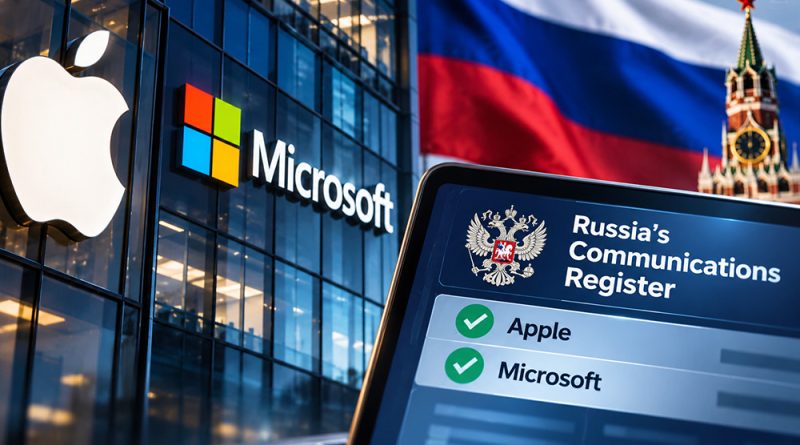
Apple and Microsoft reportedly join Russia’s communications register: what the listing does and does not establish
Apple and Microsoft have reportedly been added to a Russian register of organisers of information dissemination, a listing said to impose data retention and disclosure duties on digital communication providers. TechRadar, citing Bloomberg, and French technology site iPhoneSoft both date the entry by Russia’s communications regulator Roskomnadzor to 2 October 2026. The listing matters because it is reported to create standing obligations to retain information and produce it on request. It is not evidence that either company has transferred user communications. The primary register entry and the underlying legal text were not available to review.
TechRadar reported that the designation requires covered firms to preserve customer details and records showing how communications move through their systems, and that Russian authorities may seek correspondence, voice recordings and video exchanges. It said Russian law sets three years for retaining the records inside Russia and that companies risk financial penalties, with persistent violations potentially leading to service bans.
iPhoneSoft described a similar framework in more detail. It reported that the status requires user-identifying data and records tracing exchanges to be kept in Russia for three years, while message, photo, audio and video content must be stored for a shorter period and supplied to authorities on request. The accounts differ in emphasis rather than in the core claim: TechRadar focused on customer details and routing records, while iPhoneSoft added content retention and disclosure. The legal text was not obtained, so the precise boundary between records about a communication and its content remains unconfirmed.
Why the date matters
iPhoneSoft reported that although the entry is dated 2 October, it was noticed only on 28 October by a specialist Telegram channel. That gap is a useful detail about public visibility, but it rests on one secondary report and an unobserved channel; it does not establish concealment. The same report said Roskomnadzor had demanded that Apple register in July 2025 at the FSB’s request, that Apple refused, and that a Moscow court later ruled against it and imposed a 500,000 rouble fine. Those details were not independently verified.
The encryption question is unresolved
iPhoneSoft reported that iMessage and FaceTime are within scope and that their end-to-end encryption seriously complicates compliance. That is the central technical uncertainty. A legal power to request content does not by itself establish that a provider can produce readable content from an end-to-end encrypted service, and the reporting does not explain how Apple would reconcile the two. The material contains no evidence that encryption has been weakened, that a specific request has been made, or that any communication has been disclosed. What the rules require of encrypted services in practice remains unanswered.
Company silence and service effects
TechRadar reported that neither Apple nor Microsoft had publicly explained how it intended to address the requirements or whether it would co-operate with Russian authorities. Neither had disclosed whether the listing would affect its services or commercial activities in Russia. iPhoneSoft reported that neither company had responded and that it was unknown whether the entry followed a voluntary application or a decision by the regulator on its own initiative, a procedure the report said Russian law has permitted since 2024. The specific Microsoft services covered were not identified.
iPhoneSoft reported that being on the register does not by itself block the iPhone or the App Store, because restricting access is a separate procedure. It also reported that FaceTime has been blocked in Russia since December 2025, with fraud and criminal recruitment given as the reasons. That is an earlier restriction, not a consequence established by the register entry. Penalties for persistent violations are a reported risk, not an enforcement outcome, and no service restriction, fine or data transfer following the listing was documented.
Separate import controls, different evidence
The register is distinct from Russia’s restrictions on satellite communication equipment. Rossiyskaya Gazeta reported that Decree No. 488 of 29 April 2026 banned imports of satellite communication equipment not approved for use in Russia. Experts told the newspaper that the measure primarily concerned Starlink but might affect some recent Apple, Samsung and other devices that use satellite communication. That applicability was presented as possible and contested, not as a regulator’s determination.
It prohibits imports of certain radio-electronic means for transmitting or receiving radio waves from foreign communication satellites unless a State Commission for Radio Frequencies decision allocates frequencies. It took effect on 1 November for six months. Its annex lists commodity codes and a goods description, not manufacturers or brands. Separately, Ukraine’s Foreign Intelligence Service, an adversarial official source, reported a planned ban on parallel imports of a wide range of electronic products from 27 May 2026, naming Intel processors, SanDisk storage, SK Hynix memory, Acer and Asus laptops, and equipment from Samsung, Hewlett Packard and Fujitsu.
The satellite decrees concern imports and frequency approval; the parallel import ban concerns supply routes; the register concerns retention and disclosure by communication providers. The reporting describes wider restrictions on foreign technology, but nothing supplied establishes that these measures form a single instrument or a coordinated campaign.
What the wider claims can and cannot show
The Foreign Intelligence Service of Ukraine stated that Russia is preparing a new version of its Information Security Doctrine that would define the use of Western digital technologies as a systemic threat and expand state oversight of the digital environment, including artificial intelligence. It also stated that deliberate network shutdowns in 2025 lasted 37,100 hours, while Kyiv Post, citing Top10VPN, reported more than 37,000 hours and effects on nearly the whole population. The figures are close but not identical, and neither underlying dataset was supplied. These are context claims from an adversarial official source and a secondary report, not verification of the register’s operation.
What remains open
A reported register entry would create a legal retention and disclosure framework for Apple and Microsoft in Russia. That is materially different from a demonstrated request, handover or cyber incident. The missing primary record, the absent company statements and the unresolved encryption question all limit what can be said about compliance or practical effect.
A lawful demand for a message and a readable copy of that message are two different things, and the distance between them is largely a question of cryptography. End-to-end encryption is a design decision about who holds the keys, and a provider handed a disclosure requirement may hold only ciphertext it cannot open. Learning how encryption, key custody and decryption actually work makes it easier to read claims about compelled access without assuming that a legal power produces readable content. Readers who want that grounding can explore The Hack Academy’s online cybersecurity training programme, where cryptography is one of the listed subject areas and self-paced learning sits alongside practical exercises and theory. It will not settle what the reported register entry requires of Apple or Microsoft, but it makes the encryption question legible.