
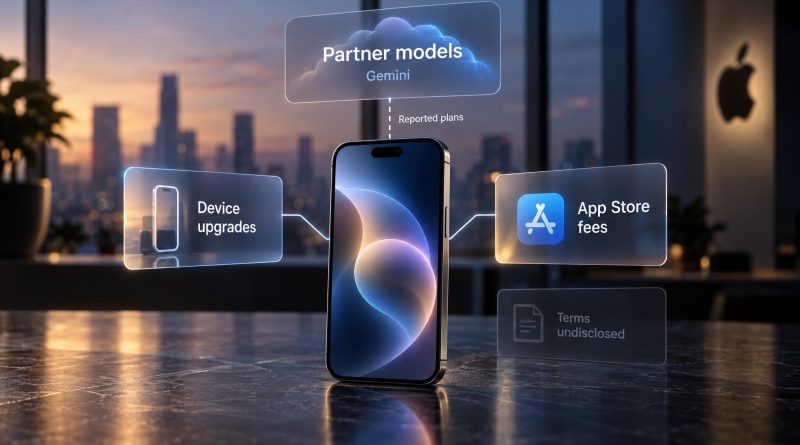
Apple’s AI pitch leans on devices, partner models and fees
Apple’s AI story divides into two questions. Can it build models that match the frontier? Can it make money by placing AI, including rivals’ AI, on devices people already own? The Verge’s account of Apple’s earnings call says more about the second than the first.
What the earnings showed
According to The Verge, Apple reported its best-ever fiscal year for revenue and earnings per share. iPhone revenue rose 17.5 per cent year on year to a September-quarter record of $57.6bn; Mac revenue climbed 24 per cent to $10.8bn. Shares fell in premarket trading after Apple warned that rising memory costs would squeeze holiday-quarter margins. The figures are as reported by The Verge; Apple’s earnings release, filing and call transcript were not available for comparison.
Apple did not disclose how much of its growth came from AI demand rather than higher prices. Chief financial officer Kevan Parekh described AI as a reason for customers to upgrade and switch, and pointed to third-party apps, partnerships and first-party features. The same account described John Ternus as making his first earnings call as chief executive; he said Apple saw a large opportunity in AI. AI and Apple Intelligence were mentioned 45 times, a count attributed to AlphaSense.
The clearest strategic contrast is capital spending. The Verge reported that Apple spent $2.2bn on capital expenditures in the quarter, against $77.3bn at Amazon and $51.4bn at Alphabet. Those totals are company-wide and exclude some AI expenses, so they are not a like-for-like AI budget. Apple’s operating expenses still rose 21 per cent to $19.2bn, with research and development spending up, including on AI.
A platform built with partners
Apple’s reported approach combines on-device processing, its own servers and outside technology. Siri AI uses models developed with Google’s Gemini technology. The Verge described a staged rollout, with a US English beta in September and five more languages in October, without giving a year. 9to5Mac reported that Apple confirmed Gemini models would power the new Siri, that Google called the arrangement a multi-year contract, and that the models would run on Apple’s Private Cloud Compute servers. The price is not officially disclosed. The Financial Times, as reported by 9to5Mac, described a multi-billion cloud contract that could lead Apple to pay several billion dollars over time, citing a person familiar with the agreement.
The revenue path described is indirect. The Verge’s account lists device upgrades and switches, commissions on subscriptions to AI apps, and charges for greater use of server-side features. Ternus said server-side features including Siri AI and intelligent photo editing would have usage limits, with expanded access sold later. The reports gave no pricing, take-up or margin figures. The Wall Street Journal, citing AppMagic, said Apple was on pace to collect more than $1bn in App Store fees from generative AI apps in 2026. That is a projection, not an Apple disclosure. The Verge also reported that OpenAI had begun directing subscribers to pay through its website to bypass Apple’s commissions.
Choice and the China exception
A key unresolved product question is how far Apple will let users choose outside AI providers inside its own features. Bloomberg reported a planned Extensions feature for iOS 27, iPadOS 27 and macOS 27 that would route tasks in Siri, Writing Tools and Image Playground through a service selected in Settings. AI companies would need to build support into existing App Store apps. Apple declined to comment, according to Yahoo Tech, so the feature has not been confirmed as shipped or final.
Bloomberg also reported a planned disclaimer saying Apple bears no responsibility for outputs from outside AI systems, and distinct Siri voices that could identify different sources. The plan raises questions about how clearly people understand which provider receives their request, what data it keeps and who is accountable for a wrong answer.
Apple’s developer documentation shows that the platform can work with more than Apple’s own models. It says the Apple Foundation Model framework supports multimodal prompts and any language model, including providers that conform to its Language Model protocol. It also says Image Playground generates images in Private Cloud Compute so that photos are not stored or shared. That is documented vendor capability, not confirmation of the consumer Extensions menu or independent proof of privacy in practice.
The China arrangement shows how partner choice can become market-specific. Alibaba announced an agreement with Apple to integrate its Qwen model into Apple Intelligence, according to CGTN Turkish. Qwen-powered services were to begin testing in the iOS developer beta from 4 November and were expected to reach users in China with an iOS 27.3 update planned for December. Apple did not confirm the arrangement.
Alibaba also said that enabling the integration and choosing what information to share would be left to users’ preferences, and that requests and responses would not be used to train the model. Those are unverified commitments. The report said the services would be available to users who bought a compatible iPhone in China or whose device location and Apple account country or region are set to China. That makes the arrangement a planned, China-specific deployment, not evidence of a global menu of providers.
The unresolved bill
The Gemini arrangement gives Apple access to a major external model without building one. It also creates a dependency whose terms are mostly undisclosed. 9to5Mac, citing the Financial Times, reported that OpenAI made a conscious decision not to become Apple’s custom model provider, while noting that it was unclear whether Apple offered a contract. Separately, Bloomberg reported through The Indian Express that OpenAI was preparing possible legal action over what it saw as a breakdown in the partnership, with lawyers examining options including a formal contractual notice. No filing or formal notice was confirmed, so the reports describe different aspects of the relationship rather than a confirmed legal claim.
Ternus’s public framing is continuity rather than reinvention. In a WIRED interview by Steven Levy published on 30 October 2026 and reported by ShiftDelete.Net, he said Apple would not add AI simply for novelty and would use it to make products people value, rather than join a chatbot competition. He rejected the idea that AI agents would replace today’s apps, and when asked about regulation pointed to security and protecting user data. This is executive positioning, not evidence of product performance.
On the available evidence, Apple’s advantage is distribution and a reluctance to match the largest cloud capital budgets. That position can also leave the company dependent on partners for capability, exposed to contract and liability disputes, and without a disclosed figure for how much profit AI itself generates. The next useful disclosures are confirmation that Extensions has shipped and on what terms, the actual availability of Qwen features in China, any formal step in the OpenAI dispute, and numbers that separate AI-attributable revenue and costs from the rest of Apple’s business. Until then, Apple is selling access to AI through its platform; it has not shown that this wins the model race or pays for itself.
When a feature is built on someone else’s model, a wrong answer raises a question the interface rarely addresses: which company is actually answerable for the result? That is a boundary problem before it is a technical one, and it helps to understand how platforms, outside providers and users divide responsibility for what a system does. It also pays to keep a documented capability apart from a shipped feature, and a beta programme apart from a promise. Cybersecurity fundamentals covers how systems, access and accountability are described as separate, checkable things rather than one trusted whole. explore The Hack Academy’s online cybersecurity training programme The programme lists cybersecurity fundamentals among its subject areas, with self-paced learning and practical exercises alongside the theory.