
Apple Alerts to Thai Opposition Figures Leave Spyware and Attribution Unresolved
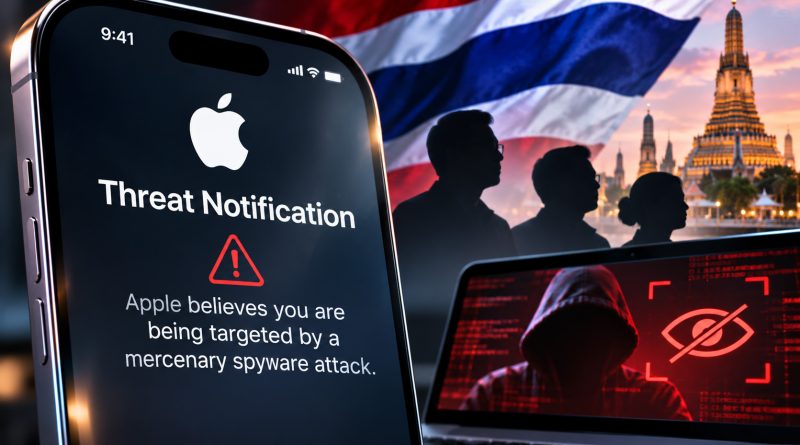
Apple alerts about spyware received by two Thai opposition figures have become a test of what a corporate security warning can establish, and what it cannot. Natthaphong Ruengpanyawut, leader of the People’s Party, published screenshots of a threat notification on his iPhone, according to AFP and Yonhap. A Democrat Party spokesman told AFP that the party’s leader, former prime minister Abhisit Vejjajiva, had also recently received an Apple spyware notification.
The reports describe an alert about mercenary spyware targeting and an attempted remote compromise, not a confirmed intrusion. The notification, as relayed by AFP and Yonhap, said Apple had detected that the recipient was targeted by a mercenary spyware attack attempting to remotely compromise the iPhone linked to the Apple Account. It said the attack was likely aimed at the person because of who they are or what they do. It did not name the attackers.
What the alert does and does not say
The wording matters. It sets out an attempted compromise, not a completed one. It also does not identify a spyware family, a vulnerability or a state. Those are the questions at the centre of the political dispute in Bangkok.
People’s Party deputy spokesperson Napath Narangsiya told AFP that it had not been confirmed which spyware was used or who was behind the attack. The Democrat spokesman, Pongsakorn Kwanmuang, said Abhisit’s phone was not compromised. That assessment came from the Democrat Party, not from a published forensic examination. The reports do not include an independent forensic finding on infection, data access or the attacker.
The political dispute
The disagreement is less about whether the alerts exist than about what they imply. Napath said that if the spyware had been developed and deployed in a similar way to Pegasus, a state actor would have to be involved. He also said no country other than Thailand was likely to target the Thai opposition leader. Those are inferences, not conclusions established by Apple’s notification.
Government spokesman Ekkapob Pianpises called the opposition’s insinuations baseless. He said agencies had requested Pegasus procurement budgets under previous administrations, but that no such budget was allocated in the current or previous fiscal year. The denial addresses a specific procurement question. It is not an independent audit, and it does not by itself exclude other spyware, other agencies or third-party access.
Rear Admiral Surasant Kongsiri, a Ministry of Defence spokesperson, said in remarks that Matichon dated to 4 November that the spokesperson team he leads did not use spyware and had no need to procure it. He said the military’s cyber mission focused on national security rather than breaking into politicians’ databases or data, while adding that he could not answer for other agencies. The qualification limits the scope of the denial.
Official handling has moved through interagency channels. Deputy Minister of Digital Economy and Society Boonthida Somchai said relevant agencies had been meeting on cybersecurity alerts since 30 October and that a meeting with relevant agencies on 4 November would consider spyware and malware alerts. She said preliminary checks indicated alerts in many countries, with Germany apparently the most affected, and that no affected politicians had contacted the ministry directly. Its information, she said, had come from news reports.
Digital Economy and Society Minister Chaichanok Chidchob said the ministry would raise the matter at a National Security Council meeting on 4 November and was coordinating with Apple for more information about the attack pattern and the alerts. The reports do not say what the meeting concluded. That absence leaves the central questions unresolved: which spyware, if any, was involved; whether any device was successfully compromised; and who, if anyone, directed the attempt.
The numbers problem
The country figures need to be attributed rather than treated as a settled count. AFP and Yonhap relayed the notification as saying it had been sent to targeted users in 110 countries. ThaiPost reported Chaichanok as referring to similar Apple alerts in 99 countries. The discrepancy is unresolved in the public accounts. It may reflect different statements or translations; it is not a basis for a precise count.
Alerts sent in many countries can coexist with targeted attacks on specific people. Boonthida’s preliminary assessment that alerts appeared in many countries does not exclude the targeting of Thai politicians. Nor does a broad notification effort establish a Thailand-specific campaign.
Why Pegasus keeps coming up
Pegasus has featured heavily in the public discussion because of Thailand’s earlier spyware controversies. Yonhap reported that Apple warned in 2021 that iPhones of Thai researchers and activists critical of the government might have been targets of state-backed hacking. In 2022, at least 30 people linked to anti-government protests were alleged to have been surveilled with Pegasus, according to Yonhap, which attributed the allegation to a cybersecurity watchdog.
That history explains why the latest alerts carry political weight. It does not decide the present case. The 2021 warning and the 2022 allegation are not findings about the spyware family, the attacker or the infection status of Natthaphong’s or Abhisit’s phones. Even the name Pegasus is not established here. Chaichanok said Abhisit referred to malware rather than specifying Pegasus, and that Apple had not clearly stated whether the software was Pegasus or another kind.
What would settle the question
For recipients, the practical question is verification. Boonthida asked people who receive such alerts to provide the data so agencies could check whether the notifications genuinely came from the service provider. That is a verification step, not a technical fix. Chaichanok offered general precautions: change passwords regularly, avoid insecure public internet connections and avoid untrustworthy advertising links during cybersecurity alerts. He presented them as general measures, not as confirmed protections against the reported spyware.
What would change the picture is a primary Apple notice, forensic examination of the devices, official Thai documents and an account of what the National Security Council discussed or concluded. Until then, the alerts are a signal of targeting, not proof of a successful compromise or data access, a confirmed Pegasus infection or a state campaign. The competing official statements should be read with those limits in view.
A phone buzzes with a warning that someone tried to compromise it. What has actually been established, and what would you want in hand before treating it as fact? That gap between a notification and a verified finding is a working skill: keeping an attempted compromise apart from a completed one, naming who made an assessment and on what basis, and leaving attribution open when the evidence does not close it. Cybersecurity fundamentals is where that discipline is built, and it travels to every alert you might one day receive. If you would like to work through those ideas, explore The Hack Academy’s online cybersecurity training programme, which lists cybersecurity fundamentals among its subject areas, with self-paced study and practical exercises set beside the theory.