
A single molecule’s light frequency stays stable for more than an hour, but it is not yet a quantum network
A single carbene molecule embedded in a host crystal has been addressed individually, its electron spin controlled with microwaves and its state read out through fluorescence at 4.5 K, while its optical frequency held steady for more than an hour. The results, reported in the peer-reviewed, open-access journal Nature (volume 658, pages 1153 to 1159), describe a laboratory spin-photon interface: a component designed to connect a stationary spin qubit to light. They do not describe a quantum network, and the paper does not claim one.
A network needs emitters that can be addressed one at a time, photons whose frequencies match well enough to interfere, and spins that hold coherence long enough to be useful. It also needs entanglement between separate nodes and devices that work reliably beyond a single laboratory setup. Scinexx reports that the study did not entangle two separate molecular qubits, did not show entanglement between the spin and an emitted photon, and did not operate the molecules on a fully integrated chip.
Why molecules, and why photons
Quantum networking needs to move information between places without moving the qubits themselves. Photons travel; spins stay put. An interface that transfers a spin state to a photon, and back, is the bridge. The Nature paper describes such optical interfaces as a central requirement for quantum networking and distributed quantum information processing, and names solid-state atomic defects, led by the nitrogen-vacancy centre in diamond, as the current leading candidates.
Diamond and silicon carbide contain extraneous electron defects and charge traps, and fluctuating charge environments cause optical spectral diffusion, which smears the frequency at which an emitter shines. Molecular crystals, held together by weak intermolecular interactions rather than a continuous covalent lattice, are described as lacking those defects and traps. Chemical synthesis, offers a route to tuning the qubit at the level of atoms.
The experiment
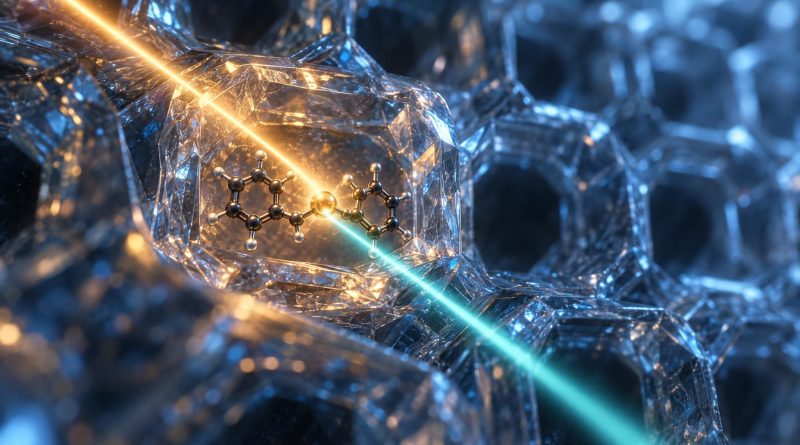
The molecule is di([1,1′-biphenyl]-4-yl)carbene, a triplet ground-state carbene with two unpaired electrons, embedded in an isosteric crystal of di([1,1′-biphenyl]-4-yl)methanone. Isosteric means the host closely matches the guest, so the molecule sits in a well fitted pocket. The team used a precursor-doped crystal at a 25 ppm doping ratio, cooled it to 4.5 K in a cryo-confocal microscope, then used a tightly focused laser to photoeliminate nitrogen and convert precursor molecules into the qubit. Thermal annealing followed to relieve local strain.
Single-molecule addressability was confirmed through photon statistics. The report a zero-delay coincidence dip of g(2)(0) = 0.142, with bounds of minus 0.023 and plus 0.169, below the 0.5 threshold used as an indicator of a single emitter. The optical resonance had a Lorentzian linewidth of 38(2) MHz, above the lifetime-limited 6.6(5) MHz, so much of the width reflects dephasing rather than the excited-state lifetime alone.
One measurement carries much of the argument. Repeated excitation spectra over more than an hour gave fitted centre frequencies for two distinct molecular lines with standard deviations of 2.4 MHz and 2.6 MHz. Slow intensity changes were attributed to relative drift between the microscope focus and the molecules. Emitters in a network must produce photons at compatible frequencies to interfere; hour-scale stability is what makes that plausible.
On the spin side, the report a Hahn-echo coherence time of 12.2(6) microseconds, a coherence time of 2.2(3) milliseconds under an XY8 dynamical decoupling sequence, and a spin-lattice relaxation time of 21(2) milliseconds. The gap between the first two figures is the point: the pulse sequence suppresses noise that would otherwise end coherence quickly. Spin-selective optical transitions, separated by about 1.555 GHz at minimum, let the spin state be addressed optically.
What the numbers leave unresolved
The system is not bright. The report net emission into the zero-phonon line of about 2.1 per cent, combining a photoluminescence quantum yield of 10.8 per cent and a Debye-Waller factor of 19 per cent, the share of emission that stays in that narrow line. They say this is comparable to solid-state defects such as the nitrogen-vacancy centre; that comparison is their own. Scinexx reports a total fluorescence quantum yield of about 11 per cent and notes that more efficient generation and collection of photons would matter in practice.
The molecules are also finite. The paper describes them as chemically stable at cryogenic temperatures but subject to photobleaching through a two-photon process, limiting their lifetime under continuous laser and microwave radiation to about 119 hours. Every measurement also sits at 4.5 K. It describes that as comparatively high for the platform, it remains cryogenic.
Demonstrated, proposed and declared
They propose that these materials’ processability, including use in ultrathin films, could support integration with photonic integrated circuits based on silicon nitride or lithium niobate, offering a route to on-chip routing of photons entangled with single-qubit molecules for quantum repeater nodes. Scinexx separately reports that NVision plans to work with the photonics company HyperLight to apply the molecules as thin layers on light-guiding chips, and that further integrated tests must show whether the approach works reliably. These are proposals and stated intentions, not demonstrated devices.
The paper’s competing interests statement is material context. It records that several named authors are employees of NVision Quantum Technologies, that some are shareholders, and that NVision is commercialising products in quantum information technology. Such a declaration is transparency, not evidence of misconduct, and does not undo peer review.
What remains open
The unresolved questions are specific. Do the properties survive in larger arrangements, where molecules may interact with neighbours and with a more complex host? Do they hold over longer link distances? Can photon collection improve without losing the spectral stability that makes the system interesting? Can any of it work above cryogenic temperatures? Scinexx reports that whether the properties persist in larger assemblies and over longer links remains open.
Peer review is not independent replication. The Nature paper, a DLR Quantum Computing Initiative page reproducing its abstract and a DLR-hosted copy of the same paper all describe one body of work, so they do not corroborate each other.
The defensible conclusion is narrow. A single molecular spin has been controlled and read optically, in a host built to keep its optical frequency steady, for long enough to be relevant to the network benchmarks reported in the paper. That is a real advance for molecular qubits, which had previously been studied optically only in bulk ensembles. It is not a node, a link or a chip. The next results to watch are entanglement between two separately addressed molecules and a device that places these emitters on a photonic circuit; those are the steps that would turn a single, well-behaved emitter into a network component.
A single stable emitter is a component, not a link, and the distance between those two ideas is mostly a question of architecture. What has to be addressed, matched, connected and repeated before separate parts can behave as one system? Networking study gives that question a durable shape, covering how connected systems and communication paths are arranged, where signals must agree and why one working element does not make a network. Readers who want to reason about systems rather than isolated parts can explore The Hack Academy’s online cybersecurity training programme, which lists networking among its subject areas, with self-paced learning and practical exercises alongside the theory.