
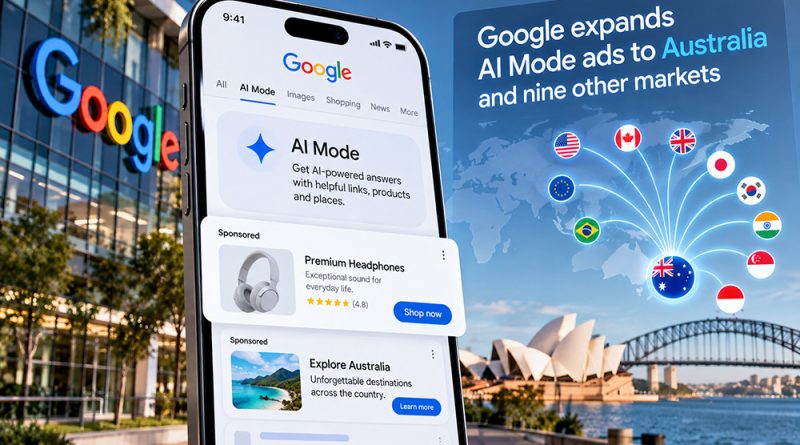
Google expands AI Mode ads to Australia and nine other markets
Google is expanding advertising in AI Mode to ten countries outside the United States, including Australia. The change, reported in late October around Alphabet’s third-quarter results, also brings multiturn ads to the US, where sponsored content can appear in follow-up queries during an AI Mode conversation.
The initial markets are Australia, Canada, India, Kenya, Malaysia, New Zealand, Nigeria, Pakistan, the Philippines and Singapore, according to Quartz, Search Engine Watch and 9to5Google. Google plans to add Brazil, Mexico and the United Kingdom in the fourth quarter of 2026. Ads will carry a Sponsored label, and Google says it will keep testing new formats.
What changes for users
AI Mode is Google’s conversational search feature. A user asks a question, receives an AI-generated answer and can continue the exchange with further questions. Advertising sits inside that experience. The US change alters where those ads can appear: multiturn ads allow sponsored content to enter a conversation after the first answer, rather than only alongside the initial query.
Australia is in the first group of markets, not a later addition. That makes the expansion a local product change rather than a distant US story. The reports do not give a separate Australian launch date, local ad frequency, pricing or user controls. For Australian users, the practical questions are how often sponsored results will appear, how clearly they will be separated from AI-generated answers, and whether any opt-out will exist. The available reports do not answer them.
The commercial logic
The financial context is clearer. Alphabet reported Google Search and other revenue of $63.35 billion in the third quarter, up 12% year on year, and total Alphabet revenue of $127.6 billion, up 25%. TechCrunch reported that Search advertising growth slowed from 17% in the second quarter and 19% in the first.
On the earnings call, Google chief business officer Philipp Schindler said AI Mode had lower monetisation than traditional Search and that strong growth in AI Mode queries had affected the bottom line for that reason, according to 9to5Google. The Verge also reported his lower-monetisation remark. He said the company felt good about its trajectory and was scaling ads, and The Verge reported that he described the ad experiments as promising. The reports did not give a product-level revenue comparison between AI Mode and traditional Search.
The expansion widens the advertising inventory available in ten markets and adds follow-up placements in the US. The timing points to a monetisation push, but the reports show timing and company remarks, not a causal finding. Google’s public statements, as relayed by the outlets, do not set out a formal rationale beyond the lower-monetisation remarks. The connection between slower Search growth and the decision is an inference, not an established cause.
Google’s claims and the missing evidence
Google’s public case rests heavily on its own performance claims. According to TechCrunch and Search Engine Watch, the company says its research shows users are comfortable with ads in AI Mode and find them relevant, and that click-through rates for sponsored product list items are already similar to those for organic product list items. Google did not share the underlying data, and Search Engine Watch noted that the comparison remains a company claim.
Executives have also offered engagement figures that make AI Mode look central to the future of search. Sundar Pichai, Google’s chief executive, said AI Mode queries average three times the length of traditional searches and that one in five AI Mode searches globally involve voice, images or documents, according to TechCrunch. He also said Search queries grew at their fastest year-on-year rate in five years, without disclosing the rate. These are company statements, not independent measurements, and they do not show how users in the new markets will respond to advertising.
Lack of independent data is not the same as evidence that the ads perform badly. It means the public case is incomplete. A Sponsored label makes a placement’s commercial nature visible. It does not, by itself, establish whether an ad is relevant, how often it appears, or how it is presented alongside the answer. The reports provide no independent user research from Australia or the other new markets, and none sets out a user opt-out.
Advertiser control and the open questions
For advertisers, the unresolved issue is control. Campaign US reported that eligible advertisers cannot opt out of placements across AI Overviews and AI Mode. That detail appeared in the report’s opening summary, and the report was not available beyond it. No other cited report substantiates the opt-out detail, so the extent of advertiser control remains unresolved. The expansion does, however, put more sponsored placements into AI Mode for advertisers to weigh.
The announced change is that AI Mode advertising will extend beyond the US in the markets Google has named. For Australian users, that means sponsored results are set to enter a search experience built around conversational answers, without a published local schedule, frequency or control scheme. The next useful evidence will be local: how the label works in practice, how often ads appear, and how users respond. Google’s planned fourth-quarter additions in Brazil, Mexico and the UK will show whether the expansion keeps its current pace.
The conclusion supported by the record is narrower than the commercial framing around the rollout. Google is widening the sponsored surface of AI Mode while the data behind its performance claims remains unpublished. That does not make the ads ineffective, and it does not make them harmful. It leaves the public, and advertisers in the new markets, to judge the rollout on Google’s account before independent evidence arrives.
A Sponsored label makes a commercial placement visible, but it does not answer the harder question: what evidence sits behind the claim that the placement works? That distinction between a marker and a verified measurement is useful well beyond search advertising. Cybersecurity fundamentals treats systems, access and evidence as things to examine for scope and provenance rather than accept because they are presented clearly. It is the kind of grounding that helps a reader ask which figures have been published, which remain company statements and what would count as independent confirmation. If that habit sounds worth building, The Hack Academy’s online cybersecurity training programme lists cybersecurity fundamentals among its subject areas, with self-paced learning and practical exercises alongside the theory.