
Cyber D-Day: The Warning Signs Of A Crisis That Could Bring The World To A Halt
Microsoft’s global outage, critical PHP vulnerabilities and America’s flight grounding are not evidence of a coordinated attack. They expose something dangerous enough without one: essential services dependent on systems whose failures can spread faster than organisations can recover.
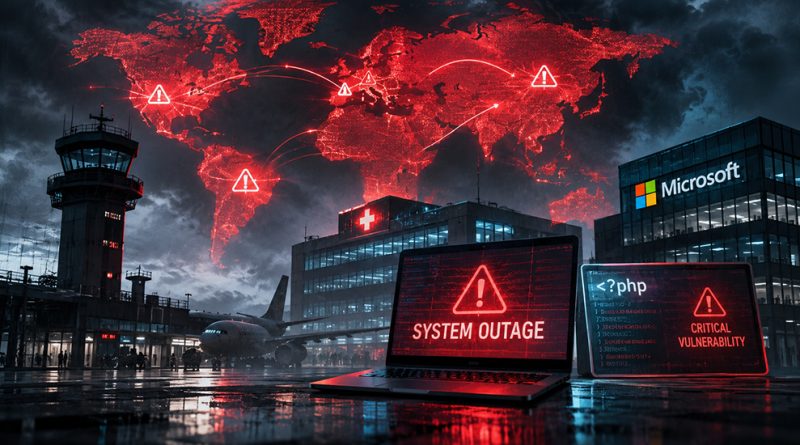
The warnings have arrived through different systems, in different forms, with consequences reaching far beyond the computer screen. Microsoft’s global outage interrupted communications relied upon by businesses and public services. Critical vulnerabilities in PHP prompted urgent patching instructions, followed by confirmation that attackers were exploiting them. Then a communications failure brought departing flights across the United States to a nationwide halt.
The US ground stop has since been lifted, and officials have reported no indication of a cyberattack. Microsoft has attributed its own disruption to a technical fault. The PHP vulnerabilities represent a different category of danger: documented weaknesses that can allow unauthenticated attackers to execute code on affected systems. These distinctions are essential, because proximity in the news cycle does not establish a common cause.
Yet dismissing the incidents as unrelated technical problems would miss the larger warning. Their causes differ, but each exposes a way in which essential activity can become dependent on technology that users cannot repair, readily replace or safely operate without.
A genuine “Cyber D-Day” would not require every computer on Earth to fail. It would require enough critical services to become unavailable, untrustworthy or impossible to coordinate at the same time. The consequences could spread through organisations that were never directly attacked.
That is a scenario to prepare for, not a conclusion established by this week’s events. The question is whether governments and businesses will investigate the dependencies now being exposed, or settle for reassurance when the screens begin working again.
Microsoft’s Outage Revealed The Difficulty Of Getting Back Online
Microsoft’s explanation points to an issue introduced during an earlier network capacity upgrade that emerged following a subsequent network change. The company said it restored services gradually, checking stability as capacity returned, and promised a full post-incident report. Its account describes a technical failure, not malicious activity.
The most troubling detail is not simply that servers became unavailable. During recovery, Microsoft reported that some servers initially appeared healthy after being restored, then became unresponsive again when traffic returned. Engineers restricted traffic in selected locations and tested systems rebuilt using an earlier software configuration.
This is where a serious outage becomes more than a broken component. Restoring a machine does not necessarily restore a functioning service. The machine must remain stable under the workload waiting for it.
Google’s site reliability engineering guidance describes how cascading failures can develop when work shifts from unavailable systems onto those still operating. The surviving infrastructure becomes overloaded, while newly restored capacity can fail again under renewed demand. This is an established failure mechanism, not an independent forensic finding about Microsoft’s incident.
The distinction matters because the first fault and the reason an outage continues may be different problems. A credible investigation must explain both.
Microsoft’s incident record also showed how the consequences extended through connected services. Alongside email and calendar problems, it identified effects on some administrative interfaces, security portal functions and policy-related processes. It did not describe a universal shutdown: most core Teams communications remained functional, and direct access to SharePoint files continued working.
For customers, the lesson is uncomfortable. Different applications do not necessarily provide independent protection. A business may appear to have several tools available while important functions within those tools depend on the same underlying service.
The danger is not merely losing an inbox. It is discovering that the inbox was also part of the machinery used to authorise work, communicate an emergency or coordinate recovery.
PHP Represents A Different Threat: A Door Attackers Can Open
The PHP emergency predates the November outages. On 21 October 2026, the PHP project released fixes for two critical vulnerabilities, CVE-2026-109618 and CVE-2026-109619. Its advisory warned that affected installations serving web requests were at risk, with a demonstrated attack against Apache’s mod_php configuration capable of reaching the vulnerable code before application-level processing began.
That places the problem beneath the website interface most people recognise. The vulnerable component is part of the software that executes web applications, rather than a suspicious email an employee might be trained to reject.
NHS England’s cybersecurity advisory assigned both vulnerabilities a critical severity score of 9.2. It described the potential for remote code execution or access to sensitive process memory and reported successful demonstrations involving applications integrating PHP, including WordPress, Drupal and Joomla. Those demonstrations do not mean every installation of those products has been compromised.
The warning subsequently moved beyond laboratory demonstrations. On 26 October, the US Cybersecurity and Infrastructure Security Agency added both vulnerabilities to its Known Exploited Vulnerabilities catalogue. Its announcement urged organisations to prioritise remediation of vulnerabilities in that catalogue.
This is the crucial difference between the PHP issue and the two major outages. The public evidence establishes exploitation of the PHP flaws. It does not establish that either flaw caused Microsoft’s disruption or the US flight grounding.
The exposure also cannot be measured simply by counting websites associated with PHP. Actual risk depends on the software build, deployment, configuration and remediation status. Canada’s Cyber Centre warned that internet-facing servers and applications were at heightened risk and advised organisations to identify vulnerable PHP components within third-party products, appliances and containers.
For an employer, retailer or public authority, that creates a practical accountability problem. Who knows which services contain the vulnerable component? Who is responsible for updating it? What evidence confirms that a supplier has completed the work?
A familiar website can conceal an unfamiliar software dependency. Outsourcing the hosting does not, by itself, answer those questions.
The Flight Grounding Showed What Happens When Information Cannot Be Trusted
At a briefing following the US grounding, the transportation secretary described instability affecting radar and communications systems. He said switches and routers had become overloaded with data and were producing inconsistent information. That remains an official preliminary explanation, not a completed technical reconstruction.
Microsoft separately told the Associated Press that it had no indication the flight grounding was connected to its own service disruption. There is no basis in that statement for treating the two events as one incident.
The significance lies elsewhere. A system does not have to be physically destroyed to become unusable for a safety-critical task. If operators cannot rely on the information reaching them, restricting operations can be the responsible decision.
That is not evidence that aircraft were hacked. It is an illustration of how the reliability of supporting information can determine whether physical activity continues.
The infrastructure concerns were already documented. A September 2024 Government Accountability Office report examined an FAA assessment that classified 51 of 138 air traffic control systems as unsustainable and another 54 as potentially unsustainable. These were historical assessments of maintainability and operational risk, not a list of systems that failed this week.
A separate GAO report published in September 2026 identified cybersecurity weaknesses involving aviation communications, including incomplete assessments of spectrum-related threats and gaps in monitoring. It also raised concerns about authentication, encryption and protocol design in applications used to exchange aviation information.
Those findings do not explain the November grounding. They establish that reliability and cybersecurity concerns existed before it.
The investigative question is therefore not whether an old audit can be repurposed as proof of a new attack. It is whether the risks already identified have been reduced, which safeguards operated during this failure and why the remaining disruption required such an extensive response.
The Common Danger Is Dependence, Not A Proven Conspiracy
The three developments expose different forms of dependence.
Microsoft’s incident concerns services sharing underlying infrastructure. The PHP vulnerabilities concern applications sharing vulnerable software. The aviation grounding concerns operations dependent on reliable communications and information. Their technical mechanisms should not be confused, but their organisational consequences invite the same question: what happens when the dependency becomes unavailable or unsafe?
This is not a newly invented concern. Responding to the Microsoft outage, the chair of the UK Parliament’s Science and Technology Committee warned about public services relying on a small number of technology providers. The committee’s criticism also concerned visibility: whether government could adequately account for its technology spending and supplier relationships.
Australia’s Critical Infrastructure Security Centre has described another dimension of the problem. At the launch of its 2026 annual risk review, officials warned that overlapping crises draw on the same limited people, budgets and resources. Their assessment emphasised that back-to-back disruption can weaken recovery capacity before the next incident arrives.
That is how separate incidents can become operationally connected without sharing an attacker.
An organisation could be restoring access to email while its technical team is also verifying emergency patches, answering customers and checking whether important messages were delivered. Add a transport interruption affecting staff or suppliers, and the pressure increases even if the underlying failures remain entirely independent.
The risk is not only that several systems fail. It is that the people expected to manage those failures are the same people.
What A Cyber D-Day Could Actually Look Like
A credible worst-case scenario is not a cinematic moment when every screen goes black. It is a sequence in which one disruption removes the alternatives needed to manage another.
Consider a hypothetical organisation whose primary communications service becomes unavailable. Its staff move to an emergency platform, only to discover that access depends on the same sign-in service. The contact list needed to coordinate a response is stored in an inaccessible location. Employees still have computers and internet connections, but the organisation has lost its agreed method of operating.
Now imagine that a supplier supporting a critical business process must suspend a service while investigating a compromise. Orders require manual confirmation. Customers seek updates through channels the organisation cannot reliably monitor. Temporary procedures begin accumulating work faster than staff can clear it.
A transport interruption need not have the same cause to make the situation worse. It could prevent specialist staff from reaching a site, delay replacement equipment or disrupt time-sensitive deliveries. What began as separate incidents could become a shared recovery problem.
This is a hypothetical chain of consequences, not a description of a coordinated attack currently underway. Its value is as a test: which organisations could continue their most important work under those conditions, and for how long?
Microsoft’s own continuity guidance recommends examining cascading dependencies and including people, suppliers, customers and facilities in that analysis. It also tells organisations to establish alternative communications before an incident, assess those alternatives for security and train employees to use them.
The broader crisis would emerge when enough organisations discover that their alternatives are not independent, their recovery resources are already committed and their suppliers face the same constraints.
Bringing “the world to a halt” is therefore better understood as a severe, cross-sector interruption than as the literal shutdown of every network. Essential services could become slow, restricted or unavailable across many regions without the entire internet disappearing.
The extent would depend on the systems affected, the duration, the availability of alternatives and the effectiveness of the response. These incidents provide reasons to examine that scenario. They do not provide a reliable prediction of its probability or timing.
Deliberate Disruption Is A Documented Threat
The absence of an established attack in the latest outages does not make the possibility of deliberate infrastructure disruption imaginary.
In a February 2024 joint advisory, US agencies and international partners warned that Chinese state-sponsored actors associated with Volt Typhoon were seeking to establish positions within critical infrastructure networks that could support disruptive or destructive operations during a major crisis or conflict. That was an official threat assessment about a separate campaign, not an attribution of this month’s incidents.
The distinction is vital. An accidental failure can demonstrate consequences that a malicious actor might also seek to produce, but that does not turn the accident into an attack.
For infrastructure owners, the defensible response is to prepare for both. Technical reliability measures should address equipment faults and unsafe changes. Cybersecurity measures should address unauthorised access, manipulation and deliberate destruction. Recovery arrangements need to work whichever category caused the interruption.
The dangerous conclusion would be that ruling out an attacker also rules out a security lesson. The equally dangerous conclusion would be that every serious outage proves hostile action.
Both can divert attention from the actual weaknesses that need repair.
Essential Services Have Already Felt The Effects
The consequences of Microsoft’s outage demonstrate why the issue cannot be confined to office productivity.
The UK’s National Pharmacy Association warned that the disruption affected pharmacies’ communication with doctors’ practices and some patients. It said waits could be longer and some prescriptions could be delayed. That was a warning about specific operational consequences, not evidence that pharmacies had ceased functioning.
NHS Supply Chain reported delays to patient referral forms and problems with email-based order communications. It also said its warehouses and transport operations were continuing normally, directing suppliers to retrieve orders through a separate portal and using telephone contact where necessary.
That example contains both the warning and part of the answer. A failed communication channel disrupted work, but alternative arrangements preserved important services.
The investigative task is to identify why those alternatives worked and whether they could sustain a longer interruption. A workaround that handles a few urgent requests may not have the capacity to replace a primary service for several days.
Likewise, technical recovery is not the same as operational recovery. Microsoft’s incident updates continued to address accumulated email queues and remaining effects after reporting sustained improvement. Restored access did not automatically mean that every delayed message had been processed.
For an affected organisation, the unresolved work still matters. Staff must determine which instructions arrived, which transactions were completed through another channel and which requests need to be followed up.
An outage ends at different times for the provider, the organisation and the person waiting for a service.
The Questions That Cannot Be Answered By An Apology
The investigations into the latest disruptions should produce more than a technical label and an assurance that normal service has resumed.
Microsoft’s report should explain how the earlier upgrade interacted with the subsequent change, why affected systems could not remain stable under returning traffic and which protections failed to contain the consequences. It should distinguish the initiating fault from the conditions that prolonged recovery.
The aviation investigation should establish the sequence of the communications failure, the role of alternative systems and the basis for decisions made during the grounding. The public does not need sensitive network configurations to understand whether backup arrangements performed as expected.
For organisations exposed to the PHP vulnerabilities, the questions are different. Have vulnerable installations been identified and patched? Were affected systems exposed before remediation? Has available evidence been reviewed for signs of compromise? Canada’s Cyber Centre specifically recommends reviewing relevant logs and investigating unexpected activity associated with PHP and web-server services.
Patching and investigating are separate tasks. Closing a vulnerability addresses future exploitation through that weakness; it does not, on its own, establish what happened before the fix.
At board and government level, the questions should become more operational. Which essential service must continue during a prolonged outage? Who has authority to activate alternatives? When were those alternatives last tested without the normal communications and access systems?
A supplier’s recovery promise is not a substitute for an organisation demonstrating what it can actually do while that supplier is unavailable.
The Next Failure Does Not Have To Become The Next Crisis
The response to these warnings should be urgent, but it should not be indiscriminate.
For the two PHP vulnerabilities, the PHP project identified fixed releases and advised immediate updating. It also recognised that some operating-system and long-term-support vendors provide backported fixes. Organisations therefore need confirmation of the relevant security fix, not assumptions based solely on a displayed version number.
For recovery planning, protected backups remain important, but their existence must be matched by a demonstrated ability to restore essential information. The UK National Cyber Security Centre recommends segregated or offline backups and retention arrangements that do not leave an organisation dependent on a single, potentially affected copy.
Continuity arrangements also need to preserve the instructions and communications used during recovery. Microsoft’s guidance recommends keeping critical documentation available offline and establishing alternative channels before normal services fail.
These measures are not glamorous. Neither are dependency maps, restoration exercises, accurate inventories and rehearsed manual procedures. Their value becomes visible when the usual systems are unavailable and somebody must still make a safe, authorised decision.
Nor does the answer have to be abandoning cloud services or duplicating every application. The practical challenge is to identify where an interruption would cause the greatest harm, then establish a sustainable alternative that does not disappear for the same reason.
A useful exercise would not merely ask whether staff can log in to a backup platform. It would ask whether they can complete the urgent order, confirm the patient-related enquiry, contact the supplier or coordinate an incident response without their normal tools.
The Warning Before The Catastrophe
Microsoft’s outage, the PHP vulnerabilities and the US flight grounding should not be combined into a fictitious account of one global cyberattack. The evidence supports separate events, different mechanisms and different investigative questions.
Their shared significance is that they force a harder examination of dependence. The issue is not simply whether a system can fail. It is whether essential activity can continue when it does, and whether the arrangements intended to support recovery remain available under pressure.
A Cyber D-Day is not inevitable. Nor has one been demonstrated by these incidents. But the possibility of a severe, compounding digital crisis should no longer be treated as a scenario that can be left to a continuity document nobody has tested.
The most dangerous moment may come after recovery, when the pressure to investigate fades because the immediate inconvenience has ended.
The world does not need to lose every computer to experience a crisis. Enough organisations could simply lose the ability to coordinate, verify and deliver their most important work at the same time. Preventing that outcome requires more than waiting for the next service-status update to turn green.
For readers, these warnings are a reason to turn concern into preparation by undertaking The Hack Academy’s online cybersecurity training programme. Strengthening your cybersecurity knowledge can help you recognise threats, understand the importance of timely updates and ask better questions about the cloud services, suppliers and recovery arrangements you depend on. Whether you are a student, employee or business owner, developing these skills is a practical step towards making more informed security decisions. The time to build that understanding is before essential systems fail, not while you are struggling to get them working again.