
AI-Powered Phishing Attacks Use Instagram Posts to Create Convincing Personalised Scams, Researchers Warn
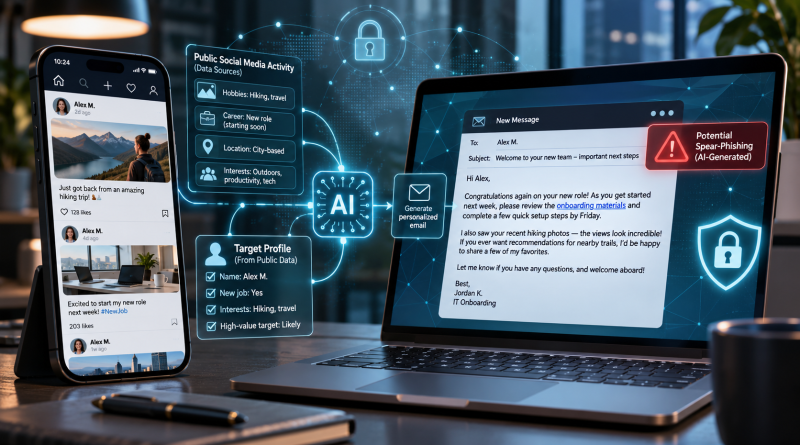
Cybersecurity researchers have demonstrated how artificial intelligence can transform publicly available Instagram posts into highly personalised phishing emails, raising concerns about the growing sophistication of online scams and the ability of traditional security measures to detect them.
A study conducted by researchers from the University of Texas at Arlington and Louisiana State University found that generative AI could analyse social media activity to create targeted phishing messages that participants in a controlled experiment considered more convincing and less suspicious than real-world phishing examples.
The research, detailed in a paper titled Context-Aware Spear Phishing: Generative AI-Enabled Attacks Against Individuals via Public Social Media Data, examined how information shared openly on social media could be used to construct convincing fraudulent communications without requiring attackers to compromise an individual’s account.
The paper, submitted to the research repository arXiv on 11 May 2026 and revised on 30 September, was subsequently highlighted in November reporting by Fox News and cybersecurity publications. Its findings demonstrate how existing artificial intelligence tools could make targeted phishing campaigns easier and less expensive to produce, although the researchers did not conduct live attacks or establish how frequently the techniques would succeed outside controlled conditions.
The investigation adds to growing concerns that generative AI is changing the nature of social engineering, allowing cybercriminals to move beyond generic fraudulent messages towards communications that incorporate genuine details about a recipient’s personal life.
How Public Instagram Posts Become Phishing Material
The researchers examined publicly accessible activity from 200 Instagram users, using the information to develop a framework capable of generating personalised phishing messages. According to cybersecurity publication Help Net Security, the team produced approximately 18,000 emails using five large language models: GPT-4, Claude 3 Haiku, Gemini 1.5 Flash, Gemma 7B and Llama 3.3.
The system analysed information contained in social media posts, including images, captions and other publicly available details, to develop profiles of individual users. It then used those profiles to construct messages that reflected the recipient’s apparent interests, activities and communication patterns.
Rather than generating conventional phishing emails containing generic warnings or offers, the framework incorporated personal context to make each message appear more relevant to its intended recipient. A person’s travel photographs, entertainment preferences or references to particular events could potentially provide sufficient background for a fraudulent message that appeared connected to something already happening in their life.
The researchers examined seven social engineering strategies, including impersonation, baiting, scareware and quid pro quo techniques, in which an attacker offers something in exchange for information or another action. By combining these established methods with personal details extracted from social media, the system could generate messages designed to exploit a recipient’s familiarity with the subject matter.
Importantly, the experiment relied on information already available to the public. The researchers did not need to gain unauthorised access to Instagram accounts or bypass the platform’s security protections.
That distinction highlights one of the central risks associated with social media exposure. Information that appears harmless when published individually can become considerably more revealing when collected, analysed and combined with other details.
AI-Generated Emails Prove Harder to Identify
To assess how convincing the generated messages appeared, the researchers recruited 70 participants through the online research platform Prolific.
Participants were shown AI-generated phishing emails alongside examples drawn from datasets maintained by the Anti-Phishing Working Group, an international organisation that collects and analyses phishing activity.
According to Help Net Security, participants generally found the AI-generated messages more difficult to identify as suspicious than the real-world phishing examples used for comparison. Some generated messages were also rated as less suspicious than legitimate emails included in the experiment.
The researchers reported that their AI-generated emails outperformed examples from the APWG eCrimeX dataset across eight assessment dimensions, suggesting that contextual personalisation could make fraudulent communications appear more credible.
However, the findings require careful interpretation. The experiment measured participants’ perceptions of suspicious messages rather than their behaviour when encountering a phishing attempt in an actual email inbox.
Participants were not required to decide whether to click a link, download an attachment, disclose credentials or complete a financial transaction. Consequently, the study does not establish the rate at which recipients would fall victim to these attacks under real-world conditions.
The researchers acknowledged that actual success would depend on how individuals respond when receiving unexpected communications in everyday circumstances.
Nevertheless, the results indicate that personal relevance may be a significant factor in determining whether a phishing message attracts suspicion, even when the content is generated automatically.
Just a Handful of Posts Can Provide Valuable Context
One of the more concerning observations from the research was the relatively small amount of social media information required to produce convincing personalised messages.
Fox News reported that as few as ten publicly available Instagram posts could provide sufficient context for AI-generated phishing attempts. Help Net Security offered a more detailed account, noting that the largest improvements in personalisation occurred within the first several posts analysed.
According to that reporting, the benefits began to level off after approximately five posts, while the researchers identified ten to fifteen posts as a practical amount of information for generating personalised campaigns at scale.
These findings do not establish a universal threshold at which a social media profile becomes vulnerable. The usefulness of publicly available information depends on what an individual shares, how specific those details are and whether they can be connected to a plausible fraudulent scenario.
However, the research suggests that attackers may not need access to extensive personal histories to create targeted communications. A relatively small collection of photographs, captions and public interactions may provide enough information for an AI system to develop a convincing narrative.
The implications extend beyond Instagram. Although the experiment focused on that platform, people routinely publish information about employment, travel, shopping, relationships and personal interests across multiple online services.
The study did not test other social media platforms, but it illustrates how publicly accessible information can become a resource for sophisticated social engineering.
AI Safety Systems Show Mixed Results
The research also examined whether existing AI safety mechanisms could identify attempts to generate personalised phishing content.
According to Fox News and BGNES, the researchers tested three safety models: Llama Guard, ShieldGemma and WildGuard.
Under their default configurations, the systems reportedly detected between zero and 19 per cent of the requests designed to generate context-aware phishing messages.
The results suggest that general-purpose content moderation systems may struggle to identify malicious intent when requests resemble ordinary writing assistance or incorporate legitimate personal information.
However, performance improved substantially when the detection systems were specifically configured to recognise context-aware phishing techniques. Under those conditions, detection rates reportedly reached as high as 99 per cent in the controlled tests.
Help Net Security also reported promising results from a separate classifier based on the RoBERTa language model, which was designed to identify suspicious prompts before phishing messages were generated.
These findings demonstrate the importance of how AI safety tools are configured and evaluated. A system that performs poorly against an unfamiliar technique under default settings may become considerably more effective when trained or adjusted to recognise the relevant patterns.
The results should not be interpreted as a comprehensive assessment of the safeguards used by commercial AI providers. The research tested specific models and configurations rather than independently auditing every security mechanism deployed across consumer-facing AI services.
The researchers also reportedly withheld the exact attack prompts to avoid publishing instructions that could make the techniques easier to reproduce.
Another significant finding concerned the resources required to generate personalised messages. Help Net Security reported that the research framework could produce phishing emails within seconds at a cost of less than one cent per message.
If similar efficiencies were achieved outside the laboratory, they could reduce the financial and technical barriers associated with large-scale targeted phishing campaigns.
How AI Is Changing Social Engineering
Although generative AI can substantially improve the presentation and personalisation of phishing messages, the underlying methods are not new.
Cybercriminals have long used publicly available information to impersonate trusted contacts, create false urgency and persuade victims to disclose sensitive information.
Traditionally, highly targeted spear-phishing campaigns required attackers to spend time researching potential victims and manually developing convincing messages.
Generative AI introduces the possibility of automating much of that process, potentially allowing personalised communications to be produced for large numbers of individuals with substantially less effort.
Sweden’s National Cybersecurity Centre has identified artificial intelligence as a technology likely to amplify existing cyber threats, including phishing and deepfake-enabled fraud, while reducing the technical expertise required to conduct certain malicious activities.
Cybersecurity firm Mjolnir Security has similarly described AI-assisted phishing as an evolution of established social engineering methods, with improved language quality and personalisation making fraudulent communications harder to distinguish through traditional warning signs.
These broader assessments are consistent with the direction of the Instagram research, although they do not independently validate its experimental results.
For individuals and organisations, the implications are significant. Cybersecurity awareness campaigns have historically encouraged people to look for spelling mistakes, unusual grammar and poorly formatted emails as indicators of potential scams.
While those warning signs remain useful when present, modern AI systems can generate polished messages with convincing language, professional formatting and relevant personal details.
As a result, the absence of obvious mistakes should no longer be regarded as meaningful evidence that a message is legitimate.
Why Personal Details Do Not Prove Authenticity
The findings reinforce an increasingly important principle in cybersecurity: a message containing accurate personal information is not necessarily genuine.
An unexpected email that mentions a real holiday destination, recent purchase, workplace event or upcoming concert may appear credible because the details are familiar to the recipient.
However, those details may have been obtained from public social media profiles, online directories or other accessible sources rather than from someone with a legitimate relationship to the recipient.
Security experts therefore recommend verifying unexpected requests through independent communication channels, particularly when a message involves passwords, payment details, account access or sensitive information.
Rather than following a link contained in a suspicious email, recipients should navigate directly to the organisation’s official website or application. Where a message claims to come from a colleague, financial institution or service provider, its authenticity should be confirmed using independently established contact details.
Individuals can also reduce unnecessary exposure by reviewing the visibility of their social media profiles, older posts and location information.
Delaying the publication of travel updates, limiting publicly available contact details and reconsidering what information is shared openly can make it more difficult for strangers to build detailed personal profiles.
These precautions cannot eliminate phishing risks, particularly where personal information has already been collected or redistributed, but they can help limit the material available for targeted attacks.
Strong account security remains equally important. Unique passwords, password managers and multifactor authentication provide additional protection, while phishing-resistant methods such as passkeys and physical security keys can reduce the effectiveness of credential theft.
Users should also avoid sharing verification codes with anyone who contacts them unexpectedly and keep devices and applications updated to address known security vulnerabilities.
Organisations Need to Look Beyond Traditional Email Warnings
For businesses, the research highlights the limitations of relying solely on employee awareness to identify suspicious communications.
Well-written phishing emails that incorporate genuine personal or professional details may be difficult to assess, particularly when they imitate familiar business processes.
Organisations can reduce exposure by combining staff training with technical controls designed to identify suspicious senders, fraudulent domains and unusual requests.
Email authentication technologies such as SPF, DKIM and DMARC can help protect against certain forms of domain impersonation, although they do not prevent every phishing technique.
Additional measures, including monitoring for look-alike domains, enforcing phishing-resistant multifactor authentication and independently verifying changes to payment instructions, can reduce opportunities for attackers to exploit convincing messages.
Security awareness training should also reflect the changing nature of phishing. Employees need to understand that professional language, accurate contextual information and familiar names are no longer reliable indicators of authenticity.
Regular security assessments can help organisations determine whether their existing controls remain effective against emerging techniques, while authorised phishing simulations can provide insight into how staff respond to suspicious communications.
However, the Instagram study did not directly evaluate these defensive measures. Their effectiveness should therefore be assessed through appropriate testing rather than assumed from the research findings.
The Importance of Testing Cybersecurity Defences
The research provides further evidence that generative AI can make established social engineering techniques more sophisticated and accessible. However, it also demonstrates the importance of distinguishing between a successful laboratory experiment and an attack that has been observed causing harm.
The study involved 200 public Instagram profiles and 70 participants in a controlled assessment. It did not document a live phishing campaign, compromised accounts, financial losses or confirmed victims.
The research was also published as a preprint, meaning its findings should be interpreted in the context of the available methodology and the need for further independent assessment.
Nevertheless, its conclusions raise important questions about how individuals recognise fraudulent communications and how organisations evaluate the effectiveness of their security protections.
Perhaps the most encouraging finding is that detection performance improved substantially when safety systems were configured specifically to identify context-aware phishing attempts. This suggests that security controls can adapt to emerging techniques, provided organisations understand the threats they are attempting to address and test their defences accordingly.
As artificial intelligence continues to influence both cybercrime and cybersecurity, the ability to conduct structured, authorised security assessments will become increasingly important.
For individuals considering a career in cybersecurity, understanding how attacks operate, how vulnerabilities are identified and how defensive controls are evaluated provides a foundation for working in this rapidly evolving field.
Practical training in penetration testing, security analysis and ethical hacking can help develop those skills, combining technical knowledge with controlled exercises designed to examine weaknesses without placing real systems or users at risk.
The findings ultimately reinforce a fundamental lesson: personal familiarity should never be confused with digital authenticity. AI-generated communications can incorporate convincing details from someone’s everyday life without having any legitimate connection to that individual.
For organisations, maintaining effective protection will require a combination of technical safeguards, employee awareness and regular testing. For individuals, the priority remains limiting unnecessary information exposure and independently verifying unexpected requests, regardless of how convincing they appear.
Those interested in developing practical cybersecurity skills can explore The Hack Academy’s online cybersecurity training programme, which offers self-paced courses covering penetration testing, advanced penetration testing and other cybersecurity disciplines, combining theoretical knowledge with practical learning in controlled, authorised environments.