
Anthropic Launches Claude Fable 5.2 and Mythos 5.2 With Lower Prices and Advanced Security Restrictions
Artificial intelligence company Anthropic has unveiled two powerful new AI models, Claude Fable 5.2 and Claude Mythos 5.2, introducing significant improvements in coding, reasoning and scientific research while reducing API pricing by 20 per cent. The release also establishes a clear distinction between broadly accessible AI capabilities and advanced cybersecurity functionality reserved for verified organisations.
Announced on 9 November 2026, the models represent the latest development in Anthropic’s expanding Claude family, with the company positioning them as specialised tools for demanding technical work, complex research and long-running autonomous AI tasks.
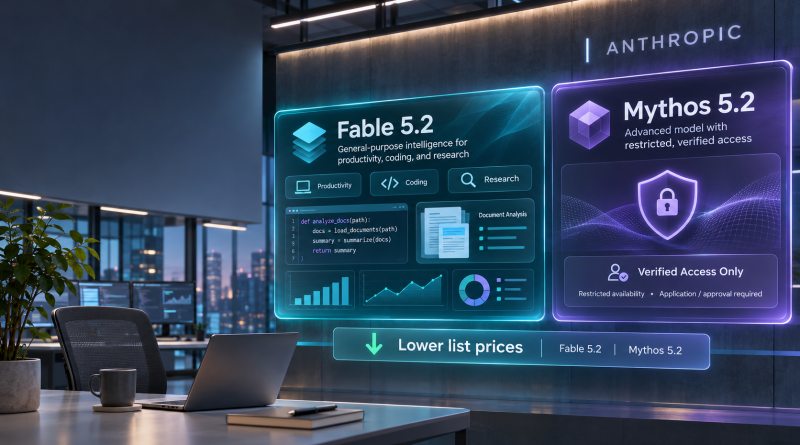
Although Fable 5.2 and Mythos 5.2 are built on the same underlying AI model, they operate under different access and safety arrangements. Fable 5.2 is available to general customers with additional safeguards restricting certain sensitive activities, while Mythos 5.2 is reserved for approved organisations working in areas such as cybersecurity and biomedical research.
Anthropic says the new releases offer improved performance across software engineering, advanced reasoning and visual analysis, while generating responses up to 30 per cent faster than their immediate predecessors. The company has also reduced standard API prices from US$10 to US$8 per million input tokens and from US$50 to US$40 per million output tokens.
The announcement comes amid increasingly intense competition between AI developers seeking to attract enterprise customers, software engineers and research organisations. As models become more capable of independently completing complex tasks, their cost, reliability and security restrictions are becoming important considerations for businesses deciding how to deploy them.
Stronger AI Capabilities at a Lower Cost
A central feature of the announcement is Anthropic’s decision to reduce the cost of accessing its most advanced specialised models while improving their technical capabilities.
Both Claude Fable 5.2 and Mythos 5.2 are priced at US$8 per million input tokens and US$40 per million output tokens, representing a 20 per cent reduction compared with the previous Fable 5.1 and Mythos 5.1 releases.
Input tokens represent the information supplied to an AI model, including instructions, documents and conversation history. Output tokens represent the text and other supported content generated in response. For organisations processing large volumes of information or running complex automated workflows, token pricing can have a significant influence on operating costs.
The new models support a context window of one million tokens and a maximum output of 128,000 tokens. These specifications allow them to process substantial amounts of information within a single interaction, supporting tasks such as examining large codebases, analysing extensive document collections and coordinating complex research projects.
Anthropic has also introduced an optional fast mode capable of increasing token generation speed by up to 2.5 times. The higher-performance setting costs US$16 per million input tokens and US$80 per million output tokens, effectively doubling the standard token prices in exchange for faster generation.
The company says the combination of lower base pricing and improved efficiency could make advanced AI systems more economical for organisations undertaking computationally demanding projects.
However, the advertised improvements are based primarily on Anthropic’s own evaluations and prerelease testing. Real-world performance and cost savings will depend on the nature of individual workloads, the amount of processing required and how effectively organisations integrate the models into existing systems.
Claude Fable 5.2 Targets Complex Coding and Research
Claude Fable 5.2 has been developed for technically demanding work that may require extended reasoning, multiple coordinated steps and sustained interaction with software tools.
Anthropic says the model performs particularly well in software engineering, scientific analysis, hardware development and tasks involving autonomous AI agents. Rather than simply responding to individual prompts, such systems can be configured to plan and execute sequences of activities, review their own work and coordinate additional AI processes.
In one internal experiment, Anthropic used an earlier version of Fable 5.2 to migrate a critical production service from Python to Rust. The company reported that the resulting system was more reliable, more efficient and approximately 26 times faster to start.
Another experiment involved asking Fable 5.2 to develop a prototype operating system from an initially empty project directory. According to Anthropic, the model coordinated more than 1,000 AI subagents over eight days, producing software capable of booting on a laptop and supporting functions including file storage, networking, windows and user authentication.
The company also reported progress in scientific and engineering applications, including the design of three functioning electronic devices and the formalisation of Fermat’s Last Theorem into a computer-checkable mathematical proof.
In the mathematical experiment, approximately 1,000 AI agents reportedly completed the formalisation in 30 hours, substantially reducing the time required compared with an earlier attempt.
These examples illustrate the scale of work Anthropic believes its new models can support, although they should be understood as reported experimental achievements rather than guarantees of comparable performance in commercial environments.
The broader significance lies in the shift towards AI systems capable of completing extended technical assignments with less continuous human intervention. Such capabilities could reduce the time required for certain development and research activities while increasing the importance of verification, oversight and quality assurance.
Mythos 5.2 Introduces Restricted Cybersecurity Access
While Fable 5.2 is intended for broad availability, Claude Mythos 5.2 is designed for organisations requiring advanced capabilities in sensitive technical fields.
Anthropic describes Mythos 5.2 as its most capable model for cybersecurity engineering, with improved performance in vulnerability identification, reproduction and remediation.
The model shares the underlying capabilities of Fable 5.2 but operates without some of the additional cybersecurity and biological safeguards applied to the generally available version.
Those differences are significant because advanced AI systems can potentially assist both legitimate security researchers and malicious actors.
A model capable of identifying complex software vulnerabilities may help defenders discover weaknesses before they are exploited. However, similar capabilities could also be misused to develop attacks against systems without authorisation.
To address that risk, Anthropic has restricted Mythos 5.2 to organisations approved through its verification programmes, including the Cyber Verification Program and Life Sciences Verification Program.
Eligible cybersecurity professionals and research organisations can apply for access, while Claude Enterprise customers may also use certain Mythos capabilities through Claude Security, Anthropic’s code vulnerability analysis service.
The access model reflects an attempt to balance the benefits of advanced technical AI with the risks associated with unrestricted use.
Rather than making every capability available to the general public, Anthropic is separating sensitive functionality from the wider consumer and developer experience.
Improved Vulnerability Detection Raises New Security Questions
Anthropic’s internal testing suggests that Mythos 5.2 offers measurable improvements in identifying known software vulnerabilities.
In its CVE Rediscovery evaluation, which examines whether an AI model can independently identify previously documented vulnerabilities in earlier versions of software, the company reported that Mythos 5.2 detected approximately 14.4 per cent more vulnerabilities than Mythos 5.1 and 10.2 per cent more than Claude Opus 5.5.
The benchmark uses software snapshots from before identified vulnerabilities were repaired, allowing researchers to assess whether a model can recognise weaknesses that were subsequently documented through the Common Vulnerabilities and Exposures system.
According to Anthropic, the latest model also demonstrated improved judgement when assessing the severity of potential vulnerabilities, reducing instances in which findings were overstated.
Although the results suggest progress in AI-assisted security analysis, they do not establish that Mythos 5.2 will identify every vulnerability or outperform specialist security tools in every environment.
Vulnerability research involves more than recognising suspicious code. Findings must be reproduced, assessed for practical exploitability and evaluated within the specific circumstances of the affected system.
False positives can consume valuable investigative resources, while overlooked vulnerabilities may remain exposed even after an automated security assessment has been completed.
Anthropic’s reported improvements therefore represent a potential enhancement to existing cybersecurity practices rather than a replacement for experienced security professionals.
The development also raises broader questions about the distribution of advanced cyber capabilities. Restricting access may reduce opportunities for misuse, but it places greater responsibility on the provider to determine which organisations are eligible and how the technology is monitored after approval.
Balancing AI Performance With Safety Controls
Anthropic has placed considerable emphasis on the safeguards accompanying its latest models, particularly as their technical capabilities expand.
Claude Fable 5.2 includes additional safety classifiers intended to restrict high-risk activities involving cybersecurity and biological research. These include certain penetration testing tasks, exploit generation and sensitive biological applications.
Where a request is restricted, Anthropic provides mechanisms for declining the request or directing supported tasks to another Claude model operating under different safeguards.
The company says its latest safeguards have become more selective, reducing unnecessary blocking while maintaining protections against potentially harmful requests.
During early testing across Claude applications, Claude Code and Cowork, Anthropic observed approximately 55 per cent fewer blocked requests compared with Fable 5.1. The company reported particularly substantial reductions in cybersecurity-related and biological research restrictions.
These figures represent Anthropic’s assessment of its own safety systems and do not independently establish their effectiveness against every form of misuse.
The company also conducted additional testing examining whether the models might attempt to circumvent operating restrictions, misrepresent their own behaviour or access information outside authorised environments.
According to Anthropic, the models generally performed as well as or better than earlier releases across most of its alignment evaluations.
However, the company acknowledged that developing tests capable of identifying every potentially harmful behaviour before deployment remains an unresolved challenge.
That uncertainty is particularly relevant as AI systems become more capable of completing lengthy assignments, using external tools and performing tasks with reduced human supervision.
New Data Retention Requirements for Advanced Models
The release also introduces important considerations for organisations handling confidential information.
Anthropic has designated both Fable 5.2 and Mythos 5.2 as Covered Models, a classification applied to certain advanced systems that require additional monitoring and security protections.
Under the standard arrangements, these models require a 30-day data retention period to support the detection of potentially harmful patterns across multiple interactions.
This represents a significant consideration for organisations that ordinarily operate under zero-data-retention agreements or strict internal privacy requirements.
Anthropic has introduced an Enterprise Frontier Safeguards programme, currently in private beta, intended to support eligible organisations that require stronger data control while using advanced models.
The programme is designed to allow automated safety monitoring within a customer’s own infrastructure rather than requiring all monitored information to be retained through Anthropic’s standard arrangements.
Certain exceptions to the normal retention requirements may therefore be available with explicit authorisation.
For businesses considering deployment, these conditions mean that the technical capabilities and lower pricing must be assessed alongside privacy obligations, contractual requirements and internal data governance policies.
Organisations working with sensitive customer information, proprietary software or regulated research will need to establish whether the available configurations meet their security and compliance requirements.
Availability Across Major Cloud Platforms
Claude Fable 5.2 is now available through Anthropic’s Claude applications and developer platform, alongside supported services from Amazon Web Services, Google Cloud and Microsoft.
Developers can access the model through the Claude API using the identifier claude-fable-5-2, allowing it to be integrated into supported applications and automated workflows.
Mythos 5.2 is also supported through selected enterprise and cloud environments, but access remains subject to organisational verification.
Anthropic has introduced temporary additional Fable usage allowances for eligible paid subscribers as part of the launch, although limits depend on the applicable subscription and account arrangements.
The company is positioning the new models above its standard Claude Opus, Sonnet and Haiku offerings for particularly demanding technical tasks.
For everyday coding, writing and knowledge-based work, Anthropic continues to recommend Claude Opus 5.5 as the starting point, with Fable and Mythos intended for workloads that require more extensive capabilities.
This approach reflects an increasingly differentiated AI market in which developers are offering specialised models for different levels of complexity, operational cost and security sensitivity.
What the Release Means for the AI Industry
The introduction of Claude Fable 5.2 and Mythos 5.2 illustrates two increasingly important developments in artificial intelligence: the growing ability of AI systems to perform complex technical work and the emergence of more restrictive access arrangements for capabilities considered sensitive.
For software developers and research organisations, improved performance and lower API pricing could make advanced automated workflows more practical.
Tasks that previously required substantial manual coordination may increasingly be supported by AI systems capable of planning, executing and reviewing multiple stages of a project.
However, greater autonomy also introduces additional risks, particularly where models interact with production software, confidential information or infrastructure that could be affected by incorrect decisions.
The distinction between Fable and Mythos demonstrates how AI companies are attempting to manage these risks through differentiated access rather than applying identical restrictions to every customer.
The strategy also reflects the commercial importance of cybersecurity and scientific research, where advanced AI capabilities may deliver substantial benefits but require stronger safeguards.
As competition between Anthropic, OpenAI, Google and other developers intensifies, model performance alone is unlikely to determine which technologies organisations adopt.
Pricing, reliability, security controls, privacy arrangements and the ability to integrate AI into existing workflows will also play important roles.
For cybersecurity professionals, the development reinforces the growing importance of understanding how AI can support vulnerability discovery, software analysis and defensive security operations while recognising the limitations of automated assessments.
Although systems such as Mythos 5.2 may assist with complex technical investigations, their findings still require appropriate verification, authorisation and professional oversight.
The release of Claude Fable 5.2 and Mythos 5.2 therefore represents more than a conventional model upgrade. It highlights the increasingly complex relationship between AI capability, accessibility and security, as developers seek to make advanced systems commercially useful while limiting the risks associated with their misuse.
As artificial intelligence becomes more deeply integrated into software development and cybersecurity, the need for skilled professionals capable of evaluating its outputs and understanding the systems it interacts with will continue to grow.
For those interested in developing practical cybersecurity skills, The Hack Academy’s online cybersecurity training programme offers self-paced learning in penetration testing, advanced penetration testing and related cybersecurity disciplines, combining technical knowledge with practical exercises conducted in controlled, authorised environments.