
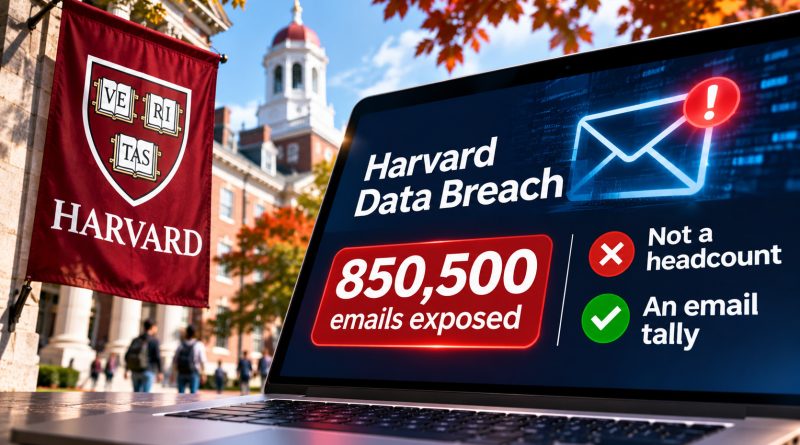
Harvard’s 850,500 breach figure is an email tally, not a headcount
Have I Been Pwned (HIBP) added Harvard University’s November 2025 Alumni Affairs and Development breach to its service on 3 November 2026. Its entry lists 850.5k affected addresses and describes the data as 851k unique email addresses. The listing is a new public analysis of an older breach. It is not a new Harvard disclosure, and the figure does not establish that 850,500 people were affected.
HIBP’s own overview presents 850.5k affected addresses and its prose describes 851k unique email addresses relating to Harvard’s alumni and fundraising systems. eSecurity Planet cautioned that this is a count of unique email addresses, not a confirmed number of individuals, and that the listing does not establish which details were exposed for each person.
A breach confirmed in 2025
Harvard confirmed in November 2025 that its Alumni Affairs and Development systems had been compromised after a phone-based phishing attack. BleepingComputer, eSecurity Planet and TechRadar reported that the university discovered unauthorised access on 18 November 2025.
The affected systems held information about alumni, donors, some faculty and staff, some current students, and their spouses, partners and parents. Current and former students were also reported affected. Harvard said the data included email addresses, telephone numbers, home and business addresses, event attendance records, donation details and biographical information related to university fundraising and alumni engagement.
Harvard’s vice president and chief information officer, Klara Jelinkova, said the breached systems did not store Social Security numbers, passwords, payment card information or financial information, according to BleepingComputer and TechRadar. eSecurity Planet reported that the notice said the systems did not generally contain those categories. Harvard’s 22 November 2025 notification email, as reported by eSecurity Planet, said the university had not determined precisely what information was accessed, had removed unauthorised access and had found no evidence of further unauthorised access.
What the database actually adds
HIBP’s entry says the data included extensive profile information for donors, alumni, parents and some faculty, staff and students. Press reports citing the listing describe fields including names, dates of birth, phone numbers, postal addresses, social media profiles, employers and donation information, as well as citizenship status, ethnicity and family members’ names. The Register noted that these data points may not have been collected about every individual. eSecurity Planet made the same point about records, adding that not every record necessarily contains every category.
The service is a breach-notification resource, not a regulator. Its entry is HIBP’s own analysis of the dataset, not an independent audit of Harvard’s account. It does not prove that every listed address belongs to a distinct person, or that each person’s record contains every field reported in the press.
Claim, leak and an unresolved attribution
ShinyHunters claimed responsibility and said it stole more than one million records containing personal information and donation data. Harvard has not publicly attributed the attack to the group. HIBP describes the breach as later linked to a ShinyHunters pay-or-leak extortion attempt, a characterisation that goes beyond Harvard’s public position.
In early February 2026, ShinyHunters published a 1.1GB archive after ransom negotiations broke down, according to BleepingComputer, which reported that Harvard refused to pay. eSecurity Planet, citing BleepingComputer, reported the group’s claim that the archive contained more than one million records, and said TechCrunch had reported verifying some of the published information.
The group’s record claim and HIBP’s unique-email tally use different units. They should not be treated as a direct contradiction, nor as confirmation of each other. The record claim remains unverified.
What the data changes for alumni and staff
eSecurity Planet said the sources it cited did not report confirmed phishing campaigns using the dataset. It did assess that detailed donor, alumni and family information could help someone impersonate university representatives and make fraudulent emails or calls harder to distinguish from legitimate outreach. That is a risk assessment, not evidence of observed misuse.
The profile data also limits how much comfort Harvard’s exclusions provide. A password can be reset. A donation history, an employer, a family connection or a past event attendance record cannot. Such details can make a fraudulent message about an alumni event, a pledge or an account update appear better informed.
For alumni and donors, eSecurity Planet’s guidance is specific. Check relevant email addresses at HIBP, but read a match as confirmation that the address appears in the dataset, not proof that a password was stolen. Treat unexpected fundraising, account-verification or payment requests as suspicious, and verify them through Harvard contact details found independently rather than through details supplied in the message.
For university IT and advancement teams, the same guidance calls for reviewing who can access and export alumni records, restricting bulk downloads, strengthening authentication for staff who handle donor databases and training help desks to challenge callers seeking access or account changes. The original intrusion was phone-based, according to Harvard’s reported account.
Separate incidents, separate questions
Reporting placed Harvard alongside other university breaches, but they should not be merged. BleepingComputer said Princeton University and the University of Pennsylvania disclosed separate data breaches in November 2025, both confirming that donor information was accessed.
Harvard separately investigated an October 2025 Clop claim involving an Oracle E-Business Suite zero-day and was later affected by a May 2026 Instructure Canvas incident. Reporting describes those as separate from the Alumni Affairs breach. The Canvas incident involved a different platform, and eSecurity Planet said there was no established connection to the alumni and donor data breach.
The central unanswered question is not whether the dataset exists, but what it means for the people in it. The exact number of individuals remains unknown, and the listing does not show each person’s exposed fields. No confirmed misuse has been reported, nor has Harvard publicly named the group, and the reporting reviewed did not include a Harvard response to the November 2026 listing.
For anyone with Harvard ties, the useful test is narrower than the headline number. Does an address appear in the dataset, and can a message that cites genuine Harvard details be verified through an independent channel? The first question is an HIBP lookup. The second is the one that may prevent a convincing impersonation from becoming a successful one.
An email address in a leak tells you that an identifier appears in a dataset, not who holds it, and a group’s claim of a million records does not become a million people. Keeping identifiers, records and individuals in separate columns is basic hygiene when reading breach news, and it is the same discipline that stops a claimed intrusion from hardening into a confirmed attribution while Harvard stays publicly silent. Cybersecurity fundamentals is where that habit is built: deciding what a piece of evidence actually measures, who is making the assertion, and what would have to be true before the stronger version could be accepted. If you would like to work through it, you can explore The Hack Academy’s online cybersecurity training programme, where cybersecurity fundamentals is a listed subject area, with self-paced learning and practical exercises alongside the theory.