
Apple offers iPhone Duo display replacements as cause and scale remain unclear
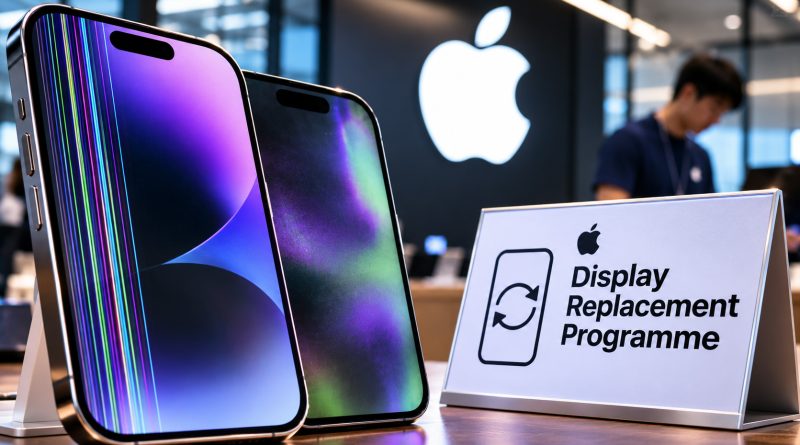
Apple has acknowledged an issue affecting the inner display on a small number of iPhone Duo units and is directing owners who experience display problems to AppleCare for a replacement. Statements relayed by 9to5Mac, WIRED Middle East and Computerworld in late October 2026 set out a support response for Apple’s first foldable phone. No recall has been announced, Apple has not named a cause and no failure rate has been disclosed.
The Duo went on sale on 23 October 2026, with a 5.4-inch outer screen that opens to a 7.6-inch inner display and a US starting price of about $2,000. Reports of cracks appeared quickly. Owners in Australia, the United States, Canada and India posted accounts and photographs of damage running along the centre of the inner display near the hinge, sometimes followed by a bright line of pixels. Some described failures within hours or after only a handful of openings.
The Independent reported one Australian owner’s description of a failure after about six hours and fewer than 20 openings. WIRED Middle East reported that Reddit moderators had verified one widely shared broken device, but had verified the phone, not how it broke. The Australian account is one of several reported across four countries; it does not establish a local pattern.
What Apple has said
According to 9to5Mac, Apple’s position is that most units are unaffected and that the fault tends to surface relatively quickly. 9to5Mac also reported that AppleCare+ is not required for the replacement and that buyers who purchased from a carrier should contact AppleCare directly rather than the carrier. Apple has not publicly named a cause.
Replacement access has become a separate part of the story. ShiftDelete.Net, relaying Bloomberg’s Mark Gurman, reported on 1 November 2026 that replacement requests for cracked inner screens were stalling at some Apple Stores because of supply constraints. Some owners received a new unit on the spot, while others were told their store had no stock to swap. The shortage account is attributed to Gurman and was not confirmed by Apple.
Competing explanations, none confirmed
iFixit’s teardown, reported by Engadget and The Independent, built a three-dimensional model of the hinge from teardown footage, patents and CT scans, then compared it with the reported damage locations. In one simulation, a centre support bar failed to drop far enough, creating a stress point where the screen’s fold comes down on it. iFixit presented this as a potential cause, not a confirmed root cause.
The repair group also found that fine particles could reach the hinge despite the Duo’s IP68 dust-resistance rating. In a fluorescent-powder test, the hinge began to crunch after traces reached moving parts. iFixit’s assessment was that the phone’s internal mechanism resists dust, while the hinge itself apparently does not, and it said similar findings had been made with foldables from Samsung and Google. A powder test shows that particles can reach the hinge; it does not show that dust caused the reported centre-line cracks.
A separate teardown by JerryRigEverything, relayed by ShiftDelete.Net, pointed to a hinge component that may press on the panel from behind. That observation is also unconfirmed and is distinct from iFixit’s simulation. WIRED Middle East reported that Apple’s launch-day service documents said there were no diagnostics or software remedies for hinge issues and that the hinge could not be fixed in isolation, only by replacing the entire inner display assembly.
The scale question
9to5Mac reported that a number of Reddit reports showing the issue were legitimate, but that there had also been a handful of fake AI-generated reports. WIRED Middle East noted claims that many circulated photographs were modified screenshots or AI-made wallpapers. Those claims about fakes are themselves unresolved.
Counter-evidence is equally limited. WIRED Middle East relayed an AppleInsider check that, as of 24 October 2026, no broken-screen Duo had been reported at Genius Bars in seven Apple Stores, including four flagships. It also relayed a robot test in which a Duo was folded more than 32,000 times over four nights without breakage. The store check covers one date and seven locations; the robot test covers one device. Neither is a population study.
What owners can do
For anyone whose inner display shows a crack or a line, Apple’s stated route is AppleCare. No preventive measure is confirmed. iFixit’s dust test led it to suggest avoiding fine-particle environments such as beaches, but that is a precautionary suggestion, not an established way to prevent the cracks.
For prospective buyers, several questions remain open. Apple has not said what is causing the cracks, how many units are affected, whether later production has changed or how quickly replacement stock will reach stores. The confirmed part is narrow: an acknowledged fault on some units and a replacement route. The unanswered part is whether the problem reflects a limited production issue, a design weakness or something else.
Francisco Jeronimo of IDC said in a note shared with Computerworld that the way Apple handles this first-generation problem would influence buyer confidence in foldables more broadly, not only its own sales. That is an analyst’s assessment, not a finding about the fault. It points to the practical test ahead: not whether Apple has responded, but whether owners can get a working phone quickly and whether the company eventually explains what went wrong.
A powder test that shows dust can reach a hinge is not a finding that dust cracked a screen, and a look at seven Genius Bars is not a failure rate. Holding each piece of evidence to the question it was actually built to answer, what the sample represents, what a simulation demonstrated and what it merely suggested, is a skill in its own right, and it is central to cybersecurity fundamentals, where a presumed cause stays separate from a confirmed one. If that kind of discipline is what you are after, The Hack Academy’s online cybersecurity training programme lists cybersecurity fundamentals among its subject areas, with practical exercises set beside the theory and study that runs at your own pace.