XPeng L05: a UK launch plan, a Tesla claim and an untested comparison
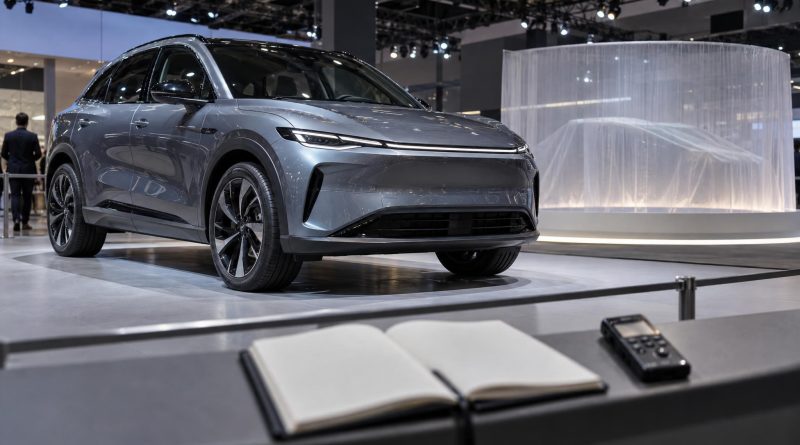
XPeng’s new family SUV is being lined up for Britain. On 3 November 2026, Auto Express reported that the all-electric L05 is set for a UK launch and is due at the Brussels Motor Show in January, with European specifications to be announced that month. The report’s eye-catching element is XPeng’s comparison between its assisted driving system and Tesla’s Full Self-Driving.
The launch is not yet a confirmed commercial event: the report gives no UK on-sale date, price or final European specification. The Tesla comparison is a manufacturer’s claim, not an independent finding, and not evidence that a contest has been settled.
What the L05 is, as far as the record goes
In China the L05 is already on sale with a choice of 58kWh or 71kWh batteries and a range of up to 394 miles on the CLTC test cycle, which Auto Express describes as more lenient than European testing. An extended-range variant is also offered there; the report makes no mention of it coming to Europe.
Auto Express describes the L05 as slightly longer than the G6, with a 702-litre boot, 41 storage spaces and a 17.3-inch infotainment screen, larger than the 15.6-inch unit in the L03. A ceiling-mounted 17.3-inch rear screen is optional in China. XPeng’s only UK model at the time was the G6; the L05 is expected to sit above it and the recently driven L03. All of this describes the Chinese car; the European specification is due in January.
The Tesla comparison and what stands behind it
XPeng claims its AI Intelligent Driving technology has shown overall performance comparable to Tesla’s Full Self-Driving, according to Auto Express. It also says the L05 uses the same set-up as its Youyou robotaxi brand in China, and that the L05’s in-house AI system is intended to react faster to its surroundings and drive more smoothly.
None of that amounts to a like-for-like test. No independent assessment of the L05’s assistance system, in the UK, Europe or China, is available, and there is no controlled comparison with Tesla. The Youyou claim concerns the same set-up, not verified identical hardware and software.
The nearest independent evidence concerns another XPeng model, the P7+, reviewed twice in China with differing conclusions.
WIRED reported that the P7+ drops Lidar for 12 external cameras, 12 ultrasonic sensors and three millimetre-wave radars, and that XPeng claims flagship-level driving assistance at no extra cost. The reviewer found the system smoother and more human-like but still prone to faltering, including switching into a lane occupied by a slow-moving vehicle and once crossing two lanes without signalling. WIRED said that without a back-to-back test in similar conditions it was hard to judge whether the vision-based Turing AI approach matched XPeng’s older Lidar system, and that the jury was out.
CAR Magazine was more impressed, judging the P7+ system ahead of autopilot technology its reviewer had sampled from Tesla, Volkswagen and Hyundai. It attributed the advantage partly to faster processing and partly to Chinese regulations that allow more driving tasks than Europe and the UK permit. The same review found overtakes cut too close and said XPeng would need to retune the system for greater following distance in the UK.
The divergence is instructive. Two single-reviewer tests in Chinese conditions, of a car that is not the L05, cannot settle whether XPeng’s approach beats the systems it was compared with, or whether vision beats Lidar. They show that informed observers disagree, and that regulation is part of the explanation.
Where the L05 fits in XPeng’s UK plans
XPeng’s British push predates the L05 report. Its January 2026 UK roadmap named the new G6, the X9 seven-seat flagship due mid-year and further SUV expansion, with more models in advanced development for announcement later in the year. In September 2026 the company said it would take direct ownership of UK operations through a National Sales Company, with International Motors providing operational support. The announcement’s summary of its UK portfolio names the X9 and L03, not the L05.
That gap deserves care. A partial portfolio summary that omits a model is not proof the model will not come; it does mean the L05’s place in the official UK plan is not established.
The G6 is concrete, by contrast: XPeng said the upgraded version would arrive in the UK in the first quarter of 2026 from £39,990, with an 800V platform, a claimed peak charging power of 451kW and a 10 to 80 per cent charge in 12 minutes. Nothing in the L05 report suggests those figures transfer to the larger car.
Trust, rules and the gap between demonstration and launch
XPeng has also commissioned research on European attitudes. Auto Express reported that a survey of more than 5,000 respondents across six European countries found 13 per cent of Europeans would get in a self-driving car, against 70 per cent in China, and that 53 per cent expressed little or no trust in AI taking over driving or making emergency decisions. Willingness to travel in an autonomous car was 34 per cent in the UK and 63 per cent in Spain, and 61 per cent cited loss of human control as a leading fear.
The figures need care. The survey was commissioned by XPeng, and the published material does not include its methodology or question wording. It also points to a distinction summaries tend to lose: up to 53 per cent were comfortable with features such as adaptive cruise control, traffic-sign recognition and lane-keep assist. Reluctance to ride in a self-driving car is not reluctance to use driver assistance.
Regulation adds a second limit. CAR Magazine’s observation that Chinese rules allow more driving tasks than Europe or the UK permits concerns the P7+, but the principle applies to any demonstration of XPeng’s system in China. What a car can do there is not a guide to what it will be allowed to do on British roads. No type-approval or regulatory classification for the L05’s assistance features is available, and no supplied material establishes any XPeng model as legally self-driving in the UK.
What to watch
The first checkpoint is the January announcement, when European specifications are due; the report does not state the year. British buyers then need price, on-sale date, final specification and the regulatory classification of the assistance features. Official confirmation of the L05 in XPeng UK’s product plan would settle the ambiguity left by September.
Then comes the test no press release can supply. Until an L05 is driven independently in UK or European conditions, ideally alongside the systems it is being compared with, the claim of Tesla-comparable performance remains a manufacturer’s assertion. The January specifications will say what the car is. They will not say how well its assistance system performs.
Two reviewers can drive the same car and reach different conclusions, while the model at the centre of a launch report has no independent assessment of its assistance system available. That gap between a confident claim and the evidence behind it is worth learning to read. Cybersecurity fundamentals develops the habit of separating a manufacturer’s assurance from an independent finding, and of asking whether a test, survey or demonstration actually supports the comparison being made. It is a useful discipline well beyond motoring, wherever a claim arrives without its method attached. If you would like to build that habit, explore The Hack Academy’s online cybersecurity training programme, where cybersecurity fundamentals is a listed subject area, with self-paced learning and practical exercises alongside the theory.