
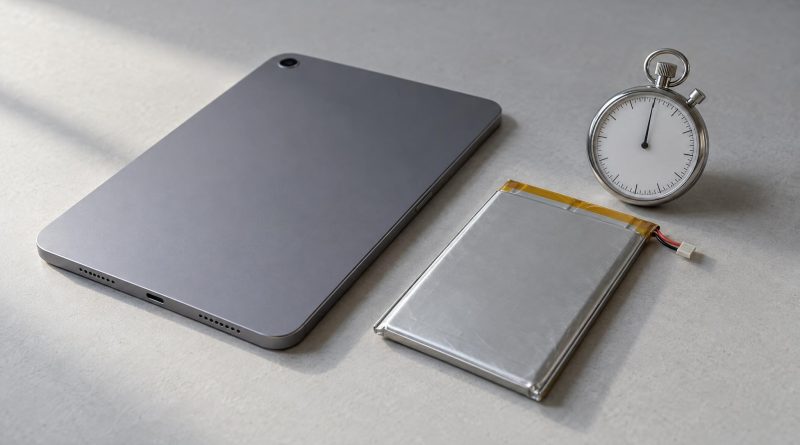
iPad mini 8 battery reported at 4,900 mAh, with endurance still unverified
MacRumors, The Mac Observer and Notebookcheck have reported that Apple’s EU energy label or regulatory sheet lists a 4,900 mAh battery for the iPad mini 8. MacRumors and The Mac Observer also reported that Apple’s technical specifications give the tablet an 18.9 Wh battery, compared with 19.3 Wh for the previous model. The figures offer a capacity comparison. They do not, by themselves, establish how long the new tablet will run between charges.
At the time of the reports, pre-orders were open and the device was scheduled to launch on Friday 6 November. Notebookcheck said the iPad mini 8 had not reached end users and that Apple’s battery-life claim was therefore difficult to verify. The reports contained no independent runtime testing.
What the disclosure does and does not show
The 4,900 mAh figure came from an EU disclosure, not from a measured runtime test. TechRadar attributed the publication to EU rules, a point this report has not independently confirmed. The label is still useful because it supplies a capacity figure in milliamp-hours alongside the watt-hour rating.
The comparison with the seventh-generation iPad mini is less tidy than it first appears. MacRumors, The Mac Observer, Notebookcheck and TechRadar give the earlier model a 5,034 mAh battery. GSMArena gives 5,078 mAh. The 19.3 Wh figure is consistent among the sources that report it, but the dispute over the older milliamp-hour rating means any percentage change should be treated as approximate. On the 5,034 mAh figure, The Mac Observer described a reduction of about 2.7% in charge capacity and about 2.1% in stored energy.
The watt-hour comparison is cleaner because 19.3 Wh is consistent across the reports. It still does not measure endurance, but it avoids relying on a disputed milliamp-hour figure for the older model. That makes 18.9 Wh against 19.3 Wh the safer numerical summary of what changed.
Why capacity is not endurance
Milliamp-hours measure charge, while watt-hours measure energy. Both describe what the battery can store, not the rate at which the tablet uses it. A processor, a display and the work being done all affect power draw, so a smaller store can sit alongside the same manufacturer estimate without contradiction. It can also sit alongside a shorter real-world result. The rating alone does not choose between those outcomes.
Apple’s published estimate, as reported by Notebookcheck and TechRadar, is up to 10 hours of web browsing over Wi-Fi or video playback, matching the previous model. TechRadar also reported an estimate of up to 9 hours of web browsing over a cellular connection. These are manufacturer figures. The claim that actual battery life has not changed is Apple’s, as relayed by those outlets, and it was not accompanied by independent test data. Without independent tests in the available reporting, the numbers are best read as estimates for specified tasks rather than a prediction of mixed use.
MacRumors suggested that improved efficiency from the A20 Pro chip may offset the smaller battery, and noted that an OLED display can use less power than an LCD when showing dark content because it has no backlight and can switch off black pixels. Notebookcheck and TechRadar offered similar explanations. This is a reported interpretation, not a measured cause. It may help explain the unchanged estimate, but it cannot be treated as proof that two devices will last equally long across different tasks.
A thinner design and two descriptions
The battery change is part of a broader redesign. MacRumors reported an 8.5-inch OLED display, the A20 Pro chip, an Acoustic Display audio system, Wi-Fi 7 support and a design described as 15% thinner and lighter than the previous model. At the time of the reports, US pricing started at $699. TechRadar reported Australian pricing from AU$1,099 for the Wi-Fi-only model with 128GB of storage, in Midnight and Starlight colours. Neither the US nor the Australian price was checked against an Apple store page.
Two competing descriptions of the same change have emerged. TechRadar framed the smaller battery as a benefit because the tablet is thinner and lighter and Apple’s estimate is unchanged. Notebookcheck described it as a downgrade because the new model stores less charge than its predecessor. These judgments address different dimensions: stored capacity on one side, physical design and a manufacturer estimate on the other. Both can be accurate at the level reported, and neither settles what buyers will experience.
Longer-term ownership
GSMArena reported that the EPREL listing for model A3596 gives the battery a rating of 1,000 full charge cycles before it falls to 80% of original capacity, says the battery is not user-replaceable, records a repairability class C and promises at least five years of software updates. Those details come from a single source’s reading of a listing that was not retrieved directly for this report. They are worth noting for long-term ownership, but they need primary confirmation before being treated as firm specifications.
What would settle the question
The next useful evidence would be independent tests of production units, comparing the iPad mini 8 with its predecessor under the same conditions. Until then, the defensible reading is narrow. The reported 4,900 mAh and 18.9 Wh describe a slightly smaller energy store on paper. The 10-hour estimate is a manufacturer claim reported before release, and the A20 Pro and OLED explanation is an interpretation of why that claim might hold. Calling the change a clear downgrade or a clear benefit goes beyond what the available evidence supports.
Comparing 18.9 Wh with 19.3 Wh looks precise until you ask how firm the earlier figure was: a baseline nobody checked can make a tidy percentage mean very little. Security assessments meet the same trap, because a finding measured against an unverified baseline or an assumed default sounds exact and proves less than it appears to. Cybersecurity fundamentals works through that groundwork, treating evidence, scope and the provenance of a comparison as things to establish before any conclusion is drawn. Anyone who wants to practise that kind of scrutiny can explore The Hack Academy’s online cybersecurity training programme, which covers cybersecurity fundamentals and pairs self-paced learning with practical exercises alongside the theory.