
Apple’s first touchscreen MacBook Pro: what the reported A$4,599 buys
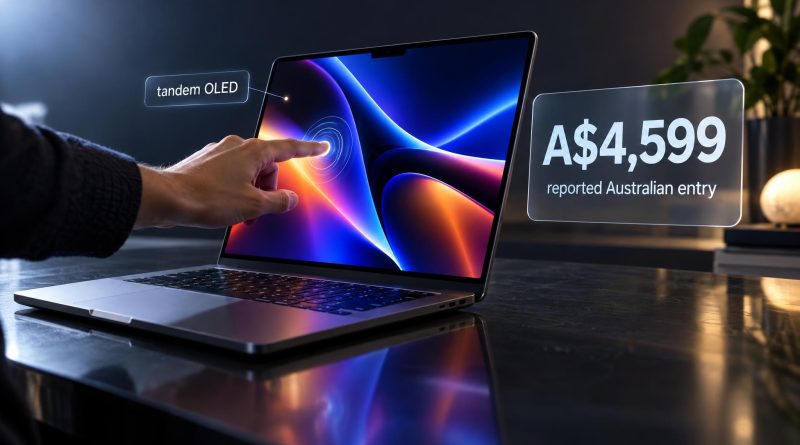
Apple has announced its first touchscreen MacBook Pro in 14-inch and 16-inch sizes with a tandem OLED display. Reports said pre-orders were open and the machines were due to go on sale on 6 November, with one report describing that date as US time. Forbes Australia and The Sydney Morning Herald reported an Australian entry price of A$4,599 for the 14-inch version.
The launch is less a chip upgrade than a price and input story. Apple spent years resisting touch on the Mac, and the new model asks buyers to pay for a display and an input method that existing software must support well.
The price picture
Australian pricing is consistent at the entry point but incomplete across the range. Forbes Australia, citing Apple, reported A$4,599 as the starting figure and A$7,699 for the 16-inch M5 Max. It also reported education savings of A$240 to A$480 and said the entry price is A$600 above the current M5 Pro model’s A$3,999 start. The Sydney Morning Herald also reported the 14-inch version from A$4,599. The reports did not set out a full Australian configuration ladder.
US pricing is less tidy. PCMag, Reuters in copy published by The Express Tribune, and The National put the 14-inch M5 Pro at US$2,899. The National reported the 14-inch M5 Max from US$4,499 and the 16-inch M5 Max from US$4,799. PCMag listed the 16-inch model from US$3,399 and said M5 Max configurations started at US$4,499 and above. Those accounts may describe different configurations, but the reports did not reconcile them.
What the extra money buys
The display is a central documented hardware change. Apple markets it as PROLED XDR, and reports described it as the first Mac with OLED, using tandem OLED technology with a 10,000,000:1 contrast ratio and a 120Hz refresh rate. Apple claimed up to 2,000 nits of peak SDR brightness and an antireflective coating, according to PCMag.
Touch input is the other. Apple said the screen supports swipe, pinch and double-tap gestures and uses a touch sensor built into the display, designed for low latency. The company pointed to 3D models, web pages and on-screen musical instruments as examples. It also said its own apps were optimised for touch and that many existing apps would work because macOS translates touches into clicks. That is Apple’s compatibility claim, and it does not establish how well third-party software will use the screen.
Reports described a thinner and lighter chassis, a Dynamic Island in place of the notch, the return of a glowing logo and a six-speaker sound system. Apple listed three Thunderbolt 5 ports, HDMI, an SDXC card slot, MagSafe and a headphone jack. PCMag reported 14-inch weights of 3 or 3.1 pounds and 16-inch weights of 4 or 4.1 pounds, down from 3.4 and 4.7 pounds. Apple claimed up to 24 hours of battery life.
Forbes Australia reported that the new laptops use the same M5 Pro and M5 Max chips as existing MacBook Pro models. On that reporting, the premium is largely tied to the display, touch, a thinner design and other hardware changes rather than a new chip generation. That makes the A$600 gap between the new entry model and the existing M5 Pro’s A$3,999 starting point the clearest Australian buyer comparison in the reports.
The software question
The practical value of touch depends on software, and the available accounts do not agree on how far Apple changed macOS. Bloomberg’s report, syndicated by The Sydney Morning Herald, described a redesigned interface optimised for touch. A Digital Today search summary, available only as a search snippet, said the overall way macOS is operated was not expected to change much, with touch functions mainly expanded within individual apps. The two accounts were not reconciled.
The historical reversal is clearer than the current software picture. Steve Jobs argued in 2010 that touchscreen laptops had poor ergonomics and would tire users’ arms, and Tim Cook in 2012 compared combining a laptop and tablet to merging a fridge and a toaster, according to reports. Apple has now added the feature, but the launch did not settle the ergonomic question. The machine was introduced by John Ternus, described in reports as Apple’s chief executive after he succeeded Tim Cook the previous month.
Durability, demand and what is still unknown
OLED burn-in is part of the maintenance question. Apple said it redesigned the chassis to draw warm air away from the display and used the computing power in its M5 chips to keep the screen refreshed, measures intended to guard against burn-in. Tom Mainelli of IDC said an OLED could be expected to last as long as a typical LCD screen, according to Reuters. That is an expectation rather than a measurement.
Market data offers context, not a forecast for this model. IDC, as cited by Reuters, estimated that PC makers shipped 33.4 million touchscreen notebooks in 2025, up 22 per cent from a year earlier and equal to 16 per cent of all notebooks, with an average selling price of around US$1,009. Apple’s reported starting prices sit far above that average, although the figures cover different configurations and currencies. The Sydney Morning Herald, citing IDC, also reported that global PC shipments fell 20 per cent in an unspecified third quarter while higher memory chip prices increased computer prices and hurt demand.
David Naranjo of Counterpoint Research argued in The National that tandem OLED, touch, improved brightness and contrast, and a thinner design provide meaningful differentiation and an opportunity to justify higher average selling prices while Apple faces cost pressures from memory, storage and other components.
The unresolved items are practical ones. A full Australian configuration ladder, confirmation from Apple’s Australian store of the A$7,699 figure for the 16-inch M5 Max and education eligibility details were absent from the reports. The reports also contained no independent tests of touch latency, battery life, thermals or repair costs. The software question remains: how much macOS and third-party apps will use touch, and whether it changes how buyers work.
Apple’s touchscreen MacBook Pro turns a launch into a buyer’s question: how much of the premium rests on features that have not yet been independently tested, and how much on software support that remains uncertain? That is a familiar technology judgement, separating a demonstrated capability from a promised one. Cybersecurity fundamentals give that judgement a firmer base by showing how systems, access and evidence are assessed rather than taken on trust. For readers who want to build that habit, The Hack Academy’s online cybersecurity training programme lists cybersecurity fundamentals among its subject areas and sets self-paced learning and practical exercises alongside the theory.