
What Starlink’s hardware-key disclosure reveals, and what remains unclear
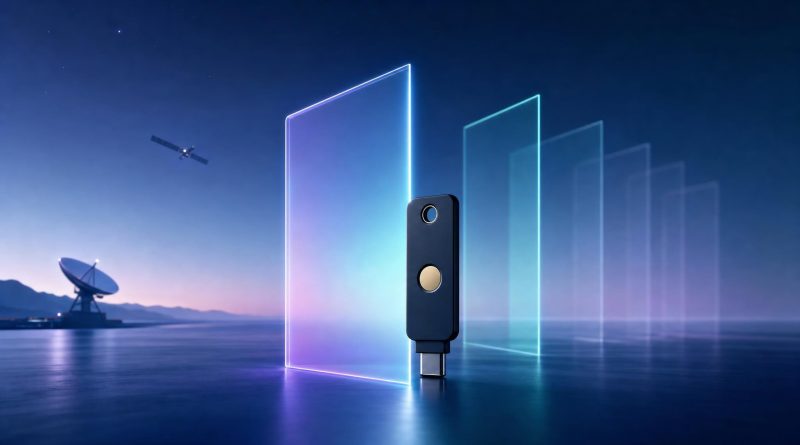
Starlink’s security page makes a concise claim with broad implications: access to the satellite internet operator’s systems requires multi-factor authentication that includes hardware security keys.
The statement, highlighted publicly by industry participant Tim Belfall on 5 October 2026 and reported by PCMag the following day, offers a glimpse of how Starlink protects access to its internal environment. It does not document an attack, a breach or a particular intrusion stopped by a key. Nor does it establish that every employee, contractor or system is covered.
Its significance is limited but substantial. Authentication is one boundary in a broader access-control system. Requiring a physical security key can reduce reliance on credentials that are easier to copy or surrender through phishing, although the strength of that protection depends on the authentication method, enrolment, recovery process and scope of deployment. Starlink has not publicly specified those details in the material reviewed.
The result is a disclosure that provides evidence of a serious control while also illustrating the limits of security claims made through a vendor’s own website. To understand what it reveals about Starlink, three different domains must be kept apart: workforce access, customer permissions and the cryptographic identities used by Starlink hardware.
A control within a larger access system
Starlink describes hardware keys as one part of multi-factor authentication, not as a replacement for passwords or as proof of a passwordless system. That distinction matters because the company has not identified the authentication standard it uses or explained which other factors accompany the key.
At a high level, a hardware security key gives an organisation a factor tied to a physical device. This can make some forms of credential phishing more difficult than authentication based only on information a user knows or can type. But the term alone does not establish how a particular deployment behaves. Different protocols, recovery routes and exception policies can produce different security outcomes.
Starlink places the requirement alongside several related controls. Its security page says the company applies least privilege, role-based access controls and separation of duties. It also says access is reviewed regularly and revoked when no longer required.
These measures address a separate part of the problem. Authentication tests whether a person can prove an identity. Authorisation determines what that identity can do after access is granted. Strong authentication and constrained permissions solve different problems; neither substitutes for the other.
The stated combination therefore matters more than the security key in isolation. Hardware-key authentication can protect an entry point, while role restrictions, separation of duties and access reviews are intended to limit the authority available through that entry point. Starlink also says it conducts penetration tests and vulnerability assessments, and continuously monitors logs, telemetry and activity for anomalies. These operational claims come from Starlink and were not independently tested in the reviewed material.
Some operational corroboration, but no deployment map
A SpaceX vacancy for an Information Security Analyst in Redmond adds a concrete detail. The employer-authored listing includes support and maintenance of YubiKeys among duties involving SSH infrastructure, certificate management and access-control systems.
That vacancy helps corroborate that hardware security keys form part of SpaceX’s operational security work. It does not show that YubiKeys are the only devices in use, that all personnel receive them or that the listed role supports Starlink rather than wider SpaceX infrastructure. It also provides no map of the applications, teams or privilege levels covered by the requirement.
This gap is important because Starlink’s phrase, access to its systems, is broad. It could encompass different categories of users and services, but the available documents do not define the boundary. The evidence supports the conclusion that hardware keys are maintained within SpaceX and required for some access described by Starlink. It does not support a claim of universal deployment.
The disclosure also says little about the controls surrounding the keys. It does not explain when the requirement began, how users enrol replacement or backup devices, what happens when a key is lost, how recovery is protected, or whether exceptions are allowed. Those processes can determine whether a strong authentication control remains strong when normal access fails.
Three kinds of keys, roles and identities
The workforce requirement is easily confused with two other parts of Starlink’s security model.
First, Starlink documents customer-facing role-based access control across its website, app and APIs. Its help material describes separate permissions for administrative, billing, technical, support and user-management functions. This is an authorisation system for customer organisations, not evidence that subscribers must use the same hardware keys required for access to Starlink systems.
Customer roles can still have security value. Dividing responsibilities can reduce the number of people able to perform sensitive account actions. But the public material reviewed does not establish that consumer or enterprise customer accounts have received mandatory hardware-key authentication. Conflating internal controls with subscriber protection would overstate the disclosure.
Second, Starlink’s document for security researchers discusses hardware-based secure key storage for device identities. It says those identities rely on public-key cryptography and signed certificates. This concerns cryptographic material held by equipment, rather than a physical authenticator used by a person during login.
The same product-security document says Starlink treats user terminals as inherently untrusted and uses least privilege to contain a compromised terminal. It also says satellites are designed to see encrypted user traffic rather than plaintext content. These measures address device trust and network architecture, which present different problems from verifying an employee or administrator.
Putting all three layers together produces a more useful picture. Workforce authentication seeks to control who enters internal systems. Customer roles limit what authorised account users can do. Device certificates and protected key storage establish identities within the product architecture. They may share concepts such as keys and least privilege, but they are not interchangeable controls.
Assurance is not the same as proof of effectiveness
Starlink’s consolidated security material appears designed partly for organisations assessing the service, as well as for general transparency. Its help centre says its security practices are ISO/IEC 27001 certified and PCI DSS compliant. Belfall highlighted the security page alongside other enterprise-oriented material covering service levels and the bug bounty programme.
Such statements can help procurement and security teams identify the questions a supplier is prepared to answer. They do not, by themselves, reveal how effectively each control operates. No underlying audit report, certificate scope statement or control test result was reviewed for this research. The absence of those documents from the reviewed material does not prove that Starlink lacks them, but it prevents an independent assessment of what systems and processes the claims cover.
The page appears to serve a commercial trust function as well as a transparency function. That does not make its claims meaningless. It does mean readers should distinguish between a vendor statement, supporting operational evidence and independent assurance. Here, the SpaceX vacancy supports the existence of work involving YubiKeys and access infrastructure, while Starlink’s own documents describe a layered security model. Neither establishes deployment metrics or continuous effectiveness.
PCMag reported that SpaceX did not immediately respond to its request for comment. The official security page also lacks an accessible publication or revision date in the reviewed record, so Belfall’s description of the pages as newly surfaced cannot establish precisely when the policy was introduced.
The questions an enterprise customer should ask
For organisations evaluating Starlink, including Australian technology teams considering satellite broadband for remote, resilient or backup connectivity, the useful response is not to dismiss the disclosure or treat it as a guarantee. It is to seek scope.
That means establishing which personnel and systems require keys, which authentication methods are supported, and how backup devices, recovery and exceptions are governed. Customers can also ask for the scope of certification and compliance claims, the evidence available from independent assessment, and the relationship between Starlink controls and broader SpaceX infrastructure.
The disclosed combination of hardware keys, limited privileges, access reviews and monitoring describes a coherent layer of identity defence. It may also represent sound enterprise security hygiene rather than a control unique to a satellite operator. Without a representative comparison with other technology, telecommunications or satellite providers, the available evidence cannot show that Starlink’s approach is unusually advanced.
Most importantly, the documentation does not show that hardware keys stopped a particular hack. Authentication keys do not by themselves secure endpoints, software, recovery channels, terminals, satellites or network services. Starlink’s other published controls acknowledge that broader problem by extending security beyond the login prompt.
The most defensible reading is therefore neither celebratory nor dismissive. Starlink has disclosed a meaningful safeguard for access to its systems and supplied some evidence that SpaceX maintains the supporting infrastructure. What remains unknown is the boundary around that safeguard and the strength of its implementation. For customers deciding how much trust to place in a satellite internet provider, the key itself is only the beginning of the security question.
A hardware security key used by a person and a cryptographic key held by equipment share a name, but they do different security work. Put cryptography and cybersecurity fundamentals on your learning agenda with The Hack Academy’s online cybersecurity training programme, which offers self-paced learning in both subjects, with practical exercises alongside theory.
