
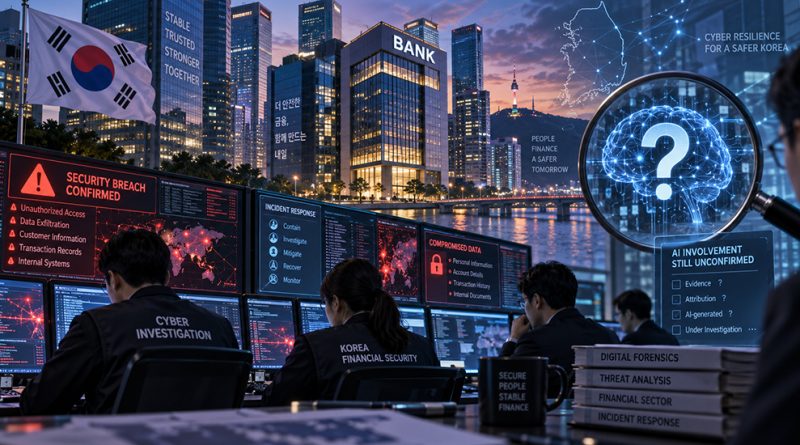
South Korea widens response to bank attacks as AI role remains unproven
South Korea has widened its response to a cluster of attacks on financial institutions after President Lee Jae Myung said on 6 October 2026 that signs of possible artificial intelligence use had emerged. His statement elevated official concern, but did not establish that an AI system performed any part of the intrusions.
Lee asked authorities to establish the circumstances quickly and minimise damage. Reuters also reported, citing Yonhap News Agency, that police had launched a full-scale investigation into attacks on commercial banks involving customer personal data. The inquiry’s scope and status were not independently established in the available reporting.
The immediate response has nevertheless become broader and more coordinated. Reuters reported that the Financial Supervisory Service and Financial Security Institute shared 28 unique IP addresses, along with associated country information, with financial firms on 6 October. Those indicators can help institutions compare activity across their records, but shared infrastructure or timing would not by itself prove that one operator conducted every attack.
Different institutions, different incident status
The confirmed and reported effects vary substantially among the named organisations, making it misleading to describe every case as the same kind of breach.
Chosunbiz and Aju Press identified exposed data relating to about 25,000 Shinhan Bank customers, 119 KB Kookmin Bank customers, 89 Hana Bank customers and 11 BNK Busan Bank contractors. Those figures remain provisional rather than a final account of the incidents.
At their respective reporting cutoffs, Chosunbiz and Aju Press said no customer information leak had been identified at Woori Bank or NH NongHyup Bank. Reuters separately said Yonhap had reported that Woori suffered a breach, leaving its precise status unresolved in the available public accounts.
By 4 and 5 October, Aju Press and BusinessKorea were reporting a cluster extending beyond the initial commercial banks. Yegaram Savings Bank, Welcome Savings Bank and Hyundai Capital were among the additional institutions named. Their inclusion does not mean that all suffered confirmed data exfiltration, and authorities had not disclosed the full scale of the incidents as of 6 October.
Reports also used terms such as attack, attempt, information leak and breach inconsistently. The strongest supported conclusion is that Shinhan experienced confirmed data extraction, several other institutions had reported exposures of varying scale, and further organisations were associated with attacks or attempts whose effects had not been fully established.
What the ARTEX evidence shows, and what it does not
The case for possible AI involvement rests partly on reported artefacts associated with ARTEX, described in local coverage as an autonomous penetration-testing system.
Chosunbiz reported that a web server believed to be connected with the attacks displayed an ARTEX console title. The publication also noted that banks and financial authorities had not confirmed that ARTEX was used. BusinessKorea later reported, attributing the finding to the Korea Financial Security Institute, that ARTEX strings had appeared on web servers associated with four commercial-bank incidents.
Finding a console title or recurring string could justify further forensic examination, particularly if similar artefacts appear across several cases. It does not demonstrate that the system ran during an intrusion, issued commands, selected an attack path or successfully accessed bank data. No public command history, model record, execution log or official forensic report has linked ARTEX, or another AI tool, to a successful intrusion.
Reuters said authorities had not disclosed which AI tools were allegedly involved. There has also been no public attribution to a threat actor. Tool language, hosting locations and IP geolocation do not establish the identity or nationality of an attacker.
A separate Financial Services Commission finding provides context but not incident evidence. On 3 September, before the attacks, the FSC said controlled testing had shown the possibility of AI enabling broad and rapid vulnerability discovery. That finding describes a general capability. It cannot establish that such a capability was used against these institutions in October.
Why exposed support systems are central to the response
Chosunbiz and Aju Press reported that the activity concentrated mainly on externally reachable loan, sales-support and operations systems rather than core banking networks. None of the reviewed sources reported a core banking outage or confirmed theft of customer funds.
The FSC convened an emergency response meeting on 2 October following the Shinhan information leak dated 30 September and subsequent attacks on other financial companies. It instructed firms to inspect externally exposed systems and services, review authentication and access controls, remove unnecessary information exposure, block unauthorised access paths and share attack IP information rapidly.
That focus reflects what is publicly known about the apparent targets. It is not evidence of one common technical cause. Reports have offered different descriptions of possible access methods, but no official forensic account has identified a specific vulnerability or reconciled those explanations. The root cause may also differ among institutions.
The regulator’s instructions therefore concentrate on discovering exposed assets and reviewing access controls rather than applying a named product patch. Comparing institutional logs with the shared indicators may help investigators identify common activity, although an IP match alone cannot establish a common operator or successful compromise.
The questions the investigation still has to answer
The presidential intervention, reported police inquiry and distribution of 28 indicators mark a significant expansion of South Korea’s response. They do not turn suspicion of AI use into a forensic finding, nor do they establish that the incidents form one coordinated campaign.
A firmer conclusion would require technical evidence connecting an AI system to actions taken during the attacks, together with direct incident findings from each institution. Investigators also have yet to establish publicly the initial access methods, final victim totals, exposure periods, remediation status and whether the cases share an operator or infrastructure owner.
Until those gaps are resolved, the most useful distinction is between the confirmed data exposure already reported at parts of the financial sector and the still unproven explanation that AI helped produce it.
Interpreting shared network indicators responsibly means evaluating apparent overlap against evidence from each institution, rather than treating correlation as proof of one operator. Consider a self-paced course of study through The Hack Academy’s online cybersecurity training programme, where theory and practical exercises support learning in networking and cybersecurity fundamentals.
