
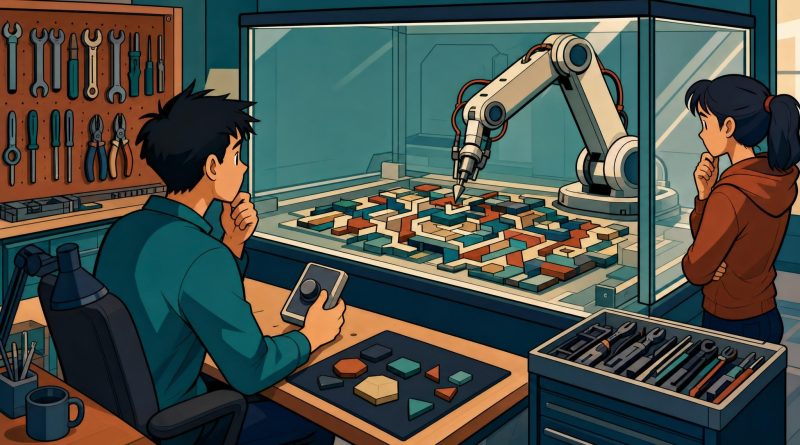
The job can survive while the craft disappears
The most revealing anxiety about workplace AI may not be receiving a redundancy notice. It may be arriving at work, keeping the same title and salary, and discovering that the part of the job through which you exercised judgement has been handed to a machine.
That is the important distinction in an essay by Liu Shengyu, an engineer at DeepSeek. According to Business Insider, Liu did not expect AI to leave him unemployed. He anticipated moving from writing specialised computing kernels himself to directing AI agents, and worried about losing the hands-on craft he valued. Jiemian later reported his clarification that the essay was chiefly a farewell to the period of hand-written kernel work, rather than an expression of unemployment anxiety or a corporate argument against a rival.
The clarification matters because the public debate about AI and work remains excessively fixated on whether jobs exist. Employment figures are important, but they cannot tell us whether a surviving role still develops expertise, provides meaningful authorship or leaves a worker with enough practical understanding to challenge the system producing the output.
My argument is that organisations need to treat the displacement of craft as a distinct form of workplace disruption. Keeping people on the payroll is not enough if automation steadily removes the practice through which they learn, make consequential choices and become capable of independent judgement.
Automation can change the substance before the status
Liu’s professional website says he joined DeepSeek in Hangzhou in April 2025, working on machine learning systems and kernel design and optimisation. A kernel, in this context, is a low-level computational routine optimised to perform efficiently on an accelerator. It is specialised work in which implementation is not merely clerical translation from an obvious answer.
Business Insider reported that Liu had seen AI tools progress, in his experience, from helping with documentation and bugs to reading low-level GPU code and optimising kernels. No independent benchmark in the available research confirms his forecast that AI-written kernels could match or surpass his own within six to 12 months. It should be treated as his assessment, not a confirmed timetable.
Yet the workplace question does not depend on that timetable being correct. If systems eventually perform more of the direct implementation, engineers could remain responsible for specification, evaluation, integration and production testing. Their employment might therefore survive even as the centre of professional activity shifts from making an artefact to supervising its production.
That shift is not automatically degradation. Directing agents could become a demanding craft of its own. It may allow experts to address larger problems, compare more possible solutions and spend less time on tasks they regard as drudgery. Nostalgia for manual work can be as unhelpful as enthusiasm for automating everything.
But it would be equally glib to assume that supervision preserves everything valuable about implementation. A person who reviews an answer does not necessarily exercise the same judgement as someone who had to construct it. Review quality itself may depend on knowledge previously acquired through direct practice. Organisations therefore cannot infer retained expertise merely from the presence of a human approver at the end of a workflow.
The apprenticeship problem
This concern becomes more serious when viewed across a career rather than through the experience of one established engineer. Epoch AI analysed 1,604 job postings across six Chinese AI firms and found relatively low mean minimum experience requirements compared with its sample of US frontier laboratories. Campus postings also accounted for nearly 20 per cent of open engineering roles in the Chinese sample.
Those advertisements are not a census of DeepSeek’s workforce, and they do not measure learning or promotion. They do, however, establish that early-career recruitment is a meaningful part of the surrounding labour picture. A separate Stanford HAI brief analysed authors of five DeepSeek papers and found that, among those with known affiliation data, 111 of 201 had only Chinese affiliations. That study concerns paper authors rather than a complete workforce, but it supports treating DeepSeek’s talent story as substantially domestic rather than reducing it to a simple imported-talent narrative.
Together, this context raises a question that headcount cannot answer: how will new recruits become independent experts if agents absorb a growing share of foundational implementation?
The risk is conditional, not an observed outcome. It assumes that hands-on work contributes materially to expert judgement, that early-career recruitment continues, and that AI takes over more of the tasks through which recruits currently learn. The available studies do not show skill atrophy. Still, waiting for career outcomes to deteriorate before considering the training pathway would be poor governance.
A company can preserve junior positions while hollowing out apprenticeship. It can produce more work while creating fewer people capable of understanding that work without machine assistance. In the short term, this may look like efficiency. Over time, it could leave organisations dependent on a narrowing group of experienced reviewers whose own expertise was formed under an earlier, more manual system.
Competition is not a governance policy
Business Insider reported that Liu felt unable to slow his own participation because competing laboratories would continue. That reasoning presents the AI race as a collective-action trap: restraint appears personally futile when every participant expects somebody else to press ahead.
The competitive pressure is a meaningful counterargument to preserving deliberate manual practice. Requiring teams to maintain training work can impose costs, and the available evidence does not calculate how much practice could be retained without slowing innovation. Individual workers also cannot solve an industry-wide incentive problem by privately refusing useful tools.
That is precisely why the decision should not be abandoned to individual preference. Managers choose workflows, allocate review time and define promotion criteria. They can decide whether a junior engineer merely accepts agent output or must also demonstrate the ability to diagnose it, reconstruct key decisions and complete selected work directly. The point is not to preserve every old task as a museum piece. It is to identify which forms of practice build judgement that the organisation will continue to need.
This demands better measures than productivity and employment totals alone. Employers should ask whether workers can explain and contest automated output, whether responsibility is matched by genuine authority, whether early-career staff still have a route to mastery, and whether people receive credit for intellectual decisions rather than serving as nominal signatories for machine-produced work. These are proposed governance tests, not findings that the cited workforce studies have already measured.
Openness does not settle control
Liu’s political answer, as reported by Business Insider, was that cutting-edge intelligence should be open and affordable. Wider availability may indeed constrain one form of power by giving more people an alternative to systems controlled by a small number of closed laboratories.
But access to a model and control over an AI-mediated workplace are different things. Epoch AI’s job-posting analysis identified demand involving Nvidia CUDA, domestic accelerators, cloud compute and self-built data centres. That does not establish who controls the market or what access costs, but it illustrates the layers of infrastructure involved in developing and deploying AI.
If access to models broadens faster than access to the necessary compute and deployment infrastructure, more people may be able to experiment without gaining equivalent economic or institutional power. Likewise, an organisation can use widely available technology while retaining highly centralised authority over how employees must use it. Openness may be valuable, but it does not by itself decide who designs the workflow, bears responsibility or captures the gains.
Without a release-specific licence analysis, Liu’s advocacy should not be converted into a technical classification of particular DeepSeek models. Open weights, available source code, permissive licensing, affordable compute and worker control are related questions, not interchangeable labels.
Choose what humans must keep learning
Liu’s essay is useful because it identifies a loss that conventional automation arguments struggle to name. It is not evidence of DeepSeek’s organisational culture, still less a portrait of workers across China. It is one engineer’s perspective, reported through translated secondary coverage, and its technical forecast remains unverified.
Even within those limits, the distinction between employment and mastery deserves to travel. The responsible objective is neither to freeze skilled work in its current form nor to automate every task that a model can perform. It is to preserve deliberate human practice where that practice creates the judgement, autonomy and review capability on which reliable work still depends.
The crucial workplace decision is therefore not simply how many people an AI deployment removes. It is which capabilities the organisation intends people to retain, how future experts will acquire them, and whether workers have meaningful influence over the transition. A job can survive on an organisation chart while its craft disappears. By the time headcount reveals the problem, the harder loss may already be the knowledge needed to take the work back.
Preserving judgement as work becomes more automated raises a wider learning question: how much understanding comes from doing the task yourself? Put that emphasis on practice into your own study with The Hack Academy’s online cybersecurity training programme; its listed subjects include cybersecurity fundamentals, and learning is self-paced with practical exercises alongside theory.
