
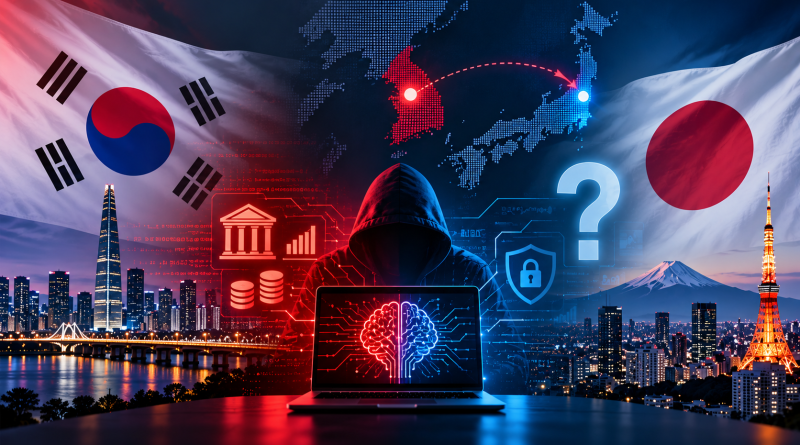
CrowdStrike links AI tools to South Korean finance campaign, while Japan link remains unproven
CrowdStrike’s newly published research provides direct evidence that a human operator used AI tools during a campaign against South Korean financial organisations, substantially strengthening the public case for AI involvement. It does not, however, show that AI drove every recent Korean incident or connect the campaign to the separate cyber incidents reported in Japan.
CrowdStrike said on 7 October that actor-controlled infrastructure contained Claude Code session histories, ARTEX configuration files and Claude memory files. The company associated that infrastructure with a campaign operating from late September into early October 2026, which it said targeted South Korean financial organisations and resulted in data exfiltration.
Those records represent a material change from the evidence available during earlier reporting. The Hack Academy reported on 2 and 6 October that an ARTEX-branded console reference did not, by itself, demonstrate that AI had been used. Session histories and configuration records found on infrastructure controlled by the operator provide a much firmer link between the tools and the campaign CrowdStrike analysed.
The limits remain important. CrowdStrike is a security vendor, and no public report from an affected bank, police force or regulator has mapped its findings to every organisation reportedly targeted. The total number of victims is unconfirmed, and targeting, successful access and data exfiltration are not interchangeable. There is also no published common vulnerability or technical cause covering the incidents.
Evidence of assistance, not autonomous hacking
The records support describing the campaign as AI-assisted activity by a human operator. They do not establish that ARTEX or a language model independently selected targets and conducted the intrusions without meaningful direction. Nor does the public material quantify how much the tools contributed, or demonstrate what the operator could have achieved without them.
CrowdStrike assessed with moderate confidence that the operator was probably a Chinese speaker and financially motivated, but it did not name an adversary. Personal details appearing in one session could not be definitively tied to the operator. Nationality, employer, group membership and any government affiliation therefore remain unknown.
South Korean authorities have also cautioned against treating a related claim as established. On 6 October, the Financial Services Commission said it had not confirmed assertions that account information from the recent incidents had leaked and been transferred to China. That distinction separates evidence about language and possible motivation from proof of identity, location or where stolen information went.
South Korea focuses on conventional controls
The government response has concentrated on established security measures rather than an AI-specific product. Following a 30 September Shinhan Bank information leak and subsequent attacks, the Financial Services Commission convened an emergency meeting on 2 October. It directed financial firms to inspect externally exposed systems, authentication, access controls, unnecessary information exposure and threat-information sharing.
At a wider meeting held on 4 October and published two days later, the commission expanded checks across the financial sector and required institutions to complete and report self-assessments. These instructions identify areas requiring scrutiny, but they should not be read as a confirmed explanation of how every incident occurred.
The commission also warned that exposed personal information could enable tailored loan phishing and smishing. It said passwords and one-time-password information were not among the leaked data covered by that warning. Customers should therefore distinguish between confirmed exposure of personal information and unsupported claims that passwords or one-time-password information were stolen, while remaining alert to messages exploiting knowledge of their financial circumstances.
Japan’s incidents remain a separate cluster
Japan issued a heightened-vigilance warning on 9 October amid a series of cyber incidents. Associated Press reported recent customer-data cases involving organisations including Lawson, Daiwa Securities, BookOff and Times Car. Reuters also presented the Korean and Japanese events as part of a wider regional picture, while noting that authorities were still investigating whether and how AI was used in many cases.
The available Japanese disclosures describe different systems and effects. Lawson confirmed on 8 October that unauthorised access affected Lawson ID between 12 and 14 September and its App Reservation service on 17 September. Information associated with 2,155,345 Lawson ID records and 26 reservation users was exposed, although Lawson had not confirmed related misuse or secondary harm when it disclosed the incident.
Lawson separately reported that its email server was misused to send approximately 700,000 suspicious messages between 25 and 27 September. The company said that event had not produced confirmed information leakage, data-centre intrusion, alteration or malware infection. Combining the two Lawson disclosures would obscure the difference between confirmed customer-data exposure and misuse of an email system without confirmed leakage.
Elsewhere, IDC Frontier said unauthorised access disrupted its IDCF Cloud service from 7 October. It established an emergency response operation with support from parent company SoftBank. The official disclosure concerns IDC Frontier’s cloud service, not a confirmed compromise of SoftBank’s telecommunications network, and the complete cause and data impact were not established in the reviewed update.
No published evidence ties these Japanese incidents to the South Korean campaign, identifies a shared actor or demonstrates AI use in Japan. Continuing investigations could produce further connections, but temporal clustering is not evidence of common causation.
What the new evidence changes
The CrowdStrike findings make it reasonable to say AI tooling supported a malicious financial campaign and may have helped its operator work across targets. They do not prove that AI was necessary, decisive or autonomous, and they cannot support a claim that one AI-enabled actor caused a regional wave.
For defenders, the documented response remains practical: inventory internet-facing services, strengthen authentication and access controls, reduce unnecessary exposure, review monitoring coverage and share relevant threat information. For customers, the immediate concern is secondary fraud using leaked personal details. The unresolved question is not whether AI appeared in one campaign, but how far that evidence extends beyond the infrastructure CrowdStrike examined.
The reported AI use sits alongside familiar defender questions about exposed services, authentication and access controls. Use those control questions to frame further study through The Hack Academy’s online cybersecurity training programme, which lists networking and internet vulnerabilities and offers self-paced learning with theory and practical exercises.
