
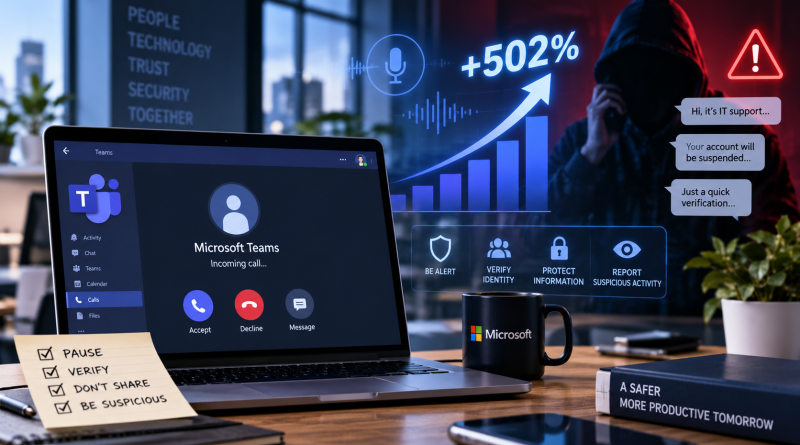
Microsoft’s reported 502% rise in Teams voice phishing needs context
Malicious voice-phishing activity through Microsoft Teams rose 502% year-on-year, according to Microsoft figures reported by the Press Association. The increase is among the findings associated with the 2026 Microsoft Digital Defense Report, but it does not show how many people were targeted, how many attempts succeeded or what proportion involved artificial intelligence.
Microsoft published the report on 1 October 2026. The company says it generally covers observations from 1 July 2025 to 30 June 2026, unless a particular metric uses a different period. Its findings draw on extensive but vendor-specific visibility: Microsoft says its security teams process more than 165 trillion signals and screen an average of 5.2 billion emails each day.
What the 502% figure establishes
Voice phishing, often called vishing, uses spoken interaction as part of social engineering. In the activity described here, attackers exploit familiar calls, collaboration identities and business communications to make a request appear trustworthy. Microsoft’s guidance highlights unexpected callers claiming to be IT support, executives or business contacts and seeking a sensitive action from the target.
The 502% figure describes the year-on-year change in activity observed through Microsoft’s systems. It should not be read as a measure of all voice phishing worldwide, a total number of victims or a success rate. The reviewed material does not provide the absolute number behind the percentage, a geographic breakdown, financial losses or a count of resulting compromises.
Those omissions matter because a percentage increase can look dramatic when its starting point is unknown. The available material also does not explain whether the metric counts calls, campaigns, accounts, tenants, detections or investigated incidents. Without the full methodology, readers cannot assess whether changes in Teams use, telemetry coverage or detection capability influenced the comparison.
Microsoft separately says 93% of voice-phishing attacks kept targets engaged long enough for social engineering to begin. That suggests an attempted call can become operationally significant before a target gives up credentials, access or money. It does not mean 93% of attacks caused a compromise. The public report page does not expose the sample size or precise definition behind that figure.
AI may amplify the tactic, not explain it entirely
Microsoft says AI can increase the speed, scale and sophistication of attacks. An official company release also describes criminals using AI to imitate voices and manipulate documents as part of identity deception. These capabilities can strengthen an established social-engineering approach by making impersonation content easier to produce or more convincing.
Independent research from the Centre for Emerging Technology and Security similarly describes generative AI as an amplifier of existing fraud and social-engineering risks, including through speed, scale and potential voice cloning. That supports treating AI as a force multiplier, rather than assuming it created a wholly new category of attack.
Neither source, however, quantifies how much of the reported Teams increase involved AI. Microsoft’s own commentary says malicious AI use remains concentrated mainly in selected stages of existing attack workflows. The evidence therefore does not establish that AI caused the entire 502% rise, or that synthetic voices mattered more than conventional impersonation, compromised identities or abuse of familiar platforms.
Trusted-channel abuse is not a Teams vulnerability
No software flaw or CVE is identified in connection with the increase. The available evidence describes attackers abusing communication channels and identity signals that users may already trust. A familiar display name, recognisable voice or call arriving through Teams can influence a recipient, but none of those signals independently verifies who is making the request.
This distinction changes the appropriate response. There is no patch identified for the reported activity because the central problem is social engineering and identity abuse, not exploitation of a disclosed Teams defect. Organisations instead need controls that reduce the authority granted to a voice, display identity or unexpected request.
Other figures in Microsoft’s report provide wider context but should not be folded into the Teams statistic. The company reports more than 46 million business impersonation detections over the previous 12 months, although its landing page alternates between describing these as business email impersonation and business contact impersonation. The intended scope remains unclear.
Microsoft also says government agencies and services represented 27% of observed cyber-threat activity by sector in 2026, followed by information technology at 17% and research and academia at 14%. Those sector shares do not show that the activity was voice phishing, AI-assisted or conducted through Teams, and they do not establish a particular category of threat actor.
Verification matters more than a familiar voice
Microsoft recommends phishing-resistant multi-factor authentication, passkeys, least privilege and stronger identity governance. These measures can limit reliance on reusable credentials and reduce the access available through an account. They address the identity layer around social engineering rather than attempting to decide whether every voice sounds authentic.
For sensitive or unexpected requests, the report’s broader implication is to replace implicit trust with explicit verification. Staff should confirm requests through an independently known contact path before granting access, resetting credentials or approving transactions. Organisations can also train users to report suspicious calls and correlate identity, endpoint, email and collaboration-platform signals rather than reviewing each channel in isolation.
Microsoft says synthetic content is eroding confidence in digital communications. That makes voice familiarity, a display name or the use of a trusted platform increasingly weak identity checks. The reviewed sources do not provide controlled evidence comparing the effectiveness of each recommended measure specifically against Teams vishing, but the controls reduce dependence on precisely those signals that impersonation seeks to exploit.
No Australia-specific rate, victim count or loss figure appears in the reviewed material, so the 502% increase should not be presented as an Australian trend. Its practical relevance is broader: organisations using Teams face an identity and verification problem that is not confined to a software version or region. The most important unanswered question is now methodological, including what Microsoft counted and how often verified AI use appeared in those observations.
A separate contact path helps replace confidence in a familiar voice with a deliberate identity check. To deepen the security principles behind that decision, explore The Hack Academy’s online cybersecurity training programme, with self-paced study of cybersecurity fundamentals and practical exercises alongside theory.
