
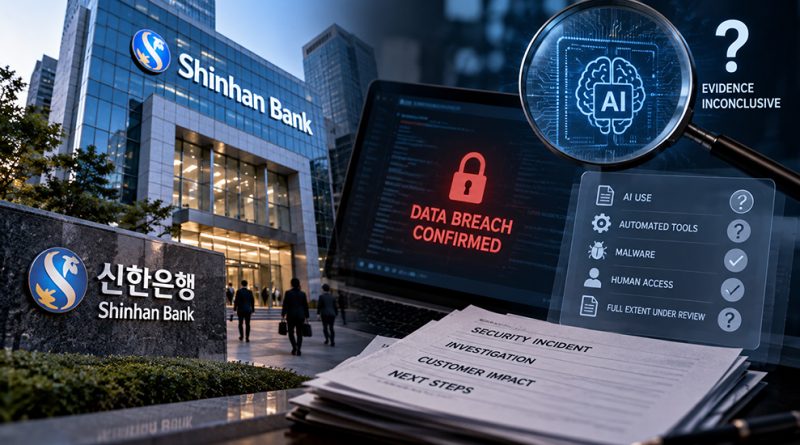
Shinhan Bank confirms data breach as evidence of AI use remains inconclusive
Shinhan Bank has confirmed that an unauthorised external party extracted personal and financial-profile information belonging to approximately 25,000 customers, while questions remain over reports linking the intrusion to an artificial intelligence penetration-testing system.
The South Korean bank said it confirmed the extraction on 30 September 2026 and issued a public apology on 1 October. Its disclosures listed names, phone numbers, annual income and calculated loan limits among the exposed information. It also reported 66 resident registration numbers and 97 identifiers described as connecting information.
The data breach is established. The role of AI is not. A reported ARTEX AI console reference on suspected attack infrastructure has provided an investigative lead, but no published logs, command history, model records or official forensic findings show that ARTEX AI executed any part of the intrusion.
A specialist service was affected
Yonhap News Agency reported, citing Shinhan, that the affected route was the M Shinhan mobile web service used by loan recruiters. The bank’s reported account said the intruder bypassed normal identity verification and manipulated query inputs to retrieve customer records.
This distinction matters because the incident has not been described as a compromise of Shinhan’s entire banking platform. Shinhan said its customer-facing applications, including Super SOL, were unrelated to the incident. That statement has not been independently validated through a public forensic report, but the available reporting identifies the loan recruiter service, rather than the main retail applications, as the affected system.
The exposure nevertheless shows how a specialist service can hold sensitive records even when the main consumer platform is not implicated. The affected information went beyond basic contact details to include income and calculated borrowing limits, creating a more detailed picture of some customers’ financial circumstances.
What the ARTEX AI reference proves
On 2 October, Yonhap reported that a server believed to have been used in a suspected credential-stuffing attack displayed an HTML title referring to an ARTEX AI autonomous penetration-testing console. Yonhap described ARTEX AI as an open-source system that uses a large language model and multiple agents to automate reconnaissance, vulnerability discovery, attack-path planning, tool execution and validation.
The title showed how the interface identified itself, making it a potentially useful clue. It does not establish that the named software was running during the Shinhan intrusion, issued commands against the bank or selected an attack path. It could instead relate to unused software, shared infrastructure, a decoy or another service whose connection to the breach has not been documented.
Yonhap’s 2 October report explicitly said that Shinhan, regulators and other official bodies had not confirmed that ARTEX AI was used in the intrusion. That caveat is central to interpreting the evidence. The artefact justifies examining possible AI-assisted activity, but it does not demonstrate that AI caused or conducted the breach.
No public official attribution has identified the operator behind the intrusion. The availability of an open-source tool, or language displayed on suspected infrastructure, would not by itself establish an attacker’s identity or nationality.
The attack method is also unresolved
There is a separate conflict in the descriptions of how the records were obtained. Yonhap’s 1 October account, citing Shinhan, described an identity-verification bypass followed by manipulation of query values. Its later report characterised the suspected server as being connected to credential stuffing, a different type of activity.
Without an official forensic report, neither description should be treated as a complete explanation of the incident. The public evidence does not reconcile the reported verification bypass and query manipulation with the later credential-stuffing account. It also does not show whether conventional scripts, an access-control weakness or an AI-enabled system played any material role.
The distinction is more than technical. Assigning a definitive method would shape conclusions about the controls that failed and the remediation required. For now, the confirmed public findings are limited to unauthorised access and extraction through the specialist service, while the root cause and tools remain under investigation.
Bank response and customer implications
Shinhan said it activated an enterprise emergency response, blocked external IP addresses, suspended the affected service and applied new security policies while investigating the cause and scope. The bank established channels through which customers can check their exposure and obtain support, and promised full compensation for losses attributable to the leak.
Bloomberg reported that South Korea’s Financial Supervisory Service had begun an emergency on-site inspection to determine the nature and extent of the incident. It also reported that the Financial Services Commission was scheduled to meet banks on 2 October in response to the breaches. No findings from those processes were included in the available evidence.
There was also no confirmed secondary fraud, identity misuse, account takeover or theft of funds linked to the Shinhan incident at the evidence cutoff. Even so, the combination of contact details, income and loan-limit information could help make fraudulent messages appear more convincing because a sender could refer to details relevant to a customer’s financial position.
Affected customers can use Shinhan’s official website, application or dedicated support channel to check their status. AhnLab guidance reported by MK advised customers to avoid unsolicited links claiming to offer compensation or account protection and to use official channels instead.
The unresolved AI question should not overshadow the clearer customer issue. Sensitive information was extracted from a specialist banking portal, and the bank and regulators are still investigating how that happened. Evidence that an AI-branded console may have existed on suspected infrastructure is a reason to examine the possibility, not a substitute for forensic proof.
A console title can identify how an interface presents itself without establishing what the system did, a distinction that sound security foundations help clarify. The Hack Academy’s online cybersecurity training programme offers a practical next step through self-paced study of cybersecurity fundamentals and internet vulnerabilities, combining theory with practical exercises.
