
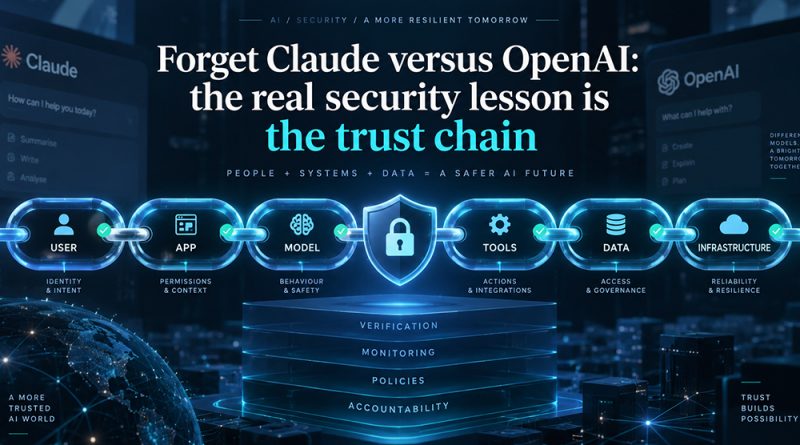
Forget Claude versus OpenAI: the real security lesson is the trust chain
The easiest version of this story has two artificial intelligence companies facing off: researchers use Anthropic’s Claude to hack OpenAI, proving that one model can turn against another. It is irresistible framing. It is also a distraction from the part that should worry technology leaders.
Claude did not independently choose a target and breach a rival. According to Hacktron, human researchers selected the problem, directed the work, tested the results and handled disclosure. The model helped them with exploit development. The chain became consequential because a public forum, employee identities, AI accounts and source control were connected through layers of trust.
That distinction matters. Model capability could change how quickly skilled people perform difficult security work. But the potential damage still depends heavily on what an organisation allows a compromised service, account or connector to reach. The useful lesson is not that AI products are fighting each other. It is that centralised identity and convenient integrations can turn a foothold at the edge into access deep inside an organisation.
A supervised investigation, not an autonomous attack
Hacktron says its researchers completed the chain on 25 July 2026. Its account describes an image-processing weakness involving Discourse and libheif, followed by an OpenAI identity flaw that provided access to employee ChatGPT and Codex accounts. The researchers say one employee’s Codex connection then allowed them to create a benign pull request in OpenAI’s private monorepo as proof of access.
Important limits accompany those claims. OpenAI has not published a detailed technical advisory describing the sign-on mechanics, token handling, number of affected accounts or repository permissions. Hacktron says the researchers did not read source code, merge changes or access customer data. The Hacker News reported no sign of malicious real-world exploitation as of mid-September.
This should therefore not be flattened into a story of stolen source code or an autonomous AI breach. It was human-led, AI-assisted vulnerability research, followed by disclosure and a bounty payment. Nor should all the activity be described as unambiguously authorised: The Hacker News reported that OpenAI regarded testing against Discourse as outside its programme scope, even though it rewarded the OpenAI-side finding.
Precision is not pedantry here. If controlled research, disputed testing boundaries and malicious exploitation are all labelled simply as hacking or a breach, the public loses the language needed to distinguish responsible proof from harmful intrusion.
AI changed the tempo, not the responsibility
The model’s reported contribution remains significant. Hacktron says Claude Opus 4.8 struggled to produce a working result over several sessions, while Opus 5 succeeded within hours. That comparison has not been independently reproduced, and no public transcript or controlled benchmark establishes exactly what changed. It is one research team’s account, not proof of a general leap across every model and vulnerability class.
Even with those qualifications, the possibility deserves attention. If the reported improvement generalises, skilled researchers or attackers could need less time to turn known flaws into workable chains, provided they continue to supply expert direction and suitable tools. AI might compress a technically demanding stage without removing the need for target selection, validation, judgement, authorisation or restraint.
That is a more credible concern than the image of an autonomous model roaming through a competitor’s systems. Faster exploit development would shorten the time available to organisations carrying old components or relying on weak trust boundaries. It would also reward researchers and defenders who can use the same tools to find and fix problems more quickly.
Some will reasonably argue that the apparent improvement between model generations is the central development. Capability does matter. But a faster route to an exploit does not explain why access to a public-facing service could reportedly lead to employee AI accounts and then a private repository. Speed supplied urgency. Architecture supplied the blast radius.
Convenience became a path to privilege
The defensive lesson lies in the sequence of trust. In Hacktron’s account, image processing at a public forum provided the initial foothold. Shared sign-on then connected that environment to employee accounts. A Codex connection extended the reachable privilege to source control. Each component may have served a legitimate workflow, but together they created a path across boundaries that should carry very different levels of trust.
OpenAI has not documented the exact identity design, so it would be wrong to prescribe a fix for mechanics that remain private. The broader principle is still supportable: organisations should not assume that authentication through a central identity system makes every connected service equally trustworthy. A public community platform and an internal development repository have different risk profiles, even when the same employee uses both.
Connectors deserve the same scrutiny. An AI coding assistant linked to source control can be useful precisely because it can act on a developer’s behalf. That convenience becomes dangerous when an inherited session or compromised account can exercise powerful permissions without a fresh check. Least-privilege access and step-up authentication before sensitive actions would introduce friction, but friction is sometimes the control that stops a low-trust foothold becoming a high-impact event.
The counterargument is practical. Shared identity and integrated tools reduce repeated logins and support productive engineering work. Constant authentication prompts and severely restricted connectors could make legitimate tasks slower. The answer is not to eliminate integration. It is to apply stronger checks where consequences rise, such as repository writes, while limiting each connector to the permissions its function actually needs.
A fix is only useful when it reaches production
The case also exposes a less glamorous AI-era problem: software maintenance. The Hacker News reported that the forum environment used libheif 1.19.7 even though the relevant upstream fix was available in 1.22.0. It also reported that Discourse-hosted sites were patched and identified fixed releases for self-hosted installations. The National Vulnerability Database now tracks the libheif issue as CVE-2026-32882.
An upstream correction does not protect a deployed service by itself. The benefit appears only after patched components move through packages, container images, hosted platforms and operational updates. The available reporting does not establish where responsibility for the lag belonged, but the outcome illustrates why organisations must track the components that actually run, not merely whether a project has produced a fix.
If AI assistance reduces exploit-development time, that maintenance gap becomes more consequential. This is a conditional risk, not a prediction from one case. Yet it supports a clear priority: isolate untrusted media processing, use current patched builds and verify that rebuilt deployments have actually replaced vulnerable dependencies.
Bounties need to recognise chains without licensing unsafe tests
Hacktron says the investigation moved from its initial work to repository access in less than 72 hours and resulted in a $6,500 payment. The Hacker News reported that OpenAI fixed its side about 14 hours after notification, paid on 1 September and said the award covered its own identity finding rather than testing against Discourse.
That payment does not prove the researchers were underpaid. The complete programme rules, severity assessment and calculation are not public. If OpenAI valued only its part of the finding, $6,500 cannot simply be compared with the theoretical impact of the entire chain.
It does, however, expose a structural problem for bounty programmes. Real impact often emerges across assets owned or operated by different parties, while programme scopes are drawn around individual organisations. A third-party service may be excluded even when it forms the first link to an in-scope identity weakness. Rewarding only isolated components can fail to reflect why their combination mattered.
Broad authorisation is not an easy answer. Strict boundaries protect users and vendors from risky production testing. Programmes should instead consider controlled environments, explicit limits and safe-harbour terms for demonstrating cross-system consequences without probing excluded live assets. Rewards can then reflect responsibly demonstrated impact while preserving firm safety boundaries.
The durable conclusion is architectural, not theatrical. Models may help experts move faster, but organisations still decide how much trust sits behind one session and how far one connector can reach. Public services should be treated as low-trust surfaces. Sensitive actions should demand fresh assurance. Developer integrations should receive only necessary privileges. Patches should be verified in deployed systems, not merely noted upstream.
AI capability deserves scrutiny, but blaming the model alone lets institutions ignore the permissions they designed around it. The decisive security question is not which model helped open the first door. It is why that door led so far.
Evaluating how far one service should trust another calls for a clear grasp of networks, internet-facing systems and security fundamentals. One practical route into that groundwork is The Hack Academy’s online cybersecurity training programme, offering self-paced learning with practical exercises alongside theory in networking, internet vulnerabilities and cybersecurity fundamentals.
