
The Coin-Sized Stowaway Exposing Aviation’s Cybersecurity Blind Spot
For decades, commercial aircraft have seemed largely insulated from the cybersecurity failures affecting cars, hospitals, utilities and other essential infrastructure. Their critical systems are heavily regulated, separated from public networks and supported by layers of operational controls designed to prevent interference.
New research, however, suggests that aviation’s apparent digital isolation may also conceal a dangerous assumption: that attackers will always remain outside the aircraft.
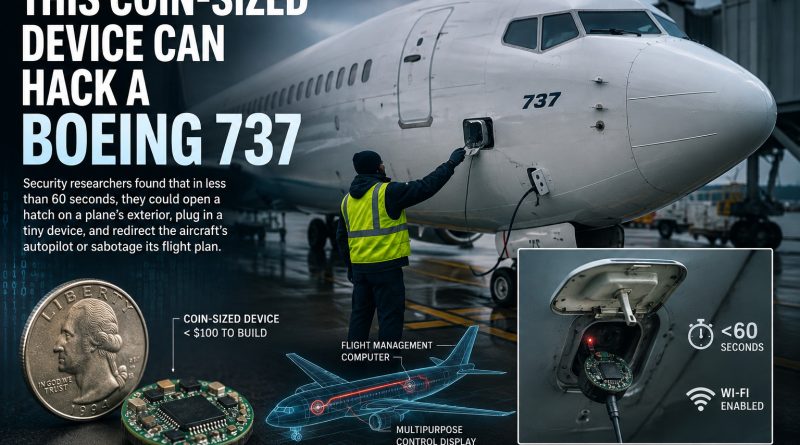
A team of security researchers has demonstrated how a tiny electronic implant, small enough to hide beneath the protective cap of an external aircraft connector, could interfere with systems responsible for navigation, cockpit information and automated flight controls. The device reportedly costs less than $100 to assemble and could be installed in under a minute by someone with physical access to the aircraft while it is on the ground.
This is not a conventional remote cyberattack launched from another country or through a passenger’s laptop. It is a physical-access attack, combining the methods of an insider, saboteur and hardware hacker.
That distinction makes the research both less immediately alarming and potentially more difficult for the aviation industry to dismiss.
The attack requires someone to approach the aircraft, open an exterior hatch and connect a malicious device to a particular service port. The location and technical details of the connector have not been publicly disclosed, reducing the risk that the research could serve as an instruction manual.
Once installed, however, the prototype could transmit carefully constructed electrical signals through one of the aircraft’s internal data networks. These signals could imitate legitimate instructions sent between essential avionics components.
In laboratory testing, the researchers found that this foothold could be used to alter information supplied to the flight management system, including the waypoints that form an aircraft’s programmed route. In theory, an attacker could redirect the autopilot by changing the flight plan while concealing those changes from the primary cockpit display.
The same technique could reportedly manipulate values used during take-off preparation, including the aircraft’s total weight and the temperature outside.
These numbers are not minor details. Pilots and onboard systems rely on them to calculate the speed, thrust and runway distance required for a safe departure. An aircraft that is heavier than its computers have been told, or operating in warmer conditions than displayed, may not accelerate or climb as expected.
The implant could potentially create a particularly dangerous form of deception. Rather than simply causing a system to fail, it could make a false value appear normal. The aircraft might receive one set of information while the pilot is shown another.
That ability to manipulate both a machine’s behaviour and the human operator’s understanding of it is a recurring concern in high-level cyberattacks. A visible malfunction may prompt an immediate response. A system that appears to be working correctly can continue misleading its operators until the consequences become much harder to reverse.
The researchers outlined several hypothetical scenarios. A modified route could gradually steer an aircraft away from its intended path. A subtle heading change during a long flight could consume additional fuel or place the aircraft in restricted airspace. More aggressive interference could direct an automated flight system towards terrain or another hazard.
These examples represent potential outcomes rather than documented incidents involving passenger flights. The attack was developed using an avionics test environment assembled from authentic aircraft components, then demonstrated under controlled conditions at a manufacturer’s testing facility.
There is no public evidence that the technique has been used against an operational commercial flight.
That distinction is important. Cybersecurity research often examines what could be achieved under carefully prepared conditions, rather than what is already happening across airports and airline fleets. Real aircraft operations include procedures, personnel, monitoring systems and physical security measures that may make an attack more complicated than it appears in a laboratory.
The manufacturer involved in the research has said its own review found that existing protections within the aircraft’s design and operating environment significantly reduce the feasibility of a real-world attack.
The researchers do not dispute that the scenario requires planning, specialist knowledge and physical access. Their concern is that none of those requirements places the attack beyond the capabilities of a well-resourced adversary.
Airliners are routinely surrounded by maintenance contractors, baggage handlers, cleaners, refuelling crews, caterers, engineers and other authorised personnel. A malicious insider, compromised employee or individual using forged credentials may not need to defeat the airport’s most visible security barriers. They may only need to look as though they belong beside the aircraft.
The device itself was designed with concealment in mind. Its small size allowed it to fit inside the exposed connection beneath a dust cover, making it difficult to identify during an ordinary visual inspection.
A wireless radio was also incorporated into the prototype. The researchers suggest that an advanced version could attempt to communicate through connectivity available aboard the aircraft, allowing commands to be issued after the implant had been installed.
Again, this possibility does not mean an attacker could simply connect to an aircraft from home and seize control. The physical implant remains the essential entry point. Network restrictions, signal availability and operational safeguards would all influence whether remote communication could be maintained.
The research instead shows how dramatically hardware has changed. Capabilities that once required bulky equipment can now be placed on a board smaller than a coin. A device capable of processing instructions, communicating wirelessly and manipulating electronic signals can be hidden inside a connector that was designed long before such technology became inexpensive and widely available.
The vulnerability also reflects the long lifespan of commercial aircraft.
Aircraft are designed, tested and certified over many years, then remain in service for decades. Components and communications systems created under earlier security assumptions cannot always be redesigned as quickly as consumer electronics or business software.
Replacing a connector, restructuring an internal network or introducing new cryptographic controls may require extensive testing and regulatory approval. Any change must be shown not only to improve security, but also to preserve safety and reliability across thousands of aircraft operating in different conditions.
This makes cybersecurity particularly challenging in aviation. A rushed software update that causes instability could create a more immediate danger than the vulnerability it was intended to address.
The researchers have therefore proposed both immediate and long-term measures.
The simplest response would be to remove, disable or permanently seal the vulnerable connection where it is not operationally required. Stronger locks, tamper-evident covers and more frequent inspections could make unauthorised access easier to detect. Airlines and airports could also tighten the monitoring of personnel working around external avionics panels.
These changes would treat access to an aircraft’s digital connectors with the same seriousness applied to access panels protecting fuel, hydraulics or other safety-critical systems.
Longer-term improvements could include stronger separation between avionics components, automatic detection of unusual signals and authentication mechanisms that prevent one system from accepting commands from an untrusted device.
Modern computer networks increasingly use cryptography to verify that a message genuinely came from an authorised source. Many older industrial and transport systems were designed on the assumption that anything connected to the internal network could be trusted.
The new research demonstrates why that assumption is becoming increasingly difficult to defend.
There are also important safeguards already available to flight crews. Manual control can override the autopilot, and critical information may be available through more than one cockpit instrument. A pilot who identifies conflicting values can cross-check displays, disengage automation and follow established procedures.
The danger is not necessarily that an implanted device would make recovery impossible. It is that misleading information could create confusion at the moment when a rapid and accurate response is required.
A pilot may recognise that something is wrong without immediately understanding which system can be trusted. A subtle manipulation may also remain undetected longer than an obvious failure, particularly during a high-workload stage of flight.
The broader lesson extends beyond a single aircraft type or manufacturer. It concerns how the aviation industry defines its cyber threat model.
Protecting passenger entertainment systems and wireless networks is no longer enough. Security planning must also consider physical access to connectors, maintenance equipment, replacement components and internal communications that were never designed to encounter hostile devices.
There is no reason for passengers to panic or avoid flying because of a controlled research demonstration. The specialists behind the project continue to travel aboard the same type of aircraft they examined.
Their message is not that commercial aviation has suddenly become unsafe. It is that a previously overlooked attack method has moved from theoretical possibility to demonstrated capability.
A coin-sized implant is unlikely to overcome every layer of aircraft security on its own. It does, however, challenge the belief that internal avionics networks are protected simply because they are difficult to reach.
The most important hatch in aviation cybersecurity may not be digital at all. It may be a small physical panel, briefly accessible on the ground, hiding a trusted connection that was never built for an age of microscopic computers and patient adversaries.